BEST WEDDING LASHES: WHAT HOLDS UP IN PHOTOS
WEDDING LASHES THAT STILL READ AS LASHES AT MIDNIGHT
A wedding day is one long exposure test: flash at two in the afternoon, warm uplighting at nine, and tears somewhere in between. Most lash failures on the day have nothing to do with style. They come from application order, band thickness, and how much the strip was handled before it touched the lid.
NOT SURE ABOUT YOUR EYE SHAPE?
Take our 60-second quiz to find your perfect lash match — no glue, no commitment.
TAKE THE QUIZ →The lashes that hold up in photographs are a tapered strip whose longest points sit over the outer third of the eye, applied to a clean, bone-dry lash line as the very last step of getting ready — after every cream, primer and setting spray.
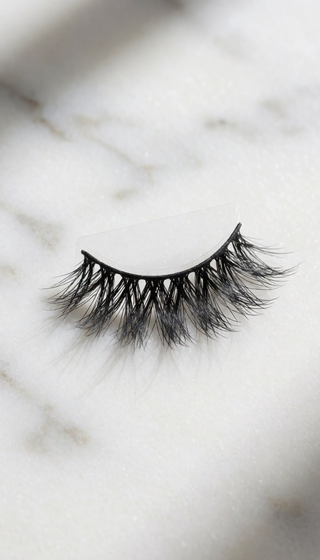
Density and taper decide how a strip reads on camera far more than length does. A tightly packed band photographs as a solid dark bar across the eye; visible separation between the hairs keeps the lash line reading like a line.
Get those two things right and the label on the box barely matters. Everything below is the reasoning behind that answer — what the camera does to a lash, how the morning should be sequenced, what heat and tears actually do to an adhesive band, and the checklist worth holding any pair against before the date.
WHAT THE CAMERA SEES THAT THE BATHROOM MIRROR DOESN'T
A dense strip with lashes packed tight reads as a solid dark bar in a portrait, because there are no gaps for light to pass through. A strip with visible separation between the hairs lets light break up the mass, so the lash line looks like a line rather than a shadow.
Flash flattens texture. A lash that looks soft and wispy at the mirror can photograph as one dark shape under direct flash, which is why a trial morning should include both a flash photo and a daylight photo of the same pair. The difference between those two images tells you more than any product description can.
The band is thin but it is not invisible. In a close photograph it shows as a dark edge where the strip meets the lid, and that is the honest limit of any press-on. Set the strip on the lash line rather than above it, so that edge sits exactly where eyeliner would sit anyway.
TAPER AND DENSITY DECIDE HOW A STRIP READS
A style that runs shortest at the inner corner and longest over the outer third follows the shape of the eye instead of masking it. In a group shot, that taper is what keeps the outer corner from disappearing into the shoulder of the person standing beside you.
Length beyond the natural lash arc is where photos go wrong. Hairs that sweep past the brow bone catch light from below and photograph shorter than they are, and a very heavy curl can drop a shadow over the socket under overhead lighting. A natural curl reflects light outward instead of scooping it.
Judge density at conversation distance, not in a magnifying mirror. If you can still see lid between the individual hairs when someone stands two feet away, the strip will photograph as lashes. If the band is a solid block at that distance, it will photograph as a block.
THE ORDER OF THE MORNING, AND WHERE THE LASHES GO IN IT
Wash, moisturise, do the makeup, then lashes last. Cream, oil, serum or a wet base under the band stops it holding — eye cream included, and setting spray counts if you spray before the strip is down. Give moisturiser ten minutes to sink in and blot anything still sitting on the lid.
Measure the strip against the lash line and trim no more than 1 cm at a time, taking the outer end in first and the inner end only if the band reaches past the tear duct. A strip that runs long past the outer corner will lift there first, usually somewhere between the vows and the receiving line.
Placement itself takes a few seconds per eye once you know where the strip sits. The first two or three attempts take closer to a minute and usually land a little high or a little long, so do a trial run on a morning nobody is photographing.
WHAT HEAT, HUMIDITY AND TEARS DO TO AN ADHESIVE BAND
Tears and warmth soften an adhesive band at the corners first, which is why a strip that felt secure at the mirror can lift at the outer edge by the reception. Blot with a tissue rather than rubbing — friction loosens a bond faster than moisture alone.
An outdoor ceremony in July and a humid marquee are both harder on a band than a dry, air-conditioned room. If the day is hot, keep the strip in its case until the last possible moment rather than putting it on before hair and dress.
Keep the clear case in your bag. If a corner lifts, take the strip off, let the skin dry completely, and set it back on the line. Pressing a lifted corner down onto a damp lid will hold for minutes, not hours.
At the end of the night, peel from the outer corner, clean the band with an oil-free remover and let it dry fully before it goes back in the case. A day pair comes off before bed — it is not built to survive a night's sleep.
TRIM, TEST, AND PHOTO-CHECK BEFORE THE DATE
Wear your chosen pair for a few hours at least a week before the wedding: through steam, a meal, and an hour of talking. That single test exposes almost every problem a mirror cannot.
- Fit. Check whether the strip runs past the outer corner or pokes the inner tear duct.
- Band visibility. Look at a close-up photo, not the mirror, and see where the dark edge lands.
- Shadow. Stand under a ceiling light and check whether the curl casts a hard shadow on the lid.
- Movement. Blink hard, look down, and press a tissue to the outer corner to simulate blotting a tear.
If the strip fails one of those four checks, adjust the trim or change the style — not the technique. A pair that passes all four on a Tuesday morning will behave the same way on the day.
STRIP, MAGNETIC AND EXTENSIONS: HOW EACH BEHAVES ON THE DAY
Every category of lash fails in a different way, and knowing the failure mode is more useful than knowing the marketing name. Read the table as a list of what each option asks of you on the morning itself.
| Type | What it is | Hold on a wedding day | What to watch |
|---|---|---|---|
| Micro-adhesion press-on strip | A strip with an adhesive band that bonds to clean, dry skin along the lash line — no glue, liner or magnets. | Holds while the skin stays dry and undisturbed; can be lifted and reset; nothing to cure before the ceremony. | Lifts at the corners with oil, tears or heavy humidity, so it must go on last. |
| Glue-on strip | A strip applied with lash glue that needs 30–60 seconds to go tacky. | Proven all-day hold once the glue has cured. | Fumes and adhesive sensitivity; one-shot placement; a crooked corner is hard to fix once the glue grabs. |
| Magnetic strip or magnetic liner | Two magnetised strips that sandwich the natural lashes, or a liner containing iron particles that the strip grips. | Repositionable and glue-free. | A heavier band, liner that has to be removed at the end of the night, and shifting when the eye is rubbed. |
| Salon extensions | Individual fibres bonded to the natural lashes by a technician. | Set and forget for weeks. | Booked weeks ahead, cannot be removed for the reception, and charged per set. |
WHAT TO LOOK FOR IN A WEDDING LASH
Hold any pair against this list before you commit to it, whatever the brand:
- What activates the band. Glue, magnets, liner or micro-adhesion — each has a different failure mode, and you should know yours before the morning.
- Taper over density. Short inner, long outer third. It photographs better in every light.
- Removable the same day. You need to be able to take the pair off for the reception or at midnight without losing lashes or damaging your own.
- A stated wear life. Vague claims are a warning. If a brand will not say how many wears a pair delivers, assume one.
- Trim margin. A band that can lose half a centimetre and still fit your eye is forgiving of a rushed morning.
- Comfort at hour ten. If you are aware of the band at minute five, you will be distracted by it by the first dance.
Those six points narrow the field fast, because most pairs fail at least two of them. The one that usually decides it is the first: what activates the band sets everything else — how early you can put the strip on, whether a corner can be reset mid-reception, and whether anything wet or fume-heavy is sitting near your eye on the one morning you cannot afford a reaction.
WEDDING LASHES THAT STAY PUT FROM THE VOWS TO THE LAST DANCE — PHANSTA LASHES
PHANSTA LASHES was built around the first criterion on that list — what activates the band. Every pair uses glue-free micro-adhesion: the band bonds to a clean, dry lash line on its own, with no glue, no magnets and no liner to cure, paint or peel off at one in the morning. That single decision is what makes the rest of the checklist easy to meet.
There are 17 styles, each shaped short at the inner corner and long over the outer third, so taper is the variable you choose between rather than something you hunt for. Every style is hypoallergenic and waterproof, and a pair is 30+ wears with care — under $2 per wear across its life.

The three things brides ask before ordering
- Will the band irritate my eyes? There is no glue, no liner and no curing time, so there are no fumes and nothing wet against the lid. The band is hypoallergenic, but patch-test on the back of your hand a week ahead if your eyes react easily.
- Will a pair really last? 30+ wears with the care routine above — off at night, cleaned with oil-free remover, dried fully before it goes back in the case. It is a day pair, not an extension, and it is not meant to be slept in.
- Is a $59 pair justified for one day? Across 30+ wears that is under $2 per wear, and the same pair covers the engagement shoot, the hen do and the honeymoon.
FREQUENTLY ASKED QUESTIONS
Why do my lashes lift at the outer corner by the reception?
Heat, tears and oil break an adhesive bond at the corners first, because that is where the skin moves most. Blot rather than rub, let the skin dry completely, then reset the strip on the line. Applying lashes after every cream and setting spray is the single biggest prevention step.
What order should lashes go in a wedding morning routine?
Skincare, then makeup, then lashes last. Moisturiser needs about ten minutes to absorb and anything still sitting on the lid should be blotted. Setting spray counts as a wet layer, so spray before the strip goes down, not after, or the band loses its grip at the edges.
Will a press-on strip survive tears during the vows?
Usually yes, if the lash line was bone dry at application and you blot instead of wipe. A tissue pressed gently to the outer corner absorbs moisture without friction. Keep the case in your bag so a lifted corner can be reset once the skin is dry again.
How many wears should I expect from a wedding lash pair?
It depends entirely on the band. PHANSTA LASHES are rated for 30+ wears when you remove them before bed, clean the band with an oil-free remover, and let them dry fully in the case. Any pair treated as disposable will behave like a single-use pair.
How do I choose a lash style for photographs?
Choose taper over density. A style that runs short at the inner corner and longest over the outer third follows the eye instead of masking it, and visible separation between hairs keeps the lash line reading as a line rather than a solid dark block under flash.
STILL COMPARING OPTIONS? Explore our guides on finding your perfect lash, magnetic vs strip, and sensitive eyes.
FIND THE PERFECT LASH — Not sure which style suits you? Take the 30-second lash finder quiz →
NOT SURE ABOUT YOUR EYE SHAPE?
Find your eye shape and get personalized lash recommendations:
FIND THE PERFECT LASH FOR EVERY MOMENT
Explore our occasion-specific lash guides:
EXPERIENCE THE DIFFERENCE
Join thousands of women who have made the switch. No glue, no damage, no salon appointments — just beautiful lashes in seconds.
SHOP PHANSTA LASHES — GLUE-FREE, 30+ WEARS →