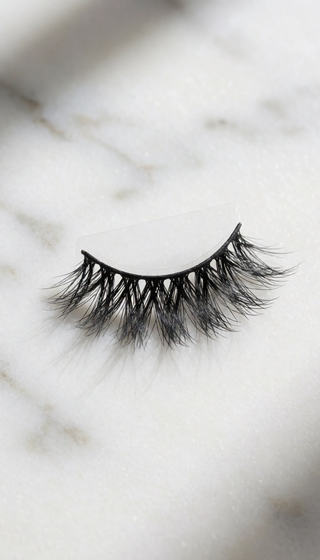
VEGAN BEAUTY LOVERS: CRUELTY-FREE LASH OPTIONS

You already swapped your cleanser, moisturizer, and mascara for plant-based versions. But those fluffy falsies on your vanity? They might be a quiet exception. Many “silk” false lashes contain animal-derived silk protein, and some lash glues use beeswax to help the band stick. That’s a tough thing to realize at 11pm when your whole routine was supposed to be clean.
I’ve been there. I once spent an hour reading a mink lash box at 1am like it was a legal contract. So let’s make it simpler.

THE DIRTY SECRET BEHIND “SILK” LASHES
True silk lashes are made from silkworm cocoons. That means the natural fiber can come from animals. It doesn’t make it automatically cruel, but it is not vegan. The same goes for mink lashes, which are more expensive — around $80–$150 a pair — and often marketed as “luxury” even though the animal’s role in it makes vegan beauty lovers uncomfortable.
Your lash band and glue deserve a label check too. Beeswax, lanolin, and shellac are common ingredients in some false lash adhesives and fibers. If the packaging doesn’t say “vegan,” don’t assume it is.

5 LINES TO READ BEFORE YOU BUY VEGAN LASHES
- “100% synthetic fiber” — look for polyester, nylon, or a plant-based fiber like bamboo (yes, that exists).
- “Vegan formula” — this should be on the adhesive, not just the lashes.
- “No beeswax, lanolin, or shellac” — those are animal or insect by-products.
- “Cruelty-free certified” — means no animal testing at any stage.
- “Flexible band without animal-derived glue” — you don’t want one animal hidden in the rose-colored unboxing.

WHAT HAPPENS WHEN YOU CHOOSE ETHICAL LASHES
When I switched to cruelty-free falsies, I expected to lose some drama. Instead, I gained peace of mind. My eyes didn’t burn from random animal proteins I couldn’t pronounce. I didn’t have to wonder if something was lost in translation. And the best part? They looked exactly like the “luxury” mink pair I used to cry about at $120. No difference in volume, no difference in everyday wear. The only difference was that I finally felt good about the ritual of applying them.

THE VEGAN LASH BUYING CRITERIA I LEARNED THE HARD WAY
After years of reading labels, I now have a process. Before I buy, I flip the box, scan for “vegan,” and check the fiber type. If it says “silk” or “mink” and doesn’t clarify the source, I put it down. If the glue isn’t listed as vegan, I assume the fiber isn’t either. I also look at the band texture — soft and flexible beats stiff every time.

VEGAN AND CRUELTY-FREE LASHES: YOUR QUESTIONS
Are silk lashes vegan? Most silk lashes use sericin from silkworm cocoons, so they are not vegan unless the label explicitly says “vegan silk” or “plant-based silk alternative.”
What are fake eyelashes made of? Most vegan lashes use polyester, nylon, or a plant-derived fiber like bamboo. Animal-derived types include mink fur and silk from silkworms.
Is lash glue vegan? Not always. Some adhesives contain beeswax or lanolin. Look for a glue labeled “vegan” to be sure.
How do I know if lashes are cruelty-free? Check for a cruelty-free certification like Leaping Bunny or PETA. That means the final product wasn’t tested on animals.
PHANSTA LASHES builds vegan, cruelty-free pairs that don’t make you choose between ethics and full lashes.
📚 Browse our complete library of lash guides →
📚 Browse our complete library of lash guides →
📚 Browse our complete library of lash guides →
Experience the Difference of PHANSTA LASHES
Quick to apply, gentle on eyes, beautiful all day. Reusable 30+ wears per pair.
SHOP PHANSTA LASHES — GLUE-FREE, 30+ WEARS →