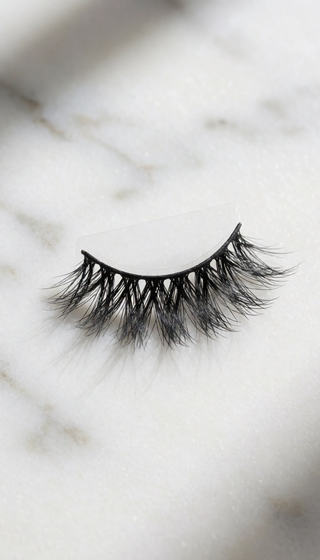
STOP THE STRUGGLE: WHY YOUR LASHES AREN'T STAYING
You spend time applying your lashes — perfect placement, beautiful curl — but by midday the corners are lifting, the tips are drooping, or the adhesive feels tacky and uncomfortable. It feels like you're fighting your own lashes. If you've tried different glues, different styles, and different techniques with the same result, the problem usually isn't the lashes themselves. It's the bond, the preparation, and the match between the lash and your eye.
Most wearers try to force a look that doesn't suit their natural eye structure or daily habits. Oily eyelids, humid weather, rubbing your eyes, and even the skincare products you use can break down adhesive faster than you'd expect. To find a fix that actually holds, we need to look at the physics of adhesion and the anatomy of your eye — not just the lash strip.
The three failures you named — lifting corners, drooping tips, and glue trouble — are three separate problems with three separate causes. The trick is knowing which one you're actually dealing with, because each one demands a different fix. Treating them as a single "bad lashes" problem is why most people never solve any of them.
THE SCIENCE BEHIND LIFT AND DROP
When corners lift, it's usually uneven adhesion or an unnatural angle pulling the lash away from your natural lash bed. The outer corner of your eye moves every time you blink, smile, or talk, so that end of the band endures the most stress. If the bond there is even slightly weaker, it's the first place to fail.
Drooping tips come down to two things: the lash being too heavy for your natural lashes to support, or the adhesive not having enough initial hold at the base. It's all about the tension point. A lash that's thick and uniform from root to tip asks your natural lash to carry weight it wasn't built for, and gravity wins by afternoon.
Think of it like tape on a curved surface. Press tape flat onto a curve and it naturally lifts at the edges. Your eye is curved, and your application has to account for that curve — a rigid, flat band will always fight it, while a flexible one conforms and holds.
Band stiffness matters more than most people realize. A band that's too rigid can't follow the shape of your lid, so it bridges the curve like a plank over a hill — and the ends lift. A soft, flexible band sits flush against the lash line from corner to corner, which is exactly what you need for a secure, all-day bond.
Your natural lashes are weaker than you think. They're designed to shed and regrow on a cycle, and a heavy strip lash accelerates that stress. The lighter the false lash, the happier your natural lashes — and the longer the whole look survives.
TROUBLESHOOTING YOUR APPLICATION ISSUES
Let's tackle the most common pain points directly. Read this as a checklist you can act on today, whether you're wearing your current pair or your next one.
- ISSUE: Corners lifting early. ACTION: Ensure the base of the lash sits exactly where your natural lash begins. Use a tiny dab of adhesive on the band where it meets the root, not just the middle. OUTCOME: A secure anchor point prevents early detachment.
- ISSUE: Drooping tips. ACTION: Choose lashes with a pre-designed taper. Avoid overly chunky styles if you have very short natural lashes. The lash needs to be supported evenly from root to tip. OUTCOME: Maintains a lifted, elongated appearance throughout the day.
- ISSUE: Glue sensitivity or messy residue. ACTION: Switch to a high-quality, professional-grade adhesive. If you are prone to irritation, look for formulas designed for sensitive skin. OUTCOME: Comfort and clean removal, eliminating the need for harsh scrubbing.
- ISSUE: The band won't sit flush. ACTION: Your band may be too stiff for your eye shape. Warm it gently between your fingers for a few seconds to soften it, then press it along your lash line and hold. OUTCOME: A band that conforms to your curve instead of bridging it.
PREP AND PLACEMENT: THE STEPS THAT MAKE OR BREAK YOUR WEAR
Even the best lash fails on a poorly prepped eyelid. Start with clean, dry lashes — oil is the enemy of any bond. If you wear mascara, apply it to your natural lashes first and let it dry completely before applying falsies over the top; never apply mascara to the false lash itself, because it weighs the fibers down and breaks the curl.
When you apply adhesive, wait 20–30 seconds until it turns tacky. Wet glue slides; tacky glue grips. Place the band as close to your natural lash line as possible — not on the eyelid skin — then press along the entire band with your fingers or a lash applicator for a full ten seconds, holding the corners last. That final press is what keeps the edges anchored through hours of blinking.
Give the bond a minute to fully set before applying eyeliner, mascara over the band, or any eye makeup that could seep underneath and dissolve the adhesive. And when you remove your lashes, peel gently from the outer corner — never pull — and store them flat in their case so the band keeps its shape for next time.
Environment matters more than most wearers realize. Humidity, steam, and oily skincare all attack the bond from opposite directions. If you live somewhere humid or wear rich eye creams, give the adhesive extra time to set and avoid touching your eyes throughout the day.
WHAT TO LOOK FOR IN A SOLUTION
When you're ready to change your routine, the right solution should address every point above at once. You need reliability — something that handles the curve of your eye, adheres strongly without causing irritation, and gives you a look that lasts. It should feel like a seamless addition, not a daily struggle. Here's what that looks like in practice:
- A bond that works without traditional glue. glue-free designs eliminate the number-one source of irritation, residue, and application mess — and they remove the drying-time guesswork entirely.
- A lightweight, tapered shape. Lashes that are thinner at the base and tips put less strain on your natural lashes, so they hold their curl instead of drooping.
- A flexible band that follows your eye's curve. A band that conforms — rather than fights — the shape of your lid stops corner lift before it starts.
- Hypoallergenic, skin-safe materials. If you've ever reacted to lash glue, the solution should be gentle enough for sensitive eyes by design, not by luck.
- Reusability. A lash you can wear many times costs less per wear and performs more consistently than a fresh disposable pair every morning.
Get those five things right, and lashes stop being a daily negotiation — they just work.
- Glue and irritation: No glue means no latex, no fumes, no sticky residue, and no adhesive allergy. The hypoallergenic micro-band is made for sensitive eyes.
- Durability: Each pair is waterproof and built for 30+ wears — roughly a month of daily use from a single pair.
- Cost: At $59 per pair lasting 30+ wears, you pay under $2 per wear — less than a disposable pair you'd toss after one night.
With 17 styles ranging from natural to dramatic, there's a shape for every eye and every occasion. Wearers who switch from daily glue consistently describe PHANSTA as the first lash that survives a full workday, a workout, and a night out — then looks brand new the next morning.
EXPERIENCE THE DIFFERENCE OF PHANSTA LASHES
PHANSTA LASHES were engineered to solve every problem on this list — without a single drop of glue. Instead of adhesive, they use glue-free micro-adhesion technology: a skin-safe micro-band that grips your natural lash line directly. No glue, no magnets, no eyeliner. The result is a lash that applies in seconds, feels weightless, and stays put through a full day — then removes cleanly and is ready to wear again and again.
Here's how PHANSTA answers the three objections wearers raise most often:
FREQUENTLY ASKED QUESTIONS
Why do the corners of my false eyelashes keep lifting?
Corner lift is almost always an adhesion problem, not a lash problem. The outer corner moves with every blink and expression, so it needs the strongest bond. Place the band exactly where your natural lashes begin, press the edges down last, and hold for ten seconds. A flexible band that follows your eye's curve resists lifting better than a stiff, flat one.
What makes lash tips droop during the day?
Drooping tips usually mean the lash is too heavy for your natural lashes to support, or the base never secured a firm hold. Choose styles with a pre-designed taper — thinner at the root and tip — and avoid chunky, uniform bands if your natural lashes are short or fine. Lightweight lashes hold their curl dramatically longer.
Can I wear false eyelashes if I'm allergic to lash glue?
Yes, if you skip the glue entirely. Glue-free lashes use micro-adhesion instead of adhesive, so there's no latex, no fumes, and no sticky residue to react to. PHANSTA LASHES are hypoallergenic and designed for sensitive eyes. If you have a history of severe allergies, patch-test on your inner arm first and check with your eye doctor.
How many times can you reuse a pair of false eyelashes?
It depends on construction. Disposable strip lashes are typically single-use, while well-made reusable lashes can be worn many times with proper care. PHANSTA LASHES are built for 30+ wears — about a month of daily use. Remove them gently, clean the micro-band after each wear, and store them in their case to maximize longevity.
How do glue-free lashes stay on without any adhesive?
Glue-free lashes use micro-adhesion: a soft, skin-safe micro-band that grips your natural lash line through thousands of tiny contact points, similar to how a sticker grips glass. There's no liquid adhesive, no drying time, and no magnets involved. Simply press the band along your lash line and hold for a few seconds.