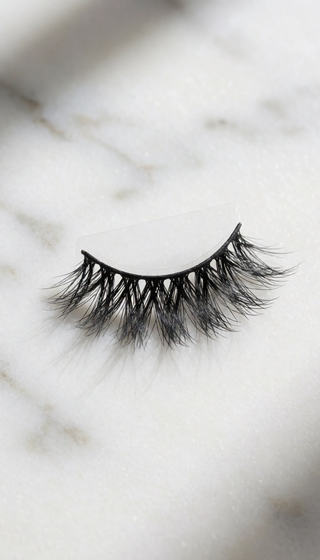
WAKE UP TO LASHES THAT LOOK LIKE YOUR OWN — EVERY SINGLE DAY
If you have ever applied a pair of false lashes, stared in the mirror, and thought "these look nothing like my own," you are not alone. The gap between "obviously fake" and "naturally gorgeous" comes down to a handful of design choices — band thickness, fiber length distribution, curl pattern, and weight. Get those right and lashes disappear into your lash line. Get them wrong and you spend the whole day aware of something sitting on your eyelids.
The good news: a believable, everyday lash look does not require a professional appointment or a drawer full of trial-and-error pairs. It starts with understanding what actually makes a lash look natural, then matching those principles to your eye shape, lifestyle, and comfort needs.
This guide walks through the design details that separate believable from obviously false, how to match a style to your eye shape, the application habits that make lashes disappear into your lash line, and the adhesion options worth considering for daily wear.
WHAT "NATURAL" ACTUALLY MEANS IN A FALSE LASH
Natural-looking does not mean invisible. It means the lash mimics the architecture of real lashes: graduated length (shorter at the inner corner, longest at the center or outer third), varied fiber thickness, a flexible band that follows the curve of your lid, and a curl that lifts without spiraling. When all four elements align, the eye reads as "well-rested" or "great genes" — not "wearing falsies."
Researchers in cosmetic dermatology consistently note that the human eye detects artificiality through uniformity. Real lashes are never identical in length, spacing, or direction. The most convincing false lashes replicate that irregularity with crisscrossed fibers, tapered tips, and a band thin enough to sit flush against the skin without a visible edge. This is why two pairs can use the same fibers and still look completely different — the architecture matters as much as the material.
THE FOUR DESIGN ELEMENTS THAT MAKE OR BREAK A NATURAL LOOK
- Band thickness. A band under 0.5mm disappears against the lash line. Thicker bands create a visible "line" that reads as makeup, not lashes. For daily wear, the thinner the band — provided it still holds its shape after repeated use.
- Length distribution. Real lashes peak at the center of the lid. Styles that are uniformly long, or longest at the inner corner, immediately signal "fake." Look for a graduated map: 6-8mm inner, 10-12mm center, tapering slightly at the outer edge.
- Fiber density and layering. A single row of identical fibers looks flat. Crisscrossed or layered fibers create depth and shadow, which is what real lashes do naturally. The goal is dimension, not volume.
- Curl pattern. A gentle J-curl or soft D-curl lifts the lid without the dramatic spiral of evening styles. The curl should complement your natural lash direction, not fight it.
MATCHING THE RIGHT LASH STYLE TO YOUR EYE SHAPE
Not every natural style works on every eye. The right match enhances what you already have; the wrong one fights your anatomy and draws attention to the lash itself.
Not sure of your eye shape? Look straight into a mirror in natural light. If the iris touches both the upper and lower lid, your eyes are more almond; if you can see white above or below the iris, they are round. If the crease disappears when your eyes are open, you are likely hooded.
- Almond eyes: Almost any graduated style works. Focus on curl preference — a soft D-curl adds lift without over-opening the eye.
- Round eyes: Longer fibers at the outer third elongate the eye. Avoid uniform length, which emphasizes roundness.
- Hooded eyes: A stronger curl and slightly shorter overall length prevent the lash from disappearing under the lid crease. A thin, flexible band is essential for comfort.
- Monolid eyes: A dramatic curl with medium length creates the illusion of a crease. Avoid overly long styles that weigh down the lid.
- Deep-set eyes: Volume at the center of the lash line brings the eye forward. Keep the inner corner short to avoid a "closed-off" look.
APPLYING FALSE LASHES FOR A SEAMLESS, NATURAL FINISH
Even a well-designed lash can look fake if the application is off. The most common errors are placing the band too high above the natural lash line, which creates a visible gap, and skipping the final pinch — pressing the false lashes and your natural ones together so they merge into a single line. Overdoing the inner corner is another frequent mistake: real lashes are shortest there, so a style that starts long at the nose instantly reads as artificial.
Before the first wear, hold the band against your lash line and trim the outer edge if it extends past the corner of your eye — a band that is too long lifts at the outer corner within minutes, no matter how good the adhesion is.
Never apply mascara after a reusable lash is on — it clumps the fibers and ruins the tapered tips that create the natural effect. If you want extra depth, apply mascara first, before the lash goes on. A lash applicator or tweezers positions the band precisely, and pressing from the center outward ensures the entire band adheres evenly.
A thin line of dark eyeliner along the lash line camouflages the band and hides any tiny gap between the band and your skin — a trick makeup artists use even with high-end lashes.
With micro-adhesion bands, the process is even simpler: press the band directly onto your lash line, hold for a few seconds, and you are done. No drying time, no precision work, no cleanup — the result is a seamless blend that looks like your own lashes, every time.
WHY GLUE IS THE #1 REASON DAILY LASH WEARERS QUIT
Ask anyone who stopped wearing false lashes daily and the answer is almost never "they looked bad." It is "my eyes got irritated" or "I was tired of the mess." Traditional lash glue contains latex and formaldehyde-releasing preservatives that trigger contact dermatitis in a significant portion of wearers. Even those without a full allergy report stinging, redness, and a gritty feeling by mid-afternoon.
Beyond irritation, glue introduces a time tax: drying time, precision application, cleanup, and the anxiety of a lifting corner during a work meeting. For daily wear, the whole routine needs to take under a minute and feel as ordinary as brushing your teeth. That is why the industry has shifted toward alternative adhesion methods — and why understanding your options matters more than any single product pick.
GLUE VS MAGNETS VS MICRO-ADHESION: AN HONEST COMPARISON
Traditional glue is the oldest method and the most common irritation source. Magnetic lashes avoid adhesive entirely but rely on a sandwiching system — two strips that clamp your natural lashes between them — which adds weight, can pinch, and still depends on small magnet strips to grip.
Micro-adhesion takes a different path: a thin adhesive strip built into the band bonds directly to the skin of the lash line. There is no liquid to dry, no magnets to align, and no liner to apply. For daily wear, the lightest, fastest system wins — and that is exactly what micro-adhesion delivers.
Each method involves trade-offs: glue irritates, magnets add weight and can pinch, and micro-adhesion is the lightest and fastest system for daily use. Understanding these differences helps you choose based on your priorities — comfort, speed, or budget.
CARING FOR REUSABLE LASHES SO THEY LAST
Reusable lashes only stay beautiful if you treat them right. After each wear, peel the band off gently from the outer corner, remove residue with a cotton pad soaked in oil-free makeup remover, and store the pair back on its original tray so the band keeps its curve. Never soak the band in water or apply mascara directly to the fibers. A quick clean after every wear, plus a cool, dry storage spot, keeps the curl and the adhesive performing at their best for the full lifespan of the pair.
Replace the pair when the band loses its curl or the adhesive strip stops gripping — with daily use, that is typically after 30+ wears.
WHAT TO LOOK FOR IN A DAILY-WEAR LASH SOLUTION
Before committing to any lash system, run it through this checklist. A solution that checks every box saves money, time, and frustration over the long term.
- Adhesion method: Glue-free micro-adhesion eliminates the most common irritation trigger. If you have sensitive eyes or wear contact lenses, this is non-negotiable.
- Reusability: A lash you can wear 30+ times costs less per application than a disposable pair. Do the math on any pair before you commit.
- Application time: Under 30 seconds per eye is the threshold for "daily wear." Anything longer becomes a weekend-only ritual.
- Weight: The lash should be imperceptible. If you can still feel it on your lid after five minutes, it is too heavy for all-day comfort.
- Waterproof performance: Humidity, sweat, and the occasional tear should not compromise adhesion. Look for a seal that holds through a full day.
- Style range: Natural is not one-size-fits-all. Enough variety means you can match the lash to the occasion without compromising the natural aesthetic.
Once you know the criteria, the question becomes which option actually meets them — without compromise.
- Glue and irritation — eliminated. The glue-free micro-adhesive band bonds directly to the skin of your lash line. There is no liquid adhesive, no latex, no formaldehyde-releasing preservatives, and no magnets — the most common irritation triggers are simply absent. The result is a hypoallergenic, waterproof lash that holds through humidity, sweat, and long days.
- Durability — built in. Each pair lasts 30+ wears when cleaned and stored properly, so one pair replaces dozens of disposable strip lashes.
- Cost per wear — under $2. At $59 divided across 30+ wears, every application costs less than your morning coffee — and you look put-together each time.
PHANSTA LASHES: THE NATURAL, GLUE-FREE ANSWER TO EVERYDAY WEAR
PHANSTA LASHES were engineered for exactly this checklist: a natural, believable lash look without glue, without irritation, and without spending twenty minutes in front of a mirror every morning. They answer the three biggest objections — in the order most wearers raise them.
Across 17 styles — from barely-there to softly defined — every pair follows the graduated-length, tapered-fiber principles above, so there is a match for every eye shape and every comfort level. Application takes seconds per eye: the band presses onto your lash line with no drying time and no cleanup. Whether you are heading to a boardroom, a brunch, or just want to feel like yourself on a Tuesday, the result is the "your lashes but better" look — without the daily compromise.
Customers consistently report that the biggest surprise is forgetting they are wearing lashes at all. The lightweight band disappears against the lash line, the micro-adhesion holds through workouts and long workdays, and the hypoallergenic design means no redness or stinging — even for contact-lens wearers. The 30+ wear lifespan turns a single pair into a months-long daily ritual, and at under $2 per application, it replaces the revolving drawer of disposable strips that never quite looked right.

FREQUENTLY ASKED QUESTIONS
How do I make false lashes look natural?
Focus on graduated length — shorter at the inner corner, longest at the center — a thin flexible band under 0.5mm, and a soft curl that matches your natural lash direction. Crisscrossed fibers with tapered tips mimic the irregularity of real lashes. Finish by pinching the false and natural lashes together so they merge into a single, believable line.
Can I wear false lashes every day?
Yes, if the system is lightweight, glue-free, and quick to apply. Daily wear demands a band you cannot feel after five minutes, adhesion that holds through humidity and sweat, and a routine under 30 seconds per eye. Glue-free micro-adhesion bands meet all three criteria, making everyday wear realistic rather than a special-occasion ritual.
Are PHANSTA LASHES safe for sensitive eyes?
PHANSTA LASHES use a glue-free micro-adhesive band with no latex, no formaldehyde-releasing preservatives, and no magnets — the most common irritation triggers are absent. The hypoallergenic, waterproof design is suitable for sensitive eyes and contact-lens wearers, with no stinging or redness even after a full day of wear.
How long does one pair of PHANSTA LASHES last?
Each pair lasts 30+ wears when cleaned and stored properly. Peel the band off gently from the outer corner after each wear, remove residue with oil-free makeup remover, and store the pair on its original tray to preserve the band's curve. At $59 per pair, that works out to under $2 per wear.
How do I apply PHANSTA LASHES?
Press the micro-adhesive band directly onto your lash line, hold for a few seconds, and you are done — no drying time, no precision work, no cleanup. Application takes seconds per eye. For a seamless finish, pinch the false lashes and your natural ones together so they blend into a single line.
STILL COMPARING OPTIONS? Explore our guides on finding your perfect lash, magnetic vs strip, and sensitive eyes.
FIND THE PERFECT LASH — Not sure which style suits you? Take the 30-second lash finder quiz →
SHOP PHANSTA LASHES — GLUE-FREE, 30+ WEARS →
Applies in seconds per eye — no glue, no drying time, no cleanup.
NOT SURE ABOUT YOUR EYE SHAPE?
Find your eye shape and get personalized lash recommendations:
FIND THE PERFECT LASH FOR EVERY MOMENT
Explore our occasion-specific lash guides:
EXPERIENCE THE DIFFERENCE
Join thousands of women who have made the switch. No glue, no damage, no salon appointments — just beautiful lashes in seconds.
SHOP PHANSTA LASHES →