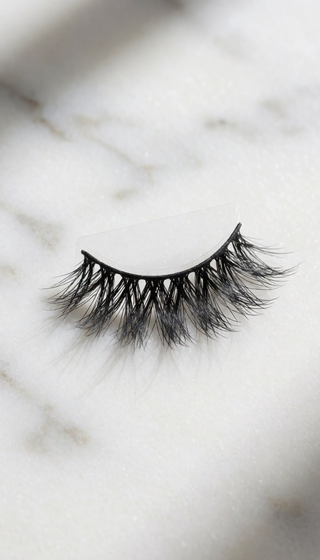
Wispy Lashes on Almond Eyes: Choose the Flare Before You Trim
The outer point is already there. A wispy strip can follow it or exaggerate it, and the choice is made in the style photo, not at the mirror.
Pick the wispy style whose longest points sit over your outer third and whose outer third is visibly separated. That keeps the almond point. The flare is bought in the style, not added afterward: the strip is one finished piece, and trimming can only take length away.
Stay at the lower end of the 13-18 mm range if you want the shape unchanged. Go to the upper end if you want the point exaggerated, and accept that the outer corner will read longer than your own lashes.

Read the outer third of the style photo first
The 15 styles differ in two things that matter on an almond eye: where the longest points sit, and how much of the strip is long. Open the photo and look at the outer third before you look at the inner. If the longest points bunch at the very end, the strip will push past your own point. If they sit just inside it, the strip follows the taper.
Separation is the second read. Wispy means gaps, clusters with air between them, so your own lash line shows through. A style with visible separation over the outer third keeps the point sharp. The densest style closes that gap and the taper reads as a solid edge instead.
The band reads as a soft liner on this shape
The band is thin but not invisible. On an almond eye it sits along the lash line and reads as a soft eyeliner line. A style with visible separation shows it less than the densest style, because the gaps break the line up. If you already wear liner, the band will look like part of it. If you don't, the sparser styles are the ones that keep it quiet.
Set the strip on the lash line, not above it. About 5 seconds per eye, and the band bonds without glue, magnets or liner. Take it out of the clear case by pulling down along one side without touching the adhesive band.
How much outer curve the trim can take
A full strip is longer than a narrow eye, so the trim is not optional. The question is which end you cut. Trim the inner end first if the band crowds the nose, because the inner end carries no flare on this shape. Take no more than 1 cm at a time.
The outer end is where the work is. The curve at the outer tip is what lands the flare at your own point, so measure before you cut there: lay the strip on the lash line with the outer tip where you want the flare to stop, and see how much hangs past your corner. Take that excess off in 1 cm steps, keeping the curve. Lose the curve and the last lash lands short of the point, and the eye reads rounder than it is.
Frequently asked questions
Should I trim the inner or outer end first?
Inner. The inner end carries no flare on an almond eye, so it is the safe end to shorten. Measure the outer tip against your corner before you cut there.
Does the band show on an almond eye?
It can, as a soft liner line along the lash line. A style with visible separation breaks that line up more than the densest style does.
Can I add flare after I put the strip on?
No. The strip is one finished piece, so the flare is whatever the style's outer third gives you. Trimming only takes length away.
One pair is $59, in 15 styles, and the case comes with it.
See the pair