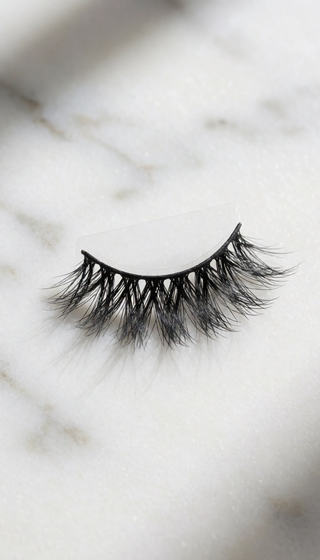
BEST LASHES FOR HIGH-FASHION MAGAZINE SHOOTS

The first time I watched a lash emergency happen on a real magazine shoot, it was quiet terror. A model sat under hot studio lights, and one lash band started curling at the inner corner. The photographer noticed. The makeup artist noticed. The retoucher, watching from a laptop, said what no one wanted to hear: 'That is going to be a pain to fix.'
THE 5:30 A.M. CALL TIME — A TRUE SHOOT STORY
Photo shoots are not like the movies. Call time is early, the schedule is tight, and 'usable' beats 'perfect' every single time. On that morning, the makeup artist had brought a kit full of heavy-volume strip lashes. They looked gorgeous in the mirror — dense, dramatic, obvious. But under the light, they had a problem: they were so heavy that the inner corner kept lifting. No one had time to re-glue mid-set, and the production assistant was holding a clipboard and counting minutes.
That is when I learned the real rule of editorial lashes: if a lash needs maintenance, it changes the entire shoot. A lash that works is a lash you forget about.
WHAT SEPARATES AN EDITORIAL LASH FROM A REAL-LIFE ONE
High-fashion lashes have a different job from your everyday 'date night' lash. An editorial lash is seen in close-up, under light that can reveal or ruin every detail. Here is what editors and photographers actually care about — in order:
- A disappearing band. 'I don't want to see the plastic,' one cover photographer told me. 'If I can see the band, the lash is wrong.' In magazine close-ups, the band has to vanish at every angle.
- Texture without weight. Studios want lashes with defined texture but a weightless feel. That balance is rare — most lashes are either invisible or too heavy.
- Zero maintenance. After hour six, most lashes look tired. Editorial requires a lash that looks the same at 3 p.m. as it did at 9 a.m.
WHY THE 'PERFECT' LASH SABOTAGES YOUR PICTURES
Here is the part nobody talks about. The dramatic lashes that look incredible in the package usually fail in photos. They cast deep shadows, weigh the eye down, and force the model to blink harder. Editors will pick a quieter lash every time if it means the eye stays open and readable.
You can get that editorial strong-but-soft eye without the glue emergencies, without the reapplication, and without the fear of a band slipping at the worst second. You just need a system that attaches evenly and holds all day. That is not a lot to ask — but most lashes still miss it.
THE SHOOT-DAY LASH CHECKLIST THAT ACTUALLY MATTERS
If you are prepping for a wedding, a content shoot, a portfolio update, or any moment that will be photographed for hours, use the same checklist I use on set:
- A band that stays put from the first look to the last outfit change.
- A curl that survives a 12-hour day (at least) without losing its lift.
- A material that removes cleanly — no pulling, no puffy lash lines.
- A lash map that photographs well from the front and the three-quarter angle.
HIGH-FASHION LASHES — YOUR QUESTIONS, ANSWERED
What lash style do makeup artists use for magazine covers?
Most cover looks use a hybrid lash map: slightly fanned in the center, with extra length at the outer corner. Lengths range from 8 to 14 millimeters, and the curl is usually 'C' or 'D' — lifted enough to read through a lens, but never costume-like.
Why do my strip lashes look fake on camera?
Because the band is visible. In person, you can get away with it. On camera, studio light hits the band and exposes the exact line where the lash starts. If the band is too thick — or sits on top of the natural lash line — it will read as fake in every frame.
Do high-fashion shoots ever use magnetic lashes?
More often than you would think. Speed is king on set, so makeup artists reach for anything that attaches exactly where it should, first time. The key is a magnetic lash that does not slide or press down on the natural lash line. The ones used on editorial sets are micro-thin, with a flexible edge that wraps the eye instead of fighting it.
How long before a shoot should I apply lashes?
Ten to fifteen minutes before you sit in front of the camera. That gives your face time to settle and lets you check every angle. Apply too early and natural oils can loosen the hold; apply too late and you feel rushed. And never apply lashes right after moisturizer — wait five minutes so the skin is dry.
That is the standard I hold every lash to after years on set. And honestly, the only lashes I have tested that check all four boxes — invisible band, weightless feel, zero maintenance, camera-ready in seconds — are PHANSTA LASHES. They have become the pair I hand over when someone asks, 'What do I wear that will not embarrass me in photos?'
Look Camera-Ready in 10 Seconds
PHANSTA LASHES uses a glue-free micro-adhesion band that snaps onto your natural lash line in one move — no adhesive, no dried-out tubes, no mid-shoot lifting. Just eyes that photograph beautifully and hold through the longest days.
Browse our complete library of lash guides →
📚 Browse our complete library of lash guides →
📚 Browse our complete library of lash guides →
📚 Browse our complete library of lash guides →
📚 Browse our complete library of lash guides →
📚 Browse our complete library of lash guides →
📚 Browse our complete library of lash guides →
Experience the Difference of PHANSTA LASHES
Quick to apply, gentle on eyes, beautiful all day. Reusable 30+ wears per pair.
SHOP PHANSTA LASHES — GLUE-FREE, 30+ WEARS →