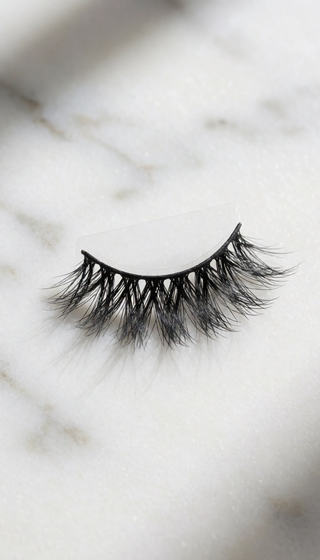
BEST LASHES FOR BIG EYES: THE PROPORTION GUIDE

If you have big, wide-open eyes, you already know the struggle: most false lashes either disappear against your eye size or go so dramatic they make you look like a cartoon. The problem is almost never the lashes themselves — it is the proportion. Big eyes have more visible lid space and a wider lash line, which changes how length, density, and curl register on your face. The good news is that once you understand a few proportion rules, big eyes are actually the easiest eye shape to flatter with lashes.
Related Resources:
Three Proportion Mistakes That Age Big Eyes
Beyond length and density, three small mistakes make the biggest difference on large eyes:
- Wearing a band that is too short. A band that stops before the outer corner makes big eyes look even wider and leaves an awkward gap. Measure your lash line before you buy — most "one size fits all" bands run 24–26 mm, but big eyes often need 26–30 mm.
- Over-curling the entire lash. A uniform, tight curl across the whole band closes the eye visually. Reserve the strongest curl for the outer third and keep the inner two-thirds softer.
- Skipping the trim. Big eyes need precision more than any other shape. Trim in tiny 1 mm increments from the outer edge, test, and repeat — a lash that fits the eye exactly looks ten times more natural than one that is slightly off.
How to Test a Lash Before You Commit
You do not need a salon chair to know whether a lash will flatter your eye. Hold the band up against your lash line without adhesive and check three things in a mirror: the band should touch your natural lash line from inner corner to outer corner with no gap; the outer edge should not extend past your eye by more than a few millimeters; and when you blink, the lash should move with your lid rather than sit stiffly on top of it. If a lash passes all three checks, the remaining question is simply how it looks with your eye shape and the occasion you are dressing for.
Styling by Occasion
Big eyes give you more styling range than any other shape — the same eye can carry a barely-there daytime lash and a full-volume evening lash. The key is changing the length and density together, never one at a time:
- Daytime and work — a natural, wispy lash with moderate length and soft curl reads as polished, not made-up.
- Date night — a cat-eye or winged shape adds drama without closing the eye. See our date night lash guide.
- Weddings and photos — camera flash flattens lash definition, so a slightly denser lash photographs better. See our wedding day lash guide and photoshoot lash guide.
- Beach and travel — waterproof, lightweight lashes that survive humidity and swimming. See our beach lash guide.
- Festivals and events — this is where big eyes can go bold; a doll or volume lash becomes a statement. See our festival lash guide.
Frequently Asked Questions
Can big eyes wear long lashes?
Yes — big eyes are the shape most capable of wearing 15–18 mm lashes without looking overdone, provided the density is controlled. Length at the outer corner reads as a lift; length everywhere reads as heaviness.
Do big eyes need a specific lash band length?
Not a specific number, but a precise fit. Measure from the inner corner of your lash line to the outer corner and choose a band that matches. Big eyes frequently need 26–30 mm bands, and trimming the outer edge by 1–2 mm is normal.
Are wispy or volume lashes better for big eyes?
Wispy lashes are the safer default because the gaps between hairs keep the eye looking bright and natural. Volume lashes work when the occasion calls for drama, but they should still have some open structure — a solid wall of lash can make big eyes look smaller, not bigger.
Do lashes make big eyes look smaller?
Only when they are too dense or too uniformly long. The right lash — fitted band, controlled density, curl concentrated at the outer third — makes big eyes look lifted and luminous, not diminished.
Are glue-free lashes safe for big eyes?
Yes. Lashes that attach along a flexible adhesive band sit more evenly on a longer lash line than lash glue, which can pool or shift on eyes with more lid space. The band also removes the mess and the risk of irritation near the eye.
— and unlike extensions, you can change the look in ten seconds, for any occasion, without touching your natural lashes. That freedom is exactly what makes glue-free, reusable lashes worth considering.
FIND THE PERFECT LASH FOR EVERY MOMENT
Explore our occasion-specific lash guides:
EXPERIENCE THE DIFFERENCE
FIND THE PERFECT LASH FOR EVERY MOMENT
Explore our occasion-specific lash guides:
Five-second application, 30+ wears, zero glue — made for eyes that deserve to be noticed.
SHOP PHANSTA LASHES — GLUE-FREE, 30+ WEARS →