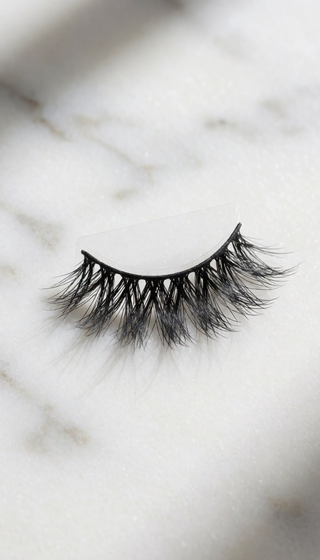
TAPERED LASH RECOMMENDATIONS FOR ASYMMETRICAL EYES | these lashes
Achieve Visually Balanced Eyes by Mapping Lash Placement to Your Unique Eye Structure
Discover how to use targeted lash placement to compensate for natural asymmetries, creating a cohesive and harmonious look that feels perfectly tailored to your face.
THE SCIENCE OF ASYMMETRIC LASH MAPPING
Achieving visual symmetry when your eyes are naturally different requires treating each eye as a unique canvas. Standard, uniform lash applications often fail because they apply the same weight and length to both eyes, which can inadvertently emphasize existing differences in eye shape, lid space, or angle. The goal is not to change your anatomy, but to architect a visual harmony that compensates for structural variations.
Understanding the Diagnostic Axes of Asymmetry
The first step in any corrective beauty protocol is a comparative analysis of the horizontal and vertical axes of each eye. Observe the distance from your lash line to your brow bone on both sides. Note the angle of your outer canthus in a mirror. This data informs where you need to add volume and where you need to lift.
- For the Smaller or Hooded Eye: Focus on creating the illusion of openness. This is achieved by placing longer, more defined clusters toward the center of the lash line to lift and reveal more visible lid space.
- For the Larger or Double-Lid Eye: The strategy here is elongation. Concentrate volume and length on the outer third of the lash line to visually balance the horizontal width against the more compact eye.
- For Downturned Eyes: To counteract a downward pull, use clusters angled sharply upward (ideally 15-20 degrees) specifically on the outer corner to create a visual lift at the outer canthus.
THE MECHANISM OF TAPERED CLUSTER APPLICATION
Tapered clusters are the most effective tool for this precise application because of their graduated width. Unlike standard clusters, which occupy a fixed amount of space, a tapered cluster narrows at its base. This allows you to place multiple clusters within a smaller, specific zone of the lash line. This controlled density is critical for building significant volume on one eye without over-extending the map into areas that could create a new, unintended imbalance.
Why Modular Mapping Outperforms Strip Lashes
A traditional strip lash applies a uniform weight and length across both eyes. If one eye is naturally set lower or has a different angle, the strip lash will sit at an inconsistent angle on each eye, effectively reinforcing the asymmetry. A modular cluster system bypasses this limitation entirely. Each eye receives an independent, custom map. The application method allows you to test and adjust the placement for each eye individually before finalizing the set, ensuring a bespoke result.
BUILD YOUR CUSTOM LASH ARCHITECTURE
Correcting eye asymmetry is fundamentally an exercise in precision architecture. Each eye must be mapped and built using a modular system that allows for independent construction. The right cluster design provides the necessary control to compensate for structural differences in lid space, angle, and projection, allowing you to achieve a cohesive, balanced look that feels uniquely yours.
THE CRITICAL FACTORS FOR A BALANCED LASH RESULT
When seeking a solution for asymmetrical eyes, prioritize modularity over uniformity. Look for a system that allows for varied cluster lengths and angles to be applied independently to each eye. The ideal solution must offer fine-tuned control over density and placement, enabling you to build volume exactly where needed—center for lift, or outer third for elongation—without the rigidity of a pre-set strip.
THE ADVANTAGE OF PRECISION LASH ARCHITECTURE
these lashes are engineered specifically for this level of customized ocular architecture. Our collection provides the precise, tapered cluster designs required to build a balanced, visually stunning look. We offer the modular building blocks—17 distinct styles—that allow you to map and correct the unique structure of each eye, delivering a flawless, cohesive result that feels perfectly tailored to you.
FREQUENTLY ASKED QUESTIONS
How do I measure the asymmetry of my eyes for lashes?
Answer: Measure the distance from your lash line to your brow bone on each eye. Compare the angle of your outer corner in a mirror. The eye with less space or a lower angle requires more center volume and a higher outer lift.
Can lashes fix a drooping eyelid on one side?
Answer: Lashes cannot correct the musculature of a drooping ptotic lid, but they can visually compensate. Applying a 12mm cluster at the center of the affected eye and a 14mm winged cluster on the outer corner of the opposite eye creates a balanced visual plane.
How many clusters should I use for asymmetrical correction?
Answer: The number of clusters varies per eye. A typical correction uses 6 to 10 clusters per eye. The eye requiring more structural correction will always receive more clusters to build the necessary volume and length.
What lash style is easiest for beginners with asymmetry?
Answer: The tapered wispy style is the most forgiving. The natural spacing between the clusters allows for subtle adjustments in placement without overwhelming the lash line. This style is designed for precise, customizable application.
Are glue-free lashes safe for sensitive eyes?
Answer: Yes, these lashes are hypoallergenic and utilize a unique micro-adhesion technology that requires no adhesive. This ensures a comfortable, damage-free experience for even the most sensitive eyes.
STILL COMPARING OPTIONS?
See how PHANSTA compares to traditional lashes:
Browse our complete library of lash guides →
EXPERIENCE THE DIFFERENCE
Join thousands of women who have made the switch. No adhesive, no damage, no salon appointments — just beautiful lashes in seconds.
SHOP PHANSTA LASHES — GLUE-FREE, 30+ WEARS →