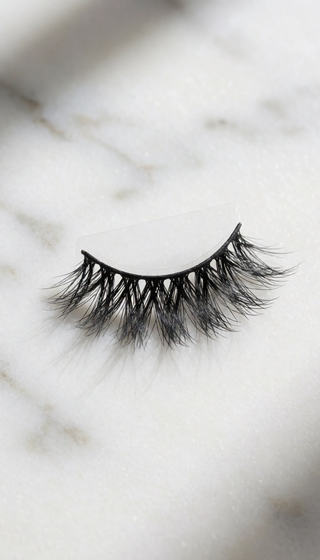
DO FALSE LASHES MAKE YOUR OWN LASHES FALL OUT? MYTH OR FACT

THE SHORT ANSWER: NO — IF YOU DO ONE THING RIGHT
You peel off a strip lash, and there they are: two or three natural lashes stuck to the band. Your heart sinks. "Great, now I'm going bald on my eyelids," you think. I've been there. I'm a beauty editor who has tested hundreds of lashes, and I've also cried over a wasted fringe. But here's the truth: that lash you lost was already about to fall out. False lashes don't make your real lashes fall out — not if you're doing it right.
Your natural lashes have a lifecycle of about 90 to 150 days. Each day, one to five lashes naturally shed. That's normal, not a sign of damage. The real issue comes when you pull, rub, or choose lashes that are too heavy. Let's break down the actual reasons lashes thin out and what you can do to keep your fringe full.
WHY YOUR NATURAL LASHES SHED EVERY DAY
Think of your lash line like a garden. Every lash grows, rests, and falls out on its own schedule. The average person loses anywhere from one to five lashes every single day. You usually don't notice because the new lash is already growing in. But when you wear false lashes, the fallout gets caught in the adhesive and becomes visible. That makes it feel like the false lash is stealing your real ones.
One 2021 study in the Journal of Cosmetic Dermatology found that the average natural lash cycle spans 90 days. So losing a few lashes during that time is a sign your body is working normally. The real problem is if you're losing more than five lashes per day consistently, or if you see bald patches. That's not caused by the false lash alone — it's usually caused by habits around the lash.
THE REAL CULPRITS BEHIND LASH LOSS
- Yanking off lashes: Pulling a false lash off by the outer corner can take healthy lashes with it. Always melt the adhesive first.
- Sleeping in falsies: Your lashes get crushed and pulled while you toss and turn. It's the single fastest way to thin your fringe.
- Using heavy strip lashes: A thick, stiff band pulls the natural lash down and stresses the root over time.
- Rubbing your eyes: Whether it's from allergy season or tiredness, rubbing breaks lashes and yanks them out early.
- Harsh adhesives: Some glues cause a slight allergic reaction, which makes your lashes shed faster. Itchy, swollen roots are a red flag.
HOW TO WEAR FALSE LASHES WITHOUT DAMAGE
You don't have to give up false lashes to keep your natural ones. You just need to follow these five rules:
- Wait 30 seconds after applying adhesive. Let it get tacky. This prevents the band from sliding and sticking to multiple lashes.
- Press the band against the skin just above your lash line, not directly on your lashes. This shifts the weight from your natural hairs to your eyelid skin.
- Remove with an oil-based remover. Let the oil sit on the lash line for 15 seconds. You'll feel the band lift on its own — no pulling.
- Lift from the outer corner, not the middle or inner. Move slowly and steadily.
- Take one full lash-free day each week. Let your natural lashes breathe and recover.
WHAT TO LOOK FOR IN GENTLE LASHES
If you want the look of full lashes without the worry, choose your lash like you'd choose a good bra — supportive, soft, and barely there. Here's what I look for when I test lashes:
- A flexible, lightweight band that curves with the eye instead of fighting it.
- Fiber that mimics the weight of a natural lash, not a plastic bristle.
- Adhesive that holds without becoming a rock-hard bond.
- Easy removal in under 30 seconds.
QUICK COMPARISON: LASH OPTIONS BY DAMAGE RISK
| Lash Type | Time to Apply | Damage Risk | Cost per Month | Maintenance |
|---|---|---|---|---|
| Strip lashes (classic) | 10 minutes | Medium if removed poorly | $5–$20 | Removal and cleaning |
| Lash extensions | 2 hours initial | High if applied too heavy | $100–$300 | Refills every 2–3 weeks |
| Flexible band strip lashes | 5 minutes | Low, with oil removal | $10–$30 | Minimal |
| DIY clusters | 15 minutes | Medium, tricky to remove | $8–$25 | Careful removal needed |
That last row — flexible band strip lashes — is the category that changed my mind. They feel like nothing on my eye, and they come off without a fight.
A NEW WAY TO THINK ABOUT LASHES
Your natural lashes are not fragile, but they are replaceable. They shed, they regrow, and they can stay full if you treat them right. The best lash routine is the one that works with your own cycle — lifting lashes gently, removing politely, and never forcing a lash to stay on longer than it wants to.
That's exactly why I started recommending PHANSTA LASHES to my girlfriends. They check every box on my "gentle lash" list: flexible, lightweight, and they look like naturally long lashes — not cartoonish spikes. But more importantly, they make me feel like I've got my life together before I've even finished my coffee.
FREQUENTLY ASKED QUESTIONS
Do false lashes cause permanent lash loss?
No. If you remove them with an oil-based remover and give your lashes a break, the shedding you see is almost always part of the natural 90-day lash cycle. Permanent loss happens when you pull out multiple healthy lashes repeatedly or develop an allergic reaction and ignore it.
Can I wear false lashes every day?
You can, but I recommend four to five days a week max. Your natural lashes need one full day without any extra weight or adhesive to stay resilient.
How do I know if my lashes are damaged?
Look for bald patches, more than five lashes shedding per day, or visible thinning. If you notice these, stop wearing falsies for two full lash cycles (about 6 months) and use a lash serum if needed.
📚 Browse our complete library of lash guides →
📚 Browse our complete library of lash guides →
📚 Browse our complete library of lash guides →
📚 Browse our complete library of lash guides →
📚 Browse our complete library of lash guides →
📚 Browse our complete library of lash guides →
📚 Browse our complete library of lash guides →
📚 Browse our complete library of lash guides →
📚 Browse our complete library of lash guides →
Experience the Difference of PHANSTA LASHES
Quick to apply, gentle on eyes, beautiful all day. Reusable 30+ wears per pair.
SHOP PHANSTA LASHES — GLUE-FREE, 30+ WEARS →