FALSE EYELASHES FOR ALMOND EYES: STYLES, FIT, AND PLACEMENT
ENHANCE YOUR ALMOND EYES WITH THE RIGHT LASH STYLE
If you have almond-shaped eyes, you already have what many people try to create with eyeliner and shadow. The almond eye is slightly elongated with a gentle upward tilt at the outer corner, and the iris is partially covered by both the upper and lower lids. This geometry is the most versatile for lash enhancement — nearly every style can work, but the right choice amplifies your natural proportions rather than fighting them.
The biggest mistake most people make with almond eyes isn't picking the wrong lash — it's applying lashes that are too heavy or too dense for their natural lash line. When the band is too thick or the fibers too voluminous, it weighs down the outer corner and flattens the very lift that makes almond eyes striking. The goal is to enhance the natural elongation, not overwhelm it. Understanding three key variables — length distribution, curl pattern, and band flexibility — is the difference between lashes that look like they belong on you and lashes that look like an afterthought.
WHAT MAKES A LASH STYLE WORK FOR ALMOND EYES
Three factors determine whether a lash will flatter an almond eye: length distribution, curl pattern, and band flexibility. Getting all three right is what separates a seamless application from one that looks obviously artificial.
Length distribution. Almond eyes handle graduated length beautifully — shorter fibers at the inner corner that lengthen toward the outer edge. This mimics the natural lash pattern and extends the eye's existing elongation. Evenly long fibers across the entire band tend to make almond eyes look rounder, which works against the shape's natural advantage. When you look at any lash strip, hold it up to your eye and check: the longest fibers should land at the outer third, not the center or the full length.
Curl pattern. A gentle, consistent curl — often called a J or B curl in lash terminology — opens up the almond eye without creating a dramatic, overly lifted look. More dramatic curls like C or D can work for evening wear but may look exaggerated on almond eyes for everyday use because the outer corner already has natural lift. Think of curl as the amplifier: your shape already provides volume, so you need a gentler signal to boost it.
Band flexibility. The almond eye's slightly angled shape means a rigid band can lift away at the outer corner. A flexible, contoured band that follows the natural curve of your lash line stays in place longer and looks more seamless. Test flexibility by holding the band between your fingers and gently bending it — if it springs back into a curve rather than staying flat, it will conform to your lid more easily.
THE BEST LASH SHAPES AND DENSITIES FOR ALMOND EYES
Based on lash technician experience and the geometry of the almond eye, these styles consistently deliver the best results:
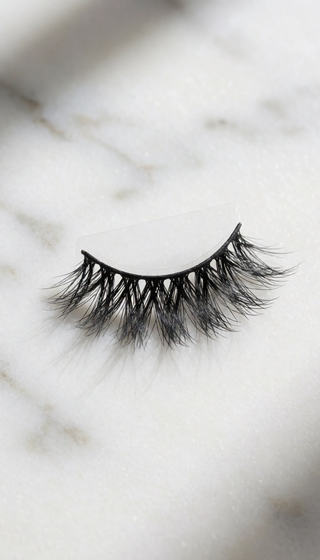
- Wispy graduated lashes: Shortest at the inner corner, longest at the outer third. This is the most universally flattering style for almond eyes because it extends the natural elongation without adding bulk. The wispy texture prevents a harsh line at the lash band, which is especially important for almond eyes where the lash line is partially visible.
- Cat-eye lashes: Length concentrated at the outer corner. These amplify the almond eye's natural upward tilt and are ideal for medium to long natural lash lines. The key is ensuring the concentration is gradual — an abrupt jump from short to long looks artificial.
- Natural everyday lashes: Even, moderate length with a soft curl. These add definition without overpowering, making them ideal for almond eyes that are already well-defined. They work best with a thin, flexible band that disappears against the lash line.
- Dramatic volume lashes: Multi-layered fibers with graduated length. These work for almond eyes when the volume is distributed toward the outer corner rather than evenly across the band. Avoid uniform density — it creates a wall of lash that obscures the almond shape's natural elegance.
Density matters as much as shape. If your natural lashes are fine or sparse, avoid dense, heavy styles that create a stark contrast between your natural lashes and the falsies. A medium density with a lightweight band creates a more harmonious look. The general rule: your natural lashes should be able to support the weight of the falsies without bending or drooping.
PLACEMENT TECHNIQUES THAT TRANSFORM ALMOND EYES
Even the perfect lash can look wrong if it's misaligned. Here's how to place lashes for the almond eye shape:
- Start with the outer corner. Position the lash band so the outer edge sits directly on your natural lash line at the outermost point. This anchors the lash where the almond shape has the most extension and prevents the band from shifting inward throughout the day.
- Press from the center outward. Use a lash applicator or tweezers to press the band down starting at the center, then smooth toward the inner and outer corners. This ensures full adhesion along the curved lash line and pushes out any air bubbles that could cause lifting.
- Check for a gap at the outer corner. If the band lifts at the outer edge, the lash is either too rigid or too long for your eye shape. Trim the outer corner by 1-2mm rather than forcing the band to conform. A small trim is invisible once applied but makes a significant difference in comfort and longevity.
- Align the inner corner with your natural lash start. Many people place falsies too far inward, which creates an uncomfortable sensation and visible gap. The inner edge of the lash should meet your first natural lash, not your tear duct. If the inner corner irritates your eye, the lash is placed too far inward.
- Secure the center first for wider-set eyes. If your almond eyes are set wider apart, pressing the center of the band first — before the corners — helps the lash conform to the broader curve of your lid. This technique is especially useful for glue-free adhesion bands that set quickly.
After application, look straight into a mirror and blink naturally. If the outer corner of the lash flips up or catches on your lower lashes, the style is too long or too dense for your shape. A well-placed lash should feel like a natural extension of your own lashes — you shouldn't be aware of it after the first few minutes.
BAND AND MATERIAL: THE UNSEEN FACTORS IN COMFORT AND LONGEVITY
The band is the most overlooked part of any false lash, and it's where most application failures happen. For almond eyes specifically, the band's properties determine whether the lash stays put and looks natural throughout the day.
Band width. A thin, flexible band (under 1mm) conforms to the curved lash line more easily than a thick cotton or plastic band. Thin bands are also less visible when you look down or close your eyes, which matters if you wear lashes for extended periods. For almond eyes, where the outer corner is most exposed, a thin band reduces the chance of visible lifting.
Fiber material. Synthetic fibers hold their curl longer and are more resistant to humidity, but they can feel heavier on fine natural lashes. Mink or faux-mink fibers are lighter and feel more natural, but they may lose their shape faster in humid conditions. For almond eyes, where the outer corner is most exposed to the elements, a material that resists humidity helps the style hold its shape throughout the day.
Adhesive method. Traditional lash glue works for most eye shapes but can irritate the delicate skin at the outer corner of the almond eye, where the lid is thinner. Glue-free micro-adhesion — a technology where the band itself adheres to the natural lash line — eliminates this irritation point entirely. Without liquid adhesive, there's no drying time, no tacky waiting period, and no residue buildup along the band edge.
Reusability. A lash that can be worn multiple times offers better value than a single-use pair. Look for bands that retain their shape after removal and fibers that don't shed or matte after cleaning. A quality reusable lash should look as good on its thirtieth wear as it did on its first — if the curl flattens or the band warps after a few uses, the materials aren't designed for longevity.
COMMON MISTAKES TO AVOID WITH ALMOND EYES
Even with the right style, several recurring errors can undermine the result. Being aware of them before you apply saves time and frustration.
- Choosing uniform length: The most common mistake is selecting a lash with even fiber length across the band. This visually rounds the eye and works against the almond shape's natural elongation. Always confirm that the longest fibers sit at the outer third.
- Ignoring band thickness: A thick, rigid band is the primary cause of visible lifting at the outer corner. Even a perfectly shaped lash will fail if the band cannot follow the curve of your lash line. Always test flexibility before application.
- Overlooking outer-corner irritation: The outer corner of the almond eye has thinner, more sensitive skin. If you experience redness, itching, or stinging after wearing glued lashes, the adhesive — not the lash style — is likely the culprit.
- Skipping the trim: Most lash strips are manufactured to a universal length. Trimming the outer corner by 1-2mm to match your specific eye width is the single most impactful step you can take for a seamless fit. It takes seconds and dramatically improves both comfort and appearance.
- Applying over mascara: Applying false lashes on top of dried mascara creates an uneven surface that prevents the band from making full contact with your natural lash line. Always apply falsies to clean, bare lashes for the strongest hold.
WHAT TO LOOK FOR IN A LASH SOLUTION
When evaluating any false lash for almond eyes, use these criteria to narrow your options quickly:
- Graduated or outer-weighted length: The lash should be longer at the outer third, not uniform across the band. This is the single most important factor for almond eye flattery.
- Flexible, thin band: The band should bend easily and conform to a curved lash line without lifting at the corners. If it resists bending, it won't follow your eye's natural angle.
- Glue-free or low-irritation adhesion: Especially important for the outer corner of the almond eye, where the skin is thinner and more sensitive. Traditional glue can cause redness and itching over time.
- Lightweight fibers: The lash should feel like you're wearing nothing — heavy fibers drag down the outer corner and flatten the almond eye's natural lift.
- Multiple wears: A quality lash should maintain its shape and curl after multiple applications. This is both a value and a sustainability consideration.
- Waterproof or water-resistant: For almond eyes, where the outer corner is most exposed to sweat and environmental moisture, water-resistant fibers hold their shape longer throughout the day.
If a lash checks most of these boxes, it's likely to work well for your almond eyes. If it fails on the first two — graduated length and flexible band — it will probably look awkward or feel uncomfortable regardless of how pretty the style is in the packaging. Prioritize fit over trend; a simple, well-constructed lash in a classic shape will outperform a trendy design that doesn't suit your eye geometry.
PHANSTA LASHES: DESIGNED FOR THE ALMOND EYE
PHANSTA LASHES were developed specifically to address the gaps most false lash brands ignore — particularly the needs of almond-eyed wearers who want volume without weight and adhesion without irritation.
Each pair of PHANSTA LASHES uses glue-free micro-adhesion technology. The band adheres directly to your natural lash line without traditional glue, magnets, or liner. This is significant for almond eyes: the outer corner — where the skin is thinnest and most prone to irritation from conventional lash adhesive — stays completely free of glue. The micro-adhesion is hypoallergenic and waterproof, so the lashes hold through humidity, sweat, and long wear without sliding or lifting at the edges.
The collection includes 17 styles at $59 per pair, most featuring graduated length distribution that naturally flatters the almond eye's geometry. Every pair is designed to be worn 30 or more times with proper care, which works out to under $2 per wear — a fraction of what disposable, single-use lashes cost over time.
Because there's no glue to dry, no magnets to adjust, and no liner to apply, the entire application process takes seconds per eye. You press the band onto your lash line, smooth from center to corners, and you're done. The micro-adhesion holds securely through the day and releases cleanly when you're ready to remove — no residue, no pulling, no damage to your natural lashes.
For almond eyes specifically, the graduated length distribution in most PHANSTA styles extends the natural elongation without overwhelming it. The thin, flexible band conforms to the angled lash line, eliminating the outer-corner lifting that plagues most glued applications. And because the band itself is the adhesive, there's zero irritation at the most sensitive part of the eye.

FREQUENTLY ASKED QUESTIONS
Can almond eyes wear any lash style?
Yes — almond eyes are the most versatile shape for false lashes. Nearly every style works, but graduated or outer-weighted length will flatter your natural elongation more than uniform length. The key is choosing a style with a flexible, thin band that follows the curve of your lash line without lifting at the outer corner.
How do I stop my lashes from lifting at the outer corner?
Outer-corner lifting is almost always caused by a rigid band or a style that's too long for your eye width. Trim the outer corner of the lash by 1-2mm, press from the center outward during application, and choose a band that bends easily. A glue-free micro-adhesion band also conforms more closely to the lash line, reducing lift.
Are glue-free lashes secure enough for all-day wear?
Glue-free micro-adhesion bands adhere directly to the natural lash line and hold through humidity, sweat, and extended wear. They release cleanly when you're ready to remove them without residue or damage. Many wearers find they stay in place as securely as traditional glued lashes, with significantly less irritation.
How many times can I wear the same pair of false lashes?
A quality reusable lash with a flexible, well-constructed band should maintain its shape and curl through 30 or more wears with proper care. After each use, gently clean the band with a lint-free wipe, store the lashes in their original case to preserve the curve, and avoid pulling or tugging during removal.
What density is best for fine or sparse natural lashes?
If your natural lashes are fine or sparse, choose a medium-density style with lightweight fibers. Heavy, dense lashes create a stark contrast that looks unnatural and can weigh down your natural lashes, causing drooping. A wispy graduated style with a thin band will blend seamlessly and provide definition without overpowering.
STILL COMPARING OPTIONS? Explore our guides on finding your perfect lash, magnetic vs strip, and sensitive eyes.
FIND THE PERFECT LASH — Not sure which style suits you? Take the 30-second lash finder quiz →
NOT SURE ABOUT YOUR EYE SHAPE?
Find your eye shape and get personalized lash recommendations:
FIND THE PERFECT LASH FOR EVERY MOMENT
Explore our occasion-specific lash guides:
EXPERIENCE THE DIFFERENCE
Join thousands of women who have made the switch. No glue, no damage, no salon appointments — just beautiful lashes in seconds.
SHOP PHANSTA LASHES →