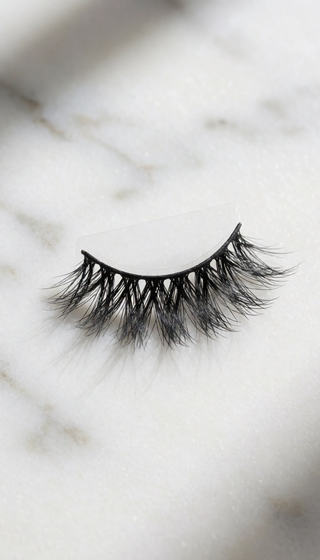
BEST LASHES FOR SENSITIVE EYES AND ALLERGIES

THE ITCHY, WATERY, RED-EYE STRUGGLE
You love the look of lashes, but your eyes have other plans. You put on a pair, and within ten minutes, your eyes are watering, itching, and turning red. You look like you have been crying for hours. It is frustrating, embarrassing, and honestly, it makes you want to give up on lashes altogether. I was like you but worse — I once wore a pair of lashes to a job interview and my eyes swelled up so badly I had to leave the room. It was a nightmare.
The problem is rarely the lash fibers themselves. It is almost always the glue or the band. Many traditional lash adhesives contain latex or formaldehyde, which are common allergens. And the thick, stiff bands that come with cheap lashes can rub against your waterline, causing irritation and redness. The good news? You absolutely can wear lashes. You just need to know what to look for and what to avoid.
THE 4 IRRITANTS YOU MUST AVOID
If you have sensitive eyes, you need to become an ingredient detective. Here are the four biggest culprits that cause allergic reactions and irritation.
- 1. LATEX: This is the most common allergen in lash glues. It is used to create a strong, flexible bond. If you have a latex allergy, even a tiny amount can cause severe swelling and itching. Avoid any glue that does not explicitly state 'latex-free.'
- 2. FORMALDEHYDE: Some glues use formaldehyde as a preservative. It is a known irritant and can cause stinging, burning, and watery eyes. It is often not listed directly, but can be hidden in ingredients like 'quaternium-15' or 'DMDM hydantoin.'
- 3. CYANOACRYLATE: This is the main bonding agent in most super glues and some lash glues. It is very strong, but it can also be very irritating. Look for glues that use a gentler alternative or a lower concentration.
- 4. HEAVY BANDS: Even if the glue is fine, a thick, stiff band can physically irritate your eye. It sits on your lash line and rubs against the delicate skin of your waterline. You need a flexible, ultra-thin band that moves with your eye.
THE BEST LASH FIBER MATERIALS FOR SENSITIVE EYES
You might be surprised to learn that the lash fiber itself can also cause issues. Some synthetic materials are more irritating than others.
Silk fibers are often touted as the most natural and gentle option. They are lightweight, flexible, and have a soft sheen that mimics natural lashes. They are less likely to cause friction on the eyelid.
Faux mink is another good option. It is a synthetic fiber designed to feel like real mink fur. It is very soft and fluffy, and it is typically lighter than regular synthetic fibers. This reduces the weight on your eyelid, which can help prevent fatigue and irritation.
Avoid any lash that feels stiff or brittle to the touch. If you bend the band and it resists, it is too heavy. It should be as flexible as a piece of thread.
HOW TO TEST FOR A REACTION BEFORE YOU WEAR THEM
Before you apply a full pair, do a patch test. This is a simple step that can save you from a painful reaction.
Step 1: Apply a tiny dot of your lash glue to the inside of your wrist or behind your ear. Wait 24 hours. If there is no redness, itching, or swelling, the glue is likely safe.
Step 2: For the lashes themselves, cut a small piece of the band and place it along your outer waterline area, without adhesive. Keep your eye closed for five minutes. If you feel no discomfort, the band is unlikely to cause physical irritation.
This is not a guarantee, but it is the best way to minimize your risk. It is a step most people skip, and it is the reason they end up with swollen eyes.
THE RIGHT APPLICATION ROUTINE
Even with hypoallergenic products, how you apply them matters. Here is a sensitive-eye-friendly routine.
1. Clean your lashes and eyelids thoroughly. Remove any traces of makeup, oil, or dirt. This prevents any product from being trapped against your skin.
2. Use a fresh, hypoallergenic glue. Even if your lash came with glue, it is often low quality. Invest in a latex-free, formaldehyde-free adhesive.
3. Apply a thin layer of glue to the band. Do not over-glue. Excess glue can seep into your eye and cause irritation.
4. Wait longer than usual. Let the glue become extra tacky before applying. This ensures a strong bond on the first try, so you don't have to reposition and cause friction.
WHAT TO LOOK FOR IN YOUR NEXT PAIR
You now have the knowledge to shop smart. Here is your final checklist for sensitive eyes.
- Latex-free and formaldehyde-free glue (or use a separate safe adhesive).
- Ultra-thin, flexible band.
- Silk or faux mink fibers.
- Lightweight construction.
- A matte finish (shiny plastic can cause glare and eye strain).
If a product does not clearly state that it is latex-free, do not buy it. If the band looks thick, do not buy it. Your comfort is more important than any trend.
FREQUENTLY ASKED QUESTIONS
Can I wear lashes if I have seasonal allergies?
Yes, but you need to be careful. Seasonal allergies can make your eyes more sensitive than usual. Wait until your symptoms are under control before wearing lashes. Also, avoid wearing them on days when your eyes are already itchy or watery.
Are magnetic lashes better for sensitive eyes?
Not necessarily. Magnetic lashes use small magnets which can be heavy and can pinch the eyelid. Another issue is that the magnetic liner required for application can contain irritants. A lightweight strip lash with a safe glue is often a better choice.
How often should I replace my lashes if I have sensitive eyes?
Replace them more frequently than you normally would. Because your eyes are prone to irritation, you don't want to risk any buildup of bacteria. If you wear them daily, consider replacing them every 5-7 uses instead of the usual 15-20.
COMFORT AND BEAUTY CAN COEXIST
You do not have to give up on beautiful lashes just because you have sensitive eyes. With the right materials, the right glue, and the right technique, you can have the fluttery, gorgeous lashes you deserve without the pain, itching, and redness. Your eyes can look amazing and feel amazing at the same time.
Discover PHANSTA LASHES for our selection of lightweight, silk-finish lashes with flexible bands, designed with comfort in mind.
Frequently Asked Questions
Are glue-free lashes safe for sensitive eyes?
Yes. PHANSTA LASHES are hypoallergenic, latex-free and fragrance-free, and they apply without liquid adhesive — the most common lash irritant. Patch-test any new product on your inner arm for 24 hours before first use.
How long do glue-free lashes last per wear?
With clean, dry lids at application, PHANSTA LASHES hold comfortably through a full day — including workouts and light rain when you use the waterproof version. Hold depends mostly on clean, dry application.
Can you really reuse PHANSTA LASHES 30+ times?
Yes, when cared for properly. Gently peel them off by lifting from the outer corner, wipe the band with a damp swab after each wear, and store pairs curved-side-up in the tray. Never soak the band in remover.
Do PHANSTA LASHES damage natural lashes?
No — unlike tugging off dried glue, PHANSTA LASHES peel away cleanly without pulling natural hairs. Remove gently by lifting from the outer corner.
How much do PHANSTA LASHES cost?
PHANSTA LASHES are $59 per pair, reusable for 30+ wears — that works out to under $2 per wear over a full month of use.
📚 Browse our complete library of lash guides →
📚 Browse our complete library of lash guides →
📚 Browse our complete library of lash guides →
📚 Browse our complete library of lash guides →
📚 Browse our complete library of lash guides →
FIND THE PERFECT LASH FOR EVERY MOMENT
From weddings to festivals — explore occasion-specific guides:
Find your eye shape and get personalized lash recommendations:NOT SURE ABOUT YOUR EYE SHAPE?
Quick to apply, gentle on eyes, beautiful all day. Reusable 30+ wears per pair.
SHOP PHANSTA LASHES — GLUE-FREE, 30+ WEARS →