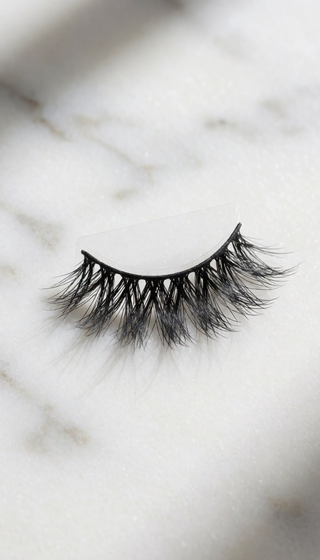
CAT EYE VS DOLL EYE LASHES: WHICH LIFTS YOUR CORNER
GET THE LIFT YOU WANT BY KNOWING WHERE THE LENGTH SITS
If two lash strips look almost identical in the tray but one makes you look awake and the other makes you look sleepy, the difference is distribution of length — not curl, not color, not brand. Here is exactly where each shape puts its weight, which one lifts a downturned corner, and how to trim a full strip without erasing the design.
Almost everyone who wears strip lashes has done this: held two styles up to one eye, squinted, and picked the one that looked prettier in the packaging. Then worn it and wondered why the outer corner of the eye still drooped. The lash was never the problem — the placement of the longest fibers was. A strip is essentially a small graphic drawn across your lid, and your eye reads that graphic in one direction or another depending on where the height peaks.
Cat eye and doll eye are the two cleanest expressions of that idea. Cat eye pushes its longest, densest fibers to the outer third, so the eye reads as elongated and pulled toward the temple. Doll eye puts its peak directly over the pupil, so the eye reads as round and open. Neither is better. But if the specific goal in your head is "lift the corner," only one of them is doing that job.
Below: the mechanics behind each shape, how to match one to your eye anatomy, the trimming mistakes that flatten a perfectly good design, and the four criteria worth checking before you commit to any strip.
THE SCIENCE OF LASH SHAPE AND EYE PERCEPTION
The perceived shape and lift of your eye are not determined by the lash itself, but by the strategic placement of the longest and densest lashes across your lid. When choosing between styles, you are essentially choosing where the visual weight of the lash strip sits relative to your natural eye anatomy.
A cat eye design is engineered to draw the gaze outward. This is achieved by concentrating the longest, most dramatic lash fibers toward the outer third of the lash line. This outward projection creates the optical illusion of an elongated, lifted outer corner, effectively pulling the eye shape toward the temple.
Conversely, the doll eye shape prioritizes symmetry and openness. Its design features a peak of maximum density and length situated directly over the center of the pupil. This central focus creates a rounder, more wide-open appearance, drawing attention inward rather than outward.
Both styles typically utilize a full strip length, often falling within the 13mm to 18mm range. Regardless of the shape, the inherent natural curl of the lash fibers remains consistent across most designs, meaning the primary variable dictating the final look is the distribution of length and density across the strip.
- Cat eye: length and density peak at the outer third; shortest fibers at the inner corner.
- Doll eye: length and density peak over the pupil; both ends taper shorter and roughly evenly.
- What your eye registers: outward mass reads as elongation and lift; central mass reads as roundness and width.
GUIDANCE ON ACHIEVING THE LIFT YOU WANT
To achieve a noticeable lift at the outer corner, the visual mass of the lashes must extend past the midpoint of your eye. The cat eye structure facilitates this by tapering the length inward while building intensity toward the outer edge. This placement ensures the heaviest part of the lash line lands beyond the center of your eye, which is what the human eye interprets as an upward or outward lift.
For the doll eye, the peak density is centered over the pupil. This configuration maximizes the perceived width and roundness of the eye, offering a softer, more symmetrical aesthetic. If your primary goal is to accentuate the outer corner, the doll eye design will not provide that specific effect — the physics of the strip work against it, no matter how you angle it.
Consider band visibility, too. The way the lash strip attaches to your natural lash line can alter the perceived shape. In a cat eye design, the band tends to be most visible at the inner corner due to the shorter lash density there. In a doll eye, the band is most apparent across the central peak. Understanding where the band sits relative to your natural lash root helps you choose the design that minimizes visual distraction.
MATCHING THE SHAPE TO YOUR EYE ANATOMY
Shape selection only works when it's read against your own lid. Two rules cover most cases:
- Downturned or hooded outer corners: cat eye is the corrective option. Weight past the midpoint counteracts the natural downward line of the lid. Keep the inner end short so nothing drags the eye inward.
- Round, prominent, or monolid eyes: doll eye adds vertical height over the pupil, which reads as openness rather than width. A centered peak also balances a lid with little visible crease.
- Close-set eyes: favor a softer cat eye with less density at the very inner corner — heavy inner lashes visually narrow the space between the eyes.
- Small or short lids: the design matters less than the total height. A 13mm–14mm strip in either shape will read more clearly than an 18mm strip that swallows the lid space.
A useful pre-check: photograph one eye straight-on, in daylight, with no lash on. Note whether the outer corner sits above or below the inner corner. That single line tells you whether you are correcting a downturn (cat eye) or simply adding openness (doll eye).
MASTER TECHNIQUE: PREVENT SHAPE DEGRADATION THROUGH TRIMMING
The most common error in lash application is over-trimming, which fundamentally alters the intended design and can negate the shape you purchased. Always measure the full strip against your natural lash line before making any cuts.
When working with a cat eye shape, trimming must be precise. Always begin by trimming the inner end. If you cut the outer end, you are removing the very lashes responsible for the characteristic outward sweep. Conversely, if you trim the inner end too aggressively, the intended build-up point shifts inward, causing the lift to weaken and morph the look toward a more centered, doll-eye appearance.
For a doll eye, maintain symmetry. Trim evenly from both the inner and outer ends to ensure the central peak remains perfectly aligned over the pupil. Uneven trimming will cause the highest lashes to drift toward one corner, inadvertently creating an asymmetrical or cat-eye effect.
Crucially, the placement of the strip matters. Always apply the lash strip directly onto your natural lash line, not above it. Placing the strip too high on the lid causes the longest, most defining points of the lash design to be hidden beneath the natural fold, effectively erasing the intended shape regardless of how perfectly you trimmed it. Check the mirror straight-on, not from above — a raised chin hides a misplaced band.
WHAT TO LOOK FOR IN A STRIP THAT HOLDS ITS SHAPE
Once the shape logic is clear, the remaining question is whether a given strip will actually hold that geometry through a full day and repeated wear. Four criteria separate a design that survives from one that droops by lunchtime:
- A band that keeps its curve. A stiff band lifts at the inner and outer corners — exactly where cat eye lift is decided. Look for a flexible band with a defined arch memory.
- An attachment method you can tolerate. Glue sensitivity, liner irritation, and magnet weight are the three most common reasons people abandon lashes. If any of those has been an issue, the mechanism matters more than the style.
- Fibers that recover. Crushed or kinked fibers permanently distort the silhouette. A strip that springs back after cleaning keeps its peak where you placed it.
- A cost-per-wear that makes sense. A single-use pair at any number is more expensive over a year than a reusable pair worn dozens of times. Do the division before you decide.
Application time is also worth weighing: a well-designed strip goes on in about five seconds per eye, so the decision really does rest on fit, band behavior, and the visual outcome you want — not on how long the routine takes.
PHANSTA LASHES: 17 SHAPES BUILT AROUND THIS EXACT LOGIC
Everything above is the reason PHANSTA LASHES exists in the form it does. The collection covers 17 styles, each built so the length sits deliberately — a true cat eye sweep for outward lift, a centered doll eye peak for openness, and the in-between shapes for the eyes that don't want either extreme. You are not adapting a generic strip to your anatomy; you are choosing the distribution you already know works.
The band uses glue-free micro-adhesion, so it holds to your natural lashes without adhesive, magnets, or liner — which removes the irritation and band-stiffness problems that flatten a shape fastest. Each pair is hypoallergenic and waterproof, and rated for 30+ wears, which puts the cost under $2 per wear at $59.
- Worried about glue or irritation? There is no glue to react to. Micro-adhesion grips the natural lashes directly, and the fibers are hypoallergenic.
- Worried it won't last? 30+ wears per pair, waterproof, and the band returns to its arch after cleaning — so the cat eye stays a cat eye.
- Worried about cost? $59 across 30+ wears works out to under $2 per wear, less than most single-use strips.

FREQUENTLY ASKED QUESTIONS
Do cat eye lashes actually lift a downturned corner?
Yes, they can, because the longest lashes are strategically placed at the outer end of the strip. By keeping the outer end intact and trimming the inner side, you encourage the eye to appear pulled outward. The effect depends on the weight landing past the midpoint of your eye, so trim conservatively.
Can I get a doll-eye look from a cat-eye strip?
No. Trimming cannot relocate the longest lashes from the outer end to the middle of the strip. The shape is determined by the original design; you must choose a style peaked at the center. Cutting a cat eye shorter simply gives you a shorter cat eye.
Which shape suits a small eye?
Both shapes can work beautifully if trimmed correctly. Because full strips are long, start by taking in length incrementally — no more than about a centimeter at a time — and recheck the curve against your lash line after each cut so the intended peak stays where the design placed it.
How long do PHANSTA LASHES last?
PHANSTA LASHES are rated for 30+ wears per pair. They are waterproof and use glue-free micro-adhesion rather than harsh adhesives, so the band keeps its arch and the fibers recover their shape after each cleaning. At $59, that works out to under $2 per wear.
Are these lashes safe for sensitive eyes?
PHANSTA LASHES are hypoallergenic and use glue-free micro-adhesion instead of lash glue, magnetic closures, or liner, which are the three most common sources of irritation. If you have a diagnosed eye condition or active infection, check with your eye care professional before wearing any lash strip.
NOT SURE ABOUT YOUR EYE SHAPE?
Find your eye shape and get personalized lash recommendations:
STILL COMPARING OPTIONS? Explore our guides on finding your perfect lash, magnetic vs strip, and sensitive eyes.
FIND THE PERFECT LASH — Not sure which style suits you? Take the 30-second lash finder quiz →
FIND THE PERFECT LASH FOR EVERY MOMENT
Explore our occasion-specific lash guides:
EXPERIENCE THE DIFFERENCE
Join thousands of women who have made the switch. No glue, no damage, no salon appointments — just beautiful lashes in seconds.
SHOP PHANSTA LASHES — GLUE-FREE, 30+ WEARS →