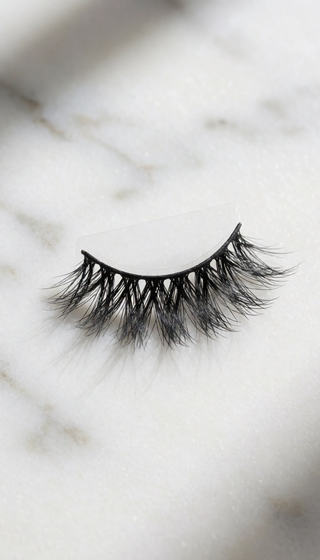
FIND THE NATURAL VS. FALSE LASH LOOK THAT’S RIGHT FOR YOU
Compare length, density, curl, placement, and real-life needs so you can choose subtle definition or full-glam volume with confidence.
The quick answer: choose a natural-looking style when you want your own lashes to look defined, lifted, and separated. Choose a fuller false style when you want visible length, density, and a more dramatic silhouette. “False lash” names an added lash; “natural-looking” describes the finished effect, so a false lash can still look believable.

You may recognize the feeling: staring at your reflection and wondering whether a dramatic style will look fun or simply give away that you are wearing lashes. That uncertainty is not a sign of bad taste. It usually means the desired effect has not been separated from the word “fake.” Your goal is not to pass a naturalness test. It is to choose an effect that suits your eye shape, comfort, schedule, and the way you want to feel.
NATURAL VS. FALSE LASHES: WHAT ACTUALLY CREATES EACH LOOK
When people discuss natural versus false lashes, they are usually comparing density, length, and curl pattern—not asking whether your natural lashes remain. Natural enhancement follows the direction and curve of your own lashes to create definition and separation. The aim is to look like the best version of your lashes, not as though you have a completely different eye.
UNDERSTANDING THE NATURAL LIFT
A natural lift usually favors wispy or flick styles. Individual fibers or very thin strips can blend more easily with existing lashes when the lengths taper and the spacing stays soft. The goal is a subtle opening of the eye, especially toward the outer corner, without a heavy edge that looks like a mask.
THE POWER OF FULL GLAM
Statement lashes use greater length—often 12 mm to 16 mm—and higher density when you want visible impact. They can suit evening events, celebrations, and photo-ready looks by creating a fuller shape that catches the light. Length is only a guide: curl, placement, and whether the fibers remain visible from the front and side determine how dramatic the result actually looks.
MATCH THE LASH LOOK TO YOUR LIFESTYLE
Think about your day before focusing on a style. A full-time office job, especially one with high-collared blouses, usually calls for a more understated effect. A night out can support more volume, while a rushed morning may only call for added length and curl.
- Daily professional look: Focus on wispy or natural styles. Your goal is clean definition without a heavy outline.
- Date night or events: Consider medium-to-full volume. Your goal is a clearer, more glamorous transformation.
- Subtle wake-up look: Try micro-volume to add visible length and curl to tired-looking eyes. Your goal is brightness rather than drama.
Compare one subtle and one dramatic style in daylight, without a filter. Check the front and side views, then notice how each feels during the longest period you expect to wear it. This is more useful than choosing solely from a style name.
WHY LASH DESIGN MATTERS MORE THAN THE “STICK”
A common misconception is that the quality of the adhesive alone determines whether lashes look fake. Application method affects the process, but design has a major influence on the finished effect. Fiber distribution, length, curl, band placement, and overall weight all shape how naturally the style integrates with your lashes.
- Fiber pattern: Graduated lengths and tapered ends blend more easily than a blunt, uniform edge.
- Spacing: Separated fibers preserve definition; excessive density can hide the natural lash line.
- Placement: A balanced band or segment usually looks more intentional than one sitting at an uneven angle.
- Curl compatibility: The style should complement your own curl rather than fight against it.
A poorly placed, overly thick band can look artificial regardless of the adhesive. Conversely, a lightweight, well-designed style can look natural in daylight when its shape suits the eye.
CHOOSE LENGTH AND CURL FOR YOUR EYE SHAPE
Eye shape changes which parts of a lash style remain visible, but no category determines one correct answer. Treat the following as styling experiments rather than fixed rules:
- Hooded or upturned eyes: Notice whether a pronounced upward curl and added outer-corner length remain visible from the front.
- Almond eyes: Moderate lengths and balanced density can create definition without overwhelming the eye shape.
- Round eyes: Graduated, slightly longer outer fibers may create a more lifted-looking line.
- Monolid, close-set, deep-set, or prominent eyes: Compare the visible silhouette, not just the style label, and prioritize a comfortable fit.
SHAPE-SPECIFIC NOTES: Read the guides for hooded eyes, almond eyes, round eyes, monolid eyes, close-set eyes, deep-set eyes, and prominent eyes.
COMPARE SUBTLE AND DRAMATIC STYLES AT A GLANCE
Use the table below as a starting point, then adjust for your lashes and comfort. A length that looks balanced on one person may disappear into another person’s crease or crowd the lash line.
| Feature | Natural/Subtle Style | Dramatic/Volume Style |
|---|---|---|
| Density | Sparse to moderate | High or dense |
| Length | Often shorter, around 8–10 mm | Often 12 mm or longer; statement styles may reach 16 mm |
| Curl | Gentle and blendable | More pronounced or lifted |
| Best for | Office settings and everyday wear | Parties, events, and statement looks |
If one style looks polished while another feels heavy, reduce only one variable—length or density—and compare again. For a natural result, definition and separation are usually more useful than maximum volume. For a full-glam result, graduated length and visible density create impact while keeping the eye shape readable.
WHAT TO LOOK FOR IN A COMFORTABLE, REUSABLE SOLUTION
Once you have chosen the effect, evaluate the solution by fit and function rather than by a dramatic label. A useful style should make the intended look easy to recreate, suit your eye shape, and come with clear wear, removal, and storage directions.
- Transparent design: Check the fiber pattern, band or segments, curl, and edge before deciding.
- Eye-shape compatibility: Make sure the important fibers remain visible from your usual viewing angle.
- Application method: Choose a format you understand and can use according to its directions.
- Care and removal: Look for realistic guidance on handling, separation, and storage.
- Repeatable wear: Compare stated durability and cost per wear, while remembering that actual cycles depend on care and condition.
Use a simple comparison test: view each style from the front and side in daylight, note how the outer corner reads, and check comfort during your expected wear time. After removal, inspect the band and fibers for residue or damage. If you have sensitive eyes, review materials and instructions, and stop use if irritation develops.
MATCH THE MOMENT: Explore guides for wedding lashes, prom lashes, beach lashes, and festival lashes.
KEEP LEARNING: 📚 Browse the complete lash-guide library →
MEET PHANSTA LASHES: 17 STYLES, ONE GLUE-FREE METHOD
You need a range that covers both subtle definition and full-glam volume, an application format you understand, and wear you can repeat. PHANSTA LASHES brings those criteria together with 17 styles, allowing you to move from a soft lift toward a fuller silhouette without changing application formats.
PHANSTA LASHES use glue-free micro-adhesion technology: no glue, no magnets, and no liner. The lashes are hypoallergenic and waterproof. At $59 with 30+ wears, PHANSTA LASHES work out to under $2 per wear. Choose by length, density, and curl—the same criteria used throughout this guide—then follow the supplied wear, removal, and storage directions.
COMPARE YOUR OPTIONS: Read PHANSTA vs Glue Lashes, PHANSTA vs Extensions, and PHANSTA vs Magnetic.
FREQUENTLY ASKED QUESTIONS
ARE NATURAL-LOOKING LASHES THE SAME AS FALSE LASHES?
False lash is a category: any added lash worn above the natural lash line. Natural-looking describes the result created by length, density, curl, spacing, and placement. A wispy 8–10 mm style may blend softly, while a dense 12 mm-plus style can look dramatic. Judge the finished effect in daylight rather than relying on the label.
HOW DO I CHOOSE BETWEEN AN EVERYDAY AND EVENT LOOK?
For everyday wear, begin with soft definition: moderate density, a gentle curl, and a length that follows your natural lashes. For an event, increase one or two variables—length, density, or outer-corner flare—instead of changing everything at once. Compare both looks in daylight and from the side, then choose the strongest effect you can comfortably repeat.
DO LONGER LASHES ALWAYS LOOK MORE DRAMATIC?
No. Length becomes visible only when the style suits your lashes, eye shape, and comfort level. A shorter, well-curled style can look polished, while an overly long or dense style may obscure the eye. For a full-glam effect, balance graduated length with separation so the eye remains readable from every angle.
WHAT SHOULD SENSITIVE EYES CONSIDER?
Sensitivity varies, so review materials, application directions, and removal guidance before wear. Patch-testing can help with cosmetic adhesives, but it cannot eliminate every reaction risk. Stop use if redness, itching, swelling, or discomfort develops. PHANSTA LASHES is hypoallergenic and uses no glue, magnets, or liner, though individual comfort still matters.
HOW ARE PHANSTA LASHES WORN AND CARED FOR?
PHANSTA LASHES use glue-free micro-adhesion technology and are waterproof and hypoallergenic. Follow the included wear and removal directions, handle the band gently, and store it as directed between uses. The stated durability is 30+ wears; actual cycles vary with care, storage, and lash condition, so replace when fibers or the band begin to degrade.
SHOP PHANSTA LASHES — GLUE-FREE, 30+ WEARS →
STILL COMPARING OPTIONS? Explore our guides on finding your perfect lash, magnetic vs strip, and sensitive eyes.
FIND THE PERFECT LASH — Not sure which style suits you? Take the 30-second lash finder quiz →