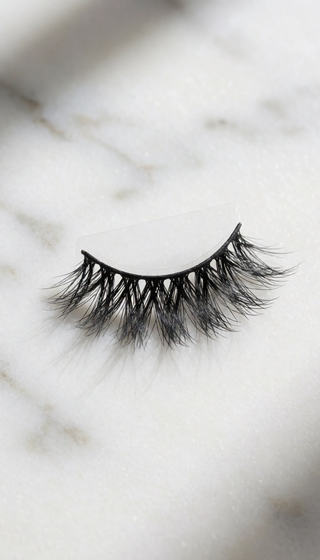
HOW TO BALANCE LASH EXTENSIONS AND NATURAL LASH HEALTH

Can you really wear lash extensions without wrecking your natural lashes? That's the first question I get from every friend who has watched a lash tech's Instagram. The honest answer is: yes, but only if you stop thinking of extensions as a beauty appointment and start treating them like a health decision. Your lash line isn't a canvas. It's living tissue, with a growth cycle that can be protected or sabotaged by what you choose to put on it.
THE LASH GROWTH CYCLE YOU NEVER KNEW EXISTED
Each eyelash lives its own little life. It grows for about 30 to 45 days, rests for a few weeks, then falls out. That's totally normal. Most people shed 20% of their lashes every two to three weeks. The problem starts when extensions are glued to lashes that are already on their way out. If you pile weight onto a shedding lash, it falls out early, and the replacement lash hasn't even started growing yet. That's how you get sudden gaps and bald patches. The healthiest lash looks don't fight the cycle. They work with it.
SIGNS YOUR NATURAL LASHES ARE STRUGGLING
- You notice more than 3 lashes on your pillow or in your coffee every morning.
- Your lids feel tight or itchy the day after a fill.
- Your real lashes look thinner and shorter when you finally take a break.
- There are tiny red bumps along your lash line.
- The extensions point in different directions, like they have a mind of their own.
If any of this sounds familiar, your lash barrier is compromised. That's not a marketing term. It just means the natural protection around each hair follicle is inflamed or weak. Bad extensions make it worse. Good lash design can actually give your natural lashes a break by distributing weight evenly across the entire lash line.
THE BALANCING ACT: EXTENSIONS WITHOUT DAMAGE
- Ask for a mapping that uses shorter, lighter lashes on weak areas. Your tech should examine each lash, not just glue on a uniform row.
- Keep fills at 3 weeks, not 2. Your natural cycle needs time to regenerate.
- Use a silk or shampoo-based lash cleanser every night, even if you're tired. Oil-based removers break down the adhesive and let the extension tug at your natural lash.
- Take a two-week break every three months. Let your lashes breathe. They'll come back stronger.
This isn't about giving up extensions. It's about redesigning the relationship. When you stop overfilling and start scheduling recovery time, you get lashes that look full while your natural lash line stays healthy.
WHAT TO LOOK FOR IN AN EXTENSION SYSTEM
Here's the part that matters. When you're choosing between a million lash brands, don't get distracted by curl types. Look for three things. First, weight: the lightest possible extension that still gives you volume. Second, adhesive flex: a bond that moves with your natural lash instead of freezing it stiff. Third, removal ease: the bond should dissolve with a gel remover, not need a metal tool. If any brand talks about 'heavy volume' or 'dramatic length,' run the other way. That's not lash health; that's lash debt.
Now, I've tested a lot of lash systems over the years. The one that finally made sense to me was developed with lash techs who were tired of seeing clients cry over fallout. It focuses on the exact principles I just listed: ultra-light yarn, a flexible bond, and a removal gel that doesn't tug. That's PHANSTA LASHES. But don't take my word for it. Check the reviews.
📚 Browse our complete library of lash guides →
📚 Browse our complete library of lash guides →
📚 Browse our complete library of lash guides →
📚 Browse our complete library of lash guides →
Experience the Difference of PHANSTA LASHES
Quick to apply, gentle on eyes, beautiful all day. Reusable 30+ wears per pair.
SHOP PHANSTA LASHES — GLUE-FREE, 30+ WEARS →