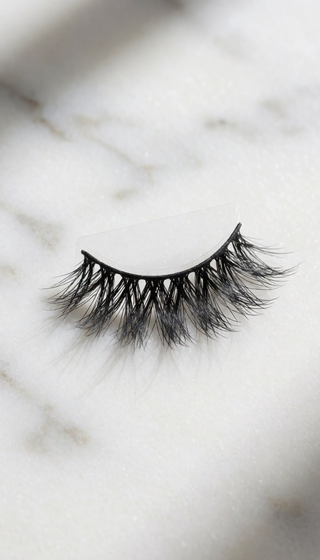
The Lash Map for Wide Set Eyes That Pulls the Eye Inward
A wide-set eye drifts apart when the weight sits at the outer corner. The map that counters it runs short at the outer end and full before the middle.
Look for a style that is shortest at the outer corner, longest before the middle, and a step shorter again at the inner end. In the 13-18 mm range that puts the outer edge near the bottom of the range and the peak near the top. The weight moves inward, so the eye reads as one unit instead of two sitting apart.
A full strip runs past most lash lines, and a wide-set eye still has a normal-width lid. Trim from the outer end in 1 cm steps and stop at your own corner, not beyond it.

The three zones, corner to corner
Read the strip in three zones. The outer third is the shortest section on the whole strip, at the bottom of the 13-18 mm range. The middle third carries the peak, near the top of it. The inner third sits between the two, a step shorter than the peak, so the inner corner does not look heavy or spiky.
That is the reverse of the map most people learn first, where the long lashes sit at the outer corner to lift and elongate. On a wide-set eye that map does the opposite of what you want: it pulls the outer corner outward and makes the gap between the eyes read wider. Look for the length before the middle instead.
The 13-18 mm range leaves room for the difference to show. An outer edge near the bottom of it and a peak near the top is a 5 mm step across one strip, which is a real change in silhouette, not a subtle one. If you want to be conservative, an outer edge near 13 mm with a peak near 16 mm still reads.
Where the outer end should stop
The outer end should stop at or just before your own outer corner, not past it. A strip that runs beyond the corner sits on skin with no lashes under it, and on a wide-set eye that extra length is the thing that drags the eye outward and down. Measure against your lash line with the strip resting where you plan to place it, then trim no more than 1 cm at a time from the outer end.
Keep the outer curve when you trim. A straight cut leaves a blunt edge that lifts off the lid at exactly the point this map depends on, and the corner is where a lifted band shows first. Small snips, following the existing arc, keep the band sitting flat.
The inner end matters too. Stop it where your own inner lashes start, not further in toward the nose. Running the strip inward past that point puts length where there is no lid to hold it, and the inner corner lifts first.
What the band does to the gap
The band is thin but not invisible. On some eyes it reads as a soft eyeliner line. On a wide-set eye that line runs the full width of the lid and draws attention to where the eye starts, which is the opposite of what the map is doing. A style with a more separated lash line shows the band less than the densest style, so the liner effect stays faint.
The first two or three tries usually land a little long, which on this map means the outer end overshoots the corner again. Take the strip off, trim another few millimetres, and place it again. The fit is the whole job here; the rest of the application is the same as on any eye.
Frequently asked questions
Should the longest lash be at the outer corner for wide set eyes?
No. Length at the outer corner pulls the eye outward and widens the gap. Choose a style with its peak before the middle and its shortest section at the outer third.
How do I know the strip is trimmed enough?
Rest it on the lash line where you plan to place it. If the outer end sits on bare skin past your corner, take off another few millimetres and check again.
Do I need a different style for a wide-set eye?
The map matters more than the style. Any style in the 13-18 mm range can be trimmed to fit; a sparser lash line shows the band less than the densest one.
One pair is $59, in 15 styles, and the case comes with it.
See the pair