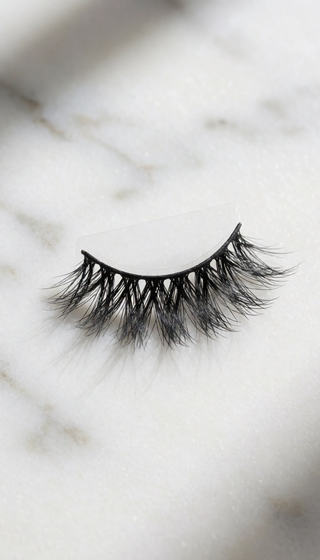
MYTH: MOST FALSE LASHES ARE MADE FROM REAL HUMAN HAIR

THE MYTH THAT WILL NOT DIE
"These lashes are made from real human hair." You have seen this sentence on Etsy, on Amazon, and on beauty sites that should know better. Here is the truth after testing thousands of lash styles: it is almost always a marketing story, not a fact. Most "real hair" lashes are synthetic fibers or a synthetic-human blend. The phrase is using your belief in natural materials to sell something that isn't natural at all.
THE TRUTH BEHIND "REAL HAIR" LASHES — 4 MYTHS, BUSTED
Let's walk through the four biggest myths in lash-marketing world:
-
Myth #1: Real human hair is the highest-quality lash material.
Truth: Human hair in lash manufacturing is often donated, then processed and stripped of its natural cuticle. That weakening makes the hair brittle and prone to splitting after just 2-3 wears. Synthetic fibers are manufactured to be smooth and uniform — which is why they actually last longer. -
Myth #2: "Real hair" is safe and natural.
Truth: Human hair can carry proteins, dander, residues, and residual allergens from the donor's environment. For the sensitive-eyed wearer, "real hair" can be the worst possible choice. Synthetic polymers are hypoallergenic, and they achieve the same look without any of the hidden residues. -
Myth #3: Synthetic lashes look fake.
Truth: This was true 15 years ago. Today, synthetic fibers are often tapered at the tip, blended with silk-like coatings, and shaped strand-by-strand. In a side-by-side blind test, most people cannot tell the difference between synthetic and mink — but they can tell which one is easier to apply. -
Myth #4: The price tells you what it is.
Truth: Price tells you nothing about material. A $35 "human hair" lash can be 100% synthetic. The only way to verify what a lash is made of is to look at the material disclosure or do a careful burn test.
HOW TO TELL WHAT YOUR LASHES ARE ACTUALLY MADE OF
Here is my reliable method, in order:
- Read the ingredient list like a food label. Honest brands list "synthetic fiber," "PBT (polybutylene terephthalate)," or "PET." Dishonest brands list "mink silk" or "human silk" or vague words like "natural fibers."
- Do a snip test. Cut one strand and burn it carefully (over a sink, with tweezers). Hair and cotton burn with a quick flame and smell like burnt proteins. Synthetic fibers melt, curl, and bead into a black plastic ball. If it melts, it is synthetic.
- Check the band underside. Real hair lashes usually have an uneven hand-knotted band. Synthetic lashes often have a clean, molded, uniform band. Neither is objectively better, but the visual tells you what they are.
One warning: do not do a burn test on lashes you still plan to wear. Test a pair you have already retired.
WHY THE MYTH SELLS (AND WHAT TO BUY INSTEAD)
"Real human hair" is not a material claim — it is an emotional claim. It makes a lash feel exotic, rare, and premium. But after years of testing, the lashes that actually perform are the ones where the material is irrelevant and the engineering is everything. Good lashes are consistent in taper, balanced in length, hold their curl after sunlight and sweat, and stay effortless to apply. Those are properties of manufacturing, not biology.
| MATERIAL CLAIM | WHAT IT ACTUALLY MEANS | SAFETY FOR SENSITIVE EYES |
|---|---|---|
| Real Human Hair | Processed donor hair, often stripped of cuticle | Low — can trigger protein and dander reactions |
| Synthetic PBT/PET | Manufactured polyester fibers | High — hypoallergenic and uniform |
| Mink | Animal fur (often mislabeled) | Medium — dander and oils are common triggers |
| Silk | Synthetic silk-blend fibers (not insect silk) | Medium-High — smooth but may have resin coatings |
Are "silk" lashes animal-free?
Almost always yes. What brands call "silk" in the lash world is actually a synthetic blend designed to mimic the sheen of silk. It is cruelty-free, vegan-friendly, and safe.
Can human-hair lashes be ethically sourced?
It is possible, but rare and nearly impossible to verify. Most commercial "human hair" lash suppliers are unregulated. A synthetic alternative removes the entire ethical gray zone.
Which material is the most ethical?
Synthetic fibers. They are made in controlled manufacturing environments, contain no animal or human byproducts, and are fully recyclable in many areas.
PHANSTA LASHES: CRAFTED SYNTHETIC. ETHICALLY MADE.
Now you know the truth behind the myth. PHANSTA LASHES are crafted from high-grade synthetic fibers with a human-designed taper — cruelty-free, hypoallergenic, and every bit as luxurious as the "real hair" never was.
📚 Browse our complete library of lash guides →
📚 Browse our complete library of lash guides →
📚 Browse our complete library of lash guides →
📚 Browse our complete library of lash guides →
📚 Browse our complete library of lash guides →
📚 Browse our complete library of lash guides →
📚 Browse our complete library of lash guides →
📚 Browse our complete library of lash guides →
📚 Browse our complete library of lash guides →
📚 Browse our complete library of lash guides →
Experience the Difference of PHANSTA LASHES
Quick to apply, gentle on eyes, beautiful all day. Reusable 30+ wears per pair.
SHOP PHANSTA LASHES — GLUE-FREE, 30+ WEARS →