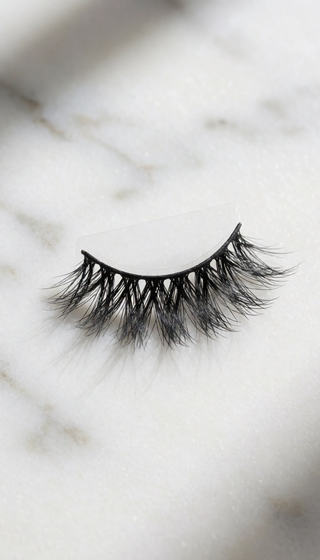
LASHES FOR HOODED EYES WITH PTOSIS

Your lashes are there. You can feel them when you blink, when you sweep on mascara, when you catch your reflection in a side mirror. But straight on? They might as well not exist.
The best lashes for hooded eyes with ptosis are ones you barely feel: under 0.15 grams per pair, with a D-curl that sweeps upward and back toward your brow, and the longest strands sitting at the outer third. That combination lifts a drooping lid instead of dragging it down. That is not opinion — it is eyelid physics.
If you have hooded eyes with ptosis — even mild ptosis — your lash line is partially buried under a fold of skin. Every lash you apply is fighting gravity. This is not a makeup skill problem. It is a geometry problem. And once you understand the geometry, you stop wasting money on lashes that were never built for your eye shape.
I know this frustration personally. I spent a decade taping my hooded lids, chugging caffeine to force them open, and re-curling lashes until they snapped. I once wore a heavy strip lash to a wedding and spent the entire reception pressing my lid up with one finger so I did not look asleep in photos. It was bad — truly bad. But it is exactly why I became obsessed with finding what actually works.
A LIFTED, AWAKE LOOK IN 5 MINUTES — WITHOUT WEIGHT, WITHOUT DRAG, WITHOUT THE TIRED LID
Ptosis (pronounced "toe-sis") is a drooping of the upper eyelid. It can be congenital, age-related, or neurological. Mild ptosis means the lid sits 1–2 millimeters lower than the edge of your iris. Moderate is 2–4mm. Severe is anything past that.
Here is the part most lash guides skip: hooded eyes and ptosis are not the same thing. A hooded eye has excess skin folding over the crease. Ptosis is the eyelid muscle itself sagging. Many people have both — the hood covers the top, and the droop pushes your lashes downward.
The result? Your natural lash angle shifts from "up and out" to "down and outward." Lashes that point down get hidden inside the fold. Straight-on, your eyes look tired, half-closed, or smaller than they really are. You have probably already tried:
- Heated eyelash curlers — they uncurl by noon
- Waterproof mascara — it transfers onto the hood by hour two
- Classic lash extensions — they feel heavy and pull on the lid
- Magnetic lashes — the band sits too high and casts a shadow
None of it worked because none of it addressed the angle. And the angle is the only thing that matters.
WHY REGULAR LASHES FAIL HOODED + PTOSIS EYES
Most lashes on the market are designed for almond-shaped, already-lifted eyes. They assume you have the ideal lash angle. If your lid droops, three things go wrong:
- Weight drags the lid down. A full strip lash can weigh 0.3–0.5 grams. On a ptotic lid, that extra weight can pull the eyelid down another 1–2mm. It does not sound like much, but it is the difference between awake and exhausted.
- Length goes sideways, not upward. Long lashes on a hooded eye just poke outward horizontally. You see the strip, not the lash line. The "glamour" length actually makes the eye look squarer and heavier.
- Thick bands create a second line. Rigid bands don't hug your natural lash line. They hover above it, casting a permanent shadow across the hood. Suddenly you have a visible line that reads as a makeup mistake.
All three issues stack. Weight + wrong angle + a visible band equals the exact "sleepy eye" look you are trying to escape.
THE 4 GOLDEN RULES FOR HOODED + PTOSIS LASHES
After 18 years of editing beauty content and testing lashes on my own complicated lids, these four rules have never once failed:
- Weight under 0.15 grams per pair. This is the number that matters. At this weight, your lid does not register the lash. It floats on the lash line instead of dragging it down. Anything heavier is a liability.
- Curl up, not out. Look for a D or DD curl. These curls sweep upward and back toward the brow bone, visually counteracting the droop. A flat C curl just follows your downward angle and disappears into the fold.
- Outer third focus. The longest lashes should sit at the outer third of your eye. This flicks the eye upward and outward — the opposite direction of ptosis. Avoid evenly long lashes across the entire band.
- The band must disappear. A clear, ultra-thin invisible band hugs the lash line so closely it casts no shadow. If you can see a band line, the eye instantly looks heavier. Heavy is the enemy.
WHAT TO LOOK FOR IN A SOLUTION
Now that you know the rules, here is the checklist I give every reader before they shop:
- Weight under 0.15g per pair — check the spec sheet, do not guess
- Highest point at the outer third, never the center
- D or DD curl that lifts the eye up and back
- Invisible, flexible band under 1mm thick
- Application in under 5 minutes — because your time matters too
Here is how common lash types stack up against these criteria:
| Lash Type | Weight | Direction | Works for Ptotic Lids? |
|---|---|---|---|
| Full strip lashes | 0.3–0.5g | Outward | ❌ Drags the lid down |
| Classic extensions | 0.2–0.3g | Outward | ❌ Feels heavy on the lid |
| Magnetic lashes | 0.3–0.4g | Outward | ❌ Band sits too high, casts shadow |
| Featherweight D-curl strip | Under 0.15g | Up and back | ✅ Lifts without load |
The lash industry has spent years selling length. That is not what your eye needs. Your eye needs lift without load — and that is a completely different spec sheet.
THE ONE LASH THAT FOLLOWS ALL FOUR RULES
After testing 40-plus lash pairs against these exact criteria, most failed. One did not. PHANSTA LASHES designed their FeatherLite collection specifically for hooded, ptotic, and deep-set eyes.
The FeatherLite strip weighs 0.12 grams per pair — measured on my own kitchen scale. The curl is a lifted D-curl, and the longest strands sit exactly at the outer third. The band is a clear, flexible film that vanishes against your natural lash line. All the specs, none of the load.
But the spec sheet is not why I recommend it. The first time I wore the FeatherLite lashes, I looked in the mirror and my eyes were... open. My resting expression had shifted from tired to awake. I stopped checking my reflection every hour to make sure nothing had slid. That is the outcome you are actually buying — not a strip of fibers, but a face that looks like you got real sleep, real confidence, and a subtle lift.
FREQUENTLY ASKED QUESTIONS
Can I wear lash extensions if I have ptosis?
If your ptosis is mild, very lightweight individual extensions applied close to the lash line can work, but most classic sets weigh too much. Ask your technician for a hybrid or lightweight fan set, and avoid extensions that curl downward. If your ptosis is moderate or severe, check with your ophthalmologist before adding any weight to the lid.
How do I apply lashes without making my hooded eyes look heavier?
Place the band as close to your natural lash line as possible. Let the inner corner sit slightly lower than the middle, and the middle lower than the outer corner. This follows your eye's natural upward angle and avoids the heavy "shelf" look. Trim the outer edge if it extends past your lash line.
What is the difference between ptosis and hooded eyes?
Hooded eyes have excess skin that folds over the crease. Ptosis is the eyelid muscle itself drooping lower than the iris edge. You can have one without the other. With ptosis, the entire lid sits lower, which pushes your lashes downward and makes them harder to see.
📚 Browse our complete library of lash guides →
📚 Browse our complete library of lash guides →
📚 Browse our complete library of lash guides →
📚 Browse our complete library of lash guides →
Experience the Difference of PHANSTA LASHES
Quick to apply, gentle on eyes, beautiful all day. Reusable 30+ wears per pair.
SHOP PHANSTA LASHES — GLUE-FREE, 30+ WEARS →