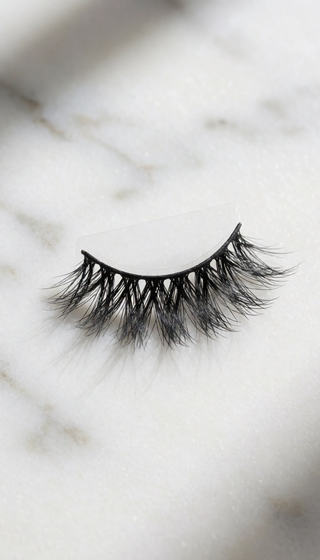
TRIM STRIP LASHES FOR ALMOND EYES IN 5 MINUTES — WITHOUT RUINING THEM
If you have almond-shaped eyes and your strip lashes never sit right — poking at the outer corner, lifting at the inner edge, or just looking uneven — the problem is almost never the lash itself. It's the fit. Almond eyes have a naturally tapered outer corner and a slightly narrower lid space than round eyes, which means a standard lash band almost always needs a small trim to follow your actual lash line. The good news: trimming strip lashes correctly takes under five minutes, requires no special tools, and can turn a drugstore pair into something that looks custom-made.
Below you'll learn exactly how to measure, mark, and cut strip lashes for almond eyes — plus the mistakes that ruin bands, the tools that actually work, and how to tell when a lash is worth trimming versus replacing.
WHY ALMOND EYES NEED A DIFFERENT TRIMMING APPROACH
Almond eyes are defined by an iris that touches both the upper and lower lash line, with a slightly upturned outer corner and a tapered shape that's longer than it is tall. This geometry creates two specific fitting challenges for strip lashes:
- The outer corner tapers inward. A standard lash band is cut for a rounder eye shape, so the outer 3–5mm often extends past your natural lash line and lifts away from the skin.
- The inner corner is narrower. The band's inner edge can overlap onto the tear duct area, causing irritation and visible overhang.
Trimming addresses both issues. The goal is to shorten the band so it follows your actual lash line from inner to outer corner — not to make the lashes shorter in length, but to make the band the right width for your eye.
HOW TO MEASURE YOUR LASH LINE BEFORE CUTTING
Never cut a strip lash while it's still in the tray. The band needs to be shaped to your eye first. Here's the measurement process:
- Remove the lash from the tray gently. Use your fingertips or a lash applicator — never pull from the outer corner, which can stretch the band.
- Place the band along your upper lash line. Hold it in position with light pressure for 10 seconds. The warmth of your skin softens the band slightly, making it more pliable.
- Identify the overhang. Look in a mirror and note where the band extends past your natural lash line. For almond eyes, this is almost always the outer 2–4mm and sometimes the inner 1–2mm.
- Mark the cut point. Use a cotton swab dipped in micellar water to make a tiny dot on the band at the point where your natural lashes end. Do this on both sides before removing the lash.
Pro tip: if you're trimming a lash you've worn before, check the band for dried adhesive residue. Old glue makes the band stiff and uneven, which throws off your measurement. Clean it with a cotton swab and a drop of oil-free makeup remeasuring first.
THE RIGHT WAY TO CUT — STEP BY STEP
Once you've marked your cut points, follow these steps:
- Use sharp, small scissors. Nail scissors or cuticle scissors work best. Dull blades crush the band fibers and leave a ragged edge that won't sit flat.
- Cut from the outer corner inward. For almond eyes, you'll typically remove 2–4mm from the outer end. Cut in one smooth snip — don't make multiple small cuts, which create a jagged edge.
- Round the outer corner slightly. After the straight cut, trim a tiny diagonal snip at the very outer edge to soften the corner. This prevents the band from poking up at the outer V of an almond eye.
- Trim the inner corner if needed. If the band overhangs your tear duct, remove 1–2mm from the inner end. Cut straight across here — no rounding needed.
- Test the fit. Place the trimmed band back along your lash line without adhesive. It should sit flush from end to end with no lifting at either corner.
- Apply adhesive and adjust. Once the glue is tacky (wait 20–30 seconds), press the band into place. If you feel a slight lift at the outer corner, remove it, dry the band, and trim another millimeter.
COMMON TRIMMING MISTAKES THAT RUIN STRIP LASHES
Even experienced lash wearers make these errors. Avoid them and your lashes will last longer and fit better:
- Cutting too much at once. You can always trim more, but you can't add band back. Start with 1–2mm and reassess.
- Cutting the lash hairs instead of the band. Only trim the band itself. Cutting the fibers changes the lash style and creates an unnatural blunt edge.
- Using dull or large scissors. Kitchen scissors or craft scissors are too wide and too dull for precision work on a 1–2mm band.
- Skipping the test fit. Always dry-fit before applying adhesive. Once glue is on, removing and re-trimming damages the band.
- Trimming both lashes at once. Eyes are rarely perfectly symmetrical. Measure and trim each lash separately against its corresponding eye.
WHEN TO TRIM VS. WHEN TO REPLACE
Not every lash is worth saving. Here's how to decide:
- Trim if: the band is intact, the fibers are still evenly distributed, and the only issue is fit. A well-maintained pair can be trimmed and re-worn many times.
- Replace if: the band is cracked, kinked, or has lost its curl. No amount of trimming fixes a compromised band.
- Replace if: fibers are clumped, matted, or falling out in clusters. This usually means the lash has reached the end of its usable life.
- Replace if: the band has been over-trimmed multiple times and is now too short to cover your lash line.
WHAT TO LOOK FOR IN A STRIP LASH THAT WORKS WITH ALMOND EYES
If you're tired of trimming every pair you buy, look for these features when choosing your next strip lash:
- A thin, flexible band. Thinner bands conform to the tapered shape of almond eyes more easily and require less trimming.
- A graduated fiber pattern. Lashes that are shorter at the inner corner and longer at the outer corner mirror the natural almond shape and need minimal adjustment.
- A glue-free or micro-adhesion option. Traditional lash glue is the number one cause of irritation and band damage over time. A lash that adheres without glue eliminates the mess, the allergic reactions, and the residue that stiffens bands between wears.
- Multiple style options. Different occasions call for different looks. Having a range of styles — from natural to dramatic — means you can match the lash to the look without forcing one pair to do everything.
THE GLUE-FREE ALTERNATIVE THAT CHANGES EVERYTHING
Here's why this matters specifically for almond eyes:
- No glue means no residue buildup. The band stays flexible and clean between wears, so the fit you trimmed stays the fit you get — every single time.
- Micro-adhesion conforms to your lash line. The technology adapts to the unique taper of almond eyes without the stiffness that glue creates as it dries.
- 30+ wears per pair. Because there's no glue degrading the band, a single pair lasts through dozens of applications — under $2 per wear at the $59 price point.
- Hypoallergenic and waterproof. No glue means no common allergens, and the hold survives sweat, humidity, and water exposure.
- 17 styles for every occasion. From natural everyday looks to full glam, there's a style designed for your eye shape and your lifestyle.
If you've been trimming strip lashes for years and dealing with glue residue, irritated lids, and bands that degrade after a few wears, there's a better way. PHANSTA LASHES use a glue-free micro-adhesion technology that bonds directly to your natural lashes — no adhesive, no magnets, no liner, no mess.
PHANSTA LASHES take seconds to apply — no drying time, no waiting for glue to get tacky, no sticky fingers. Place them, press, and go.

FREQUENTLY ASKED QUESTIONS
How much should I trim off strip lashes for almond eyes?
For most almond eye shapes, you'll trim 2–4mm from the outer corner and 0–2mm from the inner corner. Always measure against your lash line first and cut conservatively — you can remove more, but you can't reattach band. A dry fit before applying adhesive is the most reliable way to get it right.
Can I trim strip lashes more than once?
Yes, as long as the band remains intact and flexible. Each trim removes a small amount of band, so there's a limit — typically 2–3 trims before the band becomes too short. If the band is cracked or the fibers are shedding, it's time to replace the pair rather than trim again.
What's the best tool for trimming strip lashes?
Small, sharp scissors — nail scissors or cuticle scissors — give you the precision needed for a clean cut on a thin band. Avoid large or dull scissors, which crush the band fibers and leave a ragged edge that won't sit flat against your lash line.
Do glue-free lashes work for almond eyes?
Yes. Glue-free lashes that use micro-adhesion technology actually conform better to almond eye shapes because the band stays flexible and adapts to your natural lash line without the stiffness that glue creates as it dries. This means a more comfortable fit and less lifting at the outer corner.
How long do glue-free strip lashes last?
PHANSTA LASHES are designed for 30+ wears per pair when cared for properly. Because there's no adhesive degrading the band between uses, the fit and flexibility stay consistent across dozens of applications — making them significantly more cost-effective over time than traditional glue-on lashes.
STILL COMPARING OPTIONS? Explore our guides on finding your perfect lash, magnetic vs strip, and sensitive eyes.
FIND THE PERFECT LASH — Not sure which style suits you? Take the 30-second lash finder quiz →
NOT SURE ABOUT YOUR EYE SHAPE?
Find your eye shape and get personalized lash recommendations:
FIND THE PERFECT LASH FOR EVERY MOMENT
Explore our occasion-specific lash guides:
EXPERIENCE THE DIFFERENCE
Join thousands of women who have made the switch. No glue, no damage, no salon appointments — just beautiful lashes in seconds.
SHOP PHANSTA LASHES →