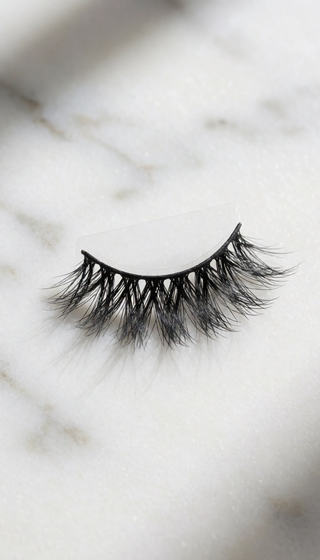
HOW TO APPLY FALSE LASHES TO MONOLIDS – NO-FAIL METHOD
Achieve Flawless, Long-Lasting Lashes on Monolids Without The Crease Struggle
Learn the exact technique and product specifications needed to secure false lashes perfectly, even when your eyelid lacks a natural fold.

MASTER THE MONOLID CANVAS: APPLICATION SCIENCE
When applying false lashes to an eyelid without a visible crease, the standard application methods fail because there is no natural fold to anchor the lash band. The key to success lies in treating the eyelid as a smooth, flat surface and adjusting both the placement and the lash structure itself.
PREPARATION: SETTING THE STAGE FOR ADHESION
Before any adhesive is applied, the eyelid must be prepped to ensure maximum grip and comfort. This process removes surface oils and ensures the lash band adheres to the skin rather than sliding across the surface.
- Curl your natural lashes thoroughly. Allow a five-second settling period to ensure the curl is set.
- Gently wipe the entire lash line area with a cotton bud to remove any residual makeup or oils.
- Pre-trim the false lash, ensuring you only remove length from the outer edge to maintain the natural shape of your eye.
THE 5-STEP APPLICATION PROTOCOL FOR FLAT SURFACES
This sequence prioritizes anchoring the center of the lash band first, which prevents the entire lash from migrating upward due to the lack of a crease.
- Step 1: Adhesive Application. Apply a thin, even layer of adhesive only to the side of the lash band that contacts the lid. Wait 20 seconds until the glue achieves a tacky consistency.
- Step 2: Center Anchor. Place the absolute middle of the lash band onto the root of your natural lashes. Linking the center firmly to the root is crucial for stability on a monolid.
- Step 3: Inner Corner Placement. Using a fingertip or fine tweezers, gently press the inner corner of the band down. The goal is for the band to sit flush against the skin, not the natural lash hairs.
- Step 4: Outer Corner Lift. Position the outer corner last, gently pushing it slightly upward toward the brow. This subtle lift helps create the visual illusion of a defined crease.
- Step 5: Final Bond Setting. Run your finger lightly over the entire band for 30 seconds. This ensures complete contact and sets the bond across the entire surface.
OPTIMIZING ADHESION: ADDRESSING LID MOISTURE
Eyelids, particularly those without a crease, can sometimes be naturally oilier, which interferes with adhesive longevity. To combat this, preparation is key to ensuring the lash stays put throughout the day.
- Utilize an oil-free makeup remover on the lid prior to application to strip surface oils.
- Apply a small piece of tissue to the lid and hold it for five seconds before beginning the adhesive process.
- Select a higher-viscosity, harder-finish adhesive rather than a flexible jelly type for superior grip on flat surfaces.
LASH STRUCTURE: WHAT TO SELECT FOR MONOLIDS
The physical characteristics of the lash itself play a massive role in how well it appears and stays in place on a monolid. Avoid overly thick or heavily structured lashes that create a harsh line against the skin.
- Band Width: Opt for 0.15 mm or thinner bands to minimize the visible edge against the skin.
- Main Length: A length between 8 and 12 mm provides significant impact without looking unnatural.
- Curl: Choose a D or L curl; avoid overly tight curls that can cause discomfort or lift prematurely.
- Material Finish: Select soft, matte fibers that absorb light rather than reflecting it harshly against the skin.
THE PERFECT SOLUTION FOR MONOLID LASH STABILITY
After understanding the mechanics of adhesion, the importance of prep, and the specific structural requirements of your lash, the final piece of the puzzle is choosing a reliable, high-quality system built for longevity and comfort. PHANSTA LASHES utilizes advanced, glue-free micro-adhesion technology designed specifically to work with the anatomy of all eye shapes, providing the lift and definition you seek without the irritation or the need for harsh adhesives.

FREQUENTLY ASKED QUESTIONS
What style of false lash is best for monolids?
Go for a feathery lash with more density in the middle rather than a heavy cat-eye. The extra lift in the center gives the illusion of a crease, which is essential for visual definition on a smooth lid.
Do I need a special tool to apply to monolids?
Not necessarily. A pair of flat tweezers helps because you can hold the band without pinching. If your hands shake, a lash applicator device is a good investment to maintain precision.
Why does my lash keep sliding up when I blink?
This usually indicates the adhesive hasn't fully set or the band is too wide for your lash line. Allow an extra five seconds for drying and verify the band conforms to the natural curve of your lash line.
How long should I expect the lashes to last?
When applied correctly using a high-quality, micro-adhesion system like PHANSTA LASHES, you can expect each pair to provide 30 or more wears, depending on your maintenance routine.
Are these lashes safe for sensitive eyes?
Yes, PHANSTA LASHES are formulated to be hypoallergenic and are designed to be gentle on the eye area, ensuring comfort for those with sensitive skin.
📚 Browse our complete library of lash guides →
📚 Browse our complete library of lash guides →
Experience the Difference of PHANSTA LASHES
Quick to apply, gentle on eyes, beautiful all day. Reusable 30+ wears per pair.
SHOP PHANSTA LASHES — GLUE-FREE, 30+ WEARS →