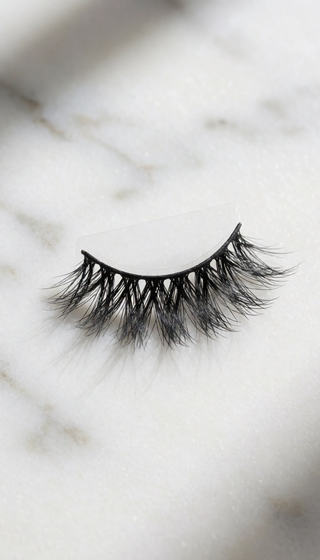
KEEP YOUR NATURAL LASHES HEALTHY — EVEN WHEN YOU WEAR FALSE LASHES
Short answer: false eyelashes are not inherently bad for your natural lashes. The damage almost never comes from the lashes themselves — it comes from how they're applied, worn, and removed. Millions of people wear strip lashes for years without losing a single natural lash, while others experience breakage after one evening. The difference is technique, adhesive choice, and the weight of the style you pick.
If you've noticed more lashes on your pillow, in the sink, or on your cotton pad lately, don't panic. Losing a few lashes each day is completely normal — your natural lashes grow in cycles and shed on their own schedule. The real concern is when shedding speeds up, lashes snap mid-shaft, or new growth comes in shorter and sparser. Those are the genuine warning signs, and they're almost always preventable.
Here's what actually causes lash damage, how your lash cycle works, and how to choose a lash style that works with your eyes instead of against them.
WHAT ACTUALLY DAMAGES NATURAL LASHES
Most lash damage traces back to a handful of common mistakes — none of which involve the false lash itself:
- Adhesive pulling at the root. Traditional lash glue bonds to the skin, and the band sits against your natural lashes. When the glue dries rigid, every blink creates micro-tension at the root. Over hours, that tension can loosen lashes before their natural shed date.
- Ripping lashes off. Peeling a strip away without softening the adhesive first is the single most common cause of sudden lash loss. You're not just removing the false lash — you're pulling out every natural lash stuck to it.
- Heavy styles and thick bands. A dense, multi-layered strip or a thick cotton band adds weight your natural lashes weren't designed to carry. Gravity plus adhesive stress equals breakage along the shaft.
- Allergic reactions and irritation. Cyanoacrylate-based glues release fumes as they cure and can trigger contact dermatitis — redness, itching, swelling. Rubbing irritated eyes accelerates lash loss.
- Sleeping in lashes. A night of pillow pressure bends the band, which levers against your natural lashes and snaps them.
HOW NATURAL LASHES GROW — AND WHY SHEDDING IS NORMAL
Understanding the lash growth cycle explains why occasional shedding is healthy and why damage shows up the way it does.
Every natural lash moves through three phases: the growth phase, where the lash actively lengthens; the transition phase, where growth stops and the follicle shrinks; and the resting phase, where the lash sits dormant until it sheds and the cycle restarts. At any given moment, your lashes are in different phases — which is why you never lose them all at once.
Because the cycle runs on a loop, a healthy lash that's pulled out early will grow back on schedule, usually within several weeks to a couple of months. The real risk isn't losing a lash — it's repeatedly traumatizing the follicle. Chronic pulling, heavy adhesive, and inflammation can thin regrowth over time, and in rare cases lead to permanent loss. That's why prevention matters far more than recovery.
This is also why a lash routine that minimizes pulling, weight, and chemical exposure protects you long after the evening is over.
SIGNS YOUR LASHES ARE UNDER STRESS
Watch for these signals that your routine needs to change:
- More than a handful of lashes appearing on your pillow, in the sink, or on your removal pad each day
- Lashes that snap or bend rather than shedding cleanly
- Regrowth that comes in shorter, finer, or sparser than before
- A visible gap or thinning along the lash line, especially at the outer corners
- Redness, itching, or puffiness of the lash line after wearing lashes
If you're seeing two or more of these consistently, give your natural lashes a break — go bare for a week or two and let the cycle reset.
SAFE APPLICATION AND REMOVAL: THE TECHNIQUE THAT PREVENTS DAMAGE
Good technique does more for your lashes than any product. Follow these steps every time:
- Start with clean, dry lashes. Oil and residue weaken adhesive grip, which leads to re-adjusting and extra pulling. Remove mascara and let your lash line dry completely before application.
- Measure and trim the band. A band that's too long lifts at the inner or outer corner, creating a lever point that pulls on natural lashes. Trim from the outer edge until the strip sits flush.
- Use the minimum effective adhesive. A thin, even line along the band — not a glob — dries faster, bonds with less rigidity, and releases more cleanly.
- Let the adhesive get tacky. Wait 20–30 seconds after applying glue before placing the band. Tacky adhesive bonds on contact and doesn't slide, which means no repositioning.
- Place the band at the root, not on the skin. Sit the strip as close to your natural lash line as possible so it moves with your lashes instead of against them.
- Never sleep in strip lashes. Make removal the non-negotiable last step of your routine.
- Soak, don't peel. Hold a cotton pad soaked in oil-based or waterproof-eye-make-up remover over the closed eye for 30–60 seconds. The adhesive softens, and the strip slides off with zero tension on the root.
- Clean the band before storing. Residue left on the band hardens and pulls at lashes next time. A quick wipe with micellar water keeps it flexible.
One more habit: give your lash line a weekly rest day when you can. A single bare day lets follicles recover and keeps the growth cycle on track.
STRIP LASHES VS EXTENSIONS VS MAGNETICS: WHICH IS GENTLEST?
Each lash method carries a different damage profile:
- Strip lashes with glue: lowest upfront cost, but adhesive is the main damage vector — fumes, rigid bonds, and peeling. Risk is moderate and almost entirely technique-dependent.
- Individual extensions: bonded one-by-one to natural lashes with cyanoacrylate. They last weeks, but the weight of multiple extensions on a single natural lash can cause breakage, and removal requires professional solvent. Highest long-term stress when applied too thickly.
- Magnetic lashes: sandwich natural lashes between two magnetic strips. No adhesive, but the magnets add weight and pinch at the root with every blink; repeated use can weaken the mid-shaft.
- Glue-free micro-adhesion strips: bond directly to the lash line with no adhesive, no magnets, and no liner. Lightweight and removable in seconds — the lowest-damage profile of the four.
WHAT TO LOOK FOR IN A LASH SOLUTION
Not all false lashes are created equal. If you want the look without the damage risk, evaluate any lash option against these criteria:
- Adhesive method. Glue-free designs eliminate the biggest damage vector entirely — no cyanoacrylate fumes, no rigid bond, no peeling. If you do use glue, choose a latex-free, sensitive-eye formula.
- Band weight and flexibility. A thin, flexible band moves with your natural lashes instead of levering against them.
- Overall weight. Lighter styles reduce gravitational stress on the root throughout the day.
- Material and finish. Soft, tapered fibers mimic natural lash texture and are less likely to irritate the eye area.
- Reusability. A lash you can wear repeatedly — with proper cleaning — is gentler on your routine and your budget than single-use strips.
- Easy removal. The best lash is the one that comes off in seconds without remover-soaked cotton pads or tugging.
THE GLUE-FREE LASH THAT PROTECTS YOUR NATURAL LASHES
Because there's no adhesive curing against your skin, there's no peeling, no fumes, and no tugging at the root. The band is lightweight and flexible, so it moves with your natural lashes instead of levering against them. The result is a lash you can apply in seconds, wear all day, and remove in one gentle pull — with your natural lashes exactly where you left them.
PHANSTA LASHES were designed around one idea: you shouldn't have to choose between a dramatic lash line and healthy natural lashes. Instead of glue, they use a micro-adhesion technology — a soft, skin-safe band that bonds directly to your lash line in seconds, with no glue, no magnets, and no eyeliner required.
- Glue and irritation — solved: micro-adhesion means no cyanoacrylate, no latex, and no fumes. The formula is hypoallergenic and waterproof, so sensitive eyes stay calm and the bond holds through sweat, tears, and long days.
- Durability — solved: each pair delivers 30+ wears with proper care, so you're not reapplying disposable strips every morning or booking refills every few weeks.
- Cost — solved: at $59 per pair, that works out to under $2 per wear — a fraction of what extensions or single-use strips cost over the same period.
With 17 styles ranging from natural everyday volume to full glam, there's a pair for every eye shape and occasion. PHANSTA LASHES have earned thousands of five-star reviews from wearers who switched from glue and extensions — most cite comfortable all-day wear and effortless removal as the reason they stayed.

FREQUENTLY ASKED QUESTIONS
Can false eyelashes make your natural lashes fall out?
False lashes themselves don't cause loss — the adhesive and removal method do. Pulling a strip off without softening the glue can take natural lashes with it. Glue-free designs and soaked-cotton-pad removal eliminate that risk, so occasional shedding stays within the normal range.
How often can you safely wear false lashes?
With glue-free, lightweight lashes and proper removal, you can wear them daily without stressing your natural lashes. Still, give your lash line a rest day when you can — a break lets the growth cycle reset and keeps follicles healthy long term.
Are glue-free lashes secure enough for all-day wear?
Yes. Micro-adhesion bands bond directly to the lash line and hold through sweat, humidity, and tears. Because the bond is flexible rather than rigid, it moves with your eyes instead of levering against natural lashes, which is what makes all-day wear comfortable.
How do you remove glue-free lashes without damaging natural lashes?
No remover needed. Grip the band at the outer corner and peel it inward in one smooth motion — the micro-adhesion releases cleanly with zero tension on the root. Clean the band, store it in the case, and it's ready for the next wear.
How long does a pair of PHANSTA LASHES last?
With proper care — cleaning the band after each wear and storing it in the original case — each pair lasts 30+ wears. At $59 per pair, that works out to under $2 per wear, far less than extensions or disposable strips over the same period.
STILL COMPARING OPTIONS? Explore our guides on finding your perfect lash, magnetic vs strip, and sensitive eyes.
FIND THE PERFECT LASH — Not sure which style suits you? Take the 30-second lash finder quiz →
NOT SURE ABOUT YOUR EYE SHAPE?
Find your eye shape and get personalized lash recommendations:
FIND THE PERFECT LASH FOR EVERY MOMENT
Explore our occasion-specific lash guides:
EXPERIENCE THE DIFFERENCE
Join thousands of women who have made the switch. No glue, no damage, no salon appointments — just beautiful lashes in seconds.
SHOP PHANSTA LASHES →