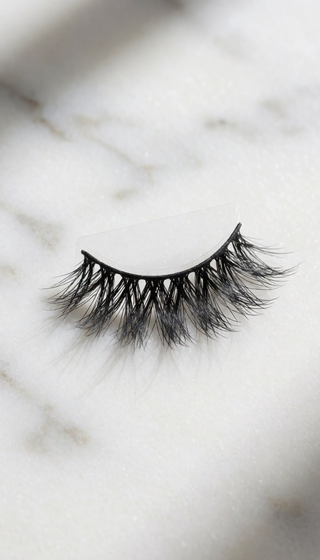
AFFORDABLE LUXURY VS PREMIUM LASHES: THE TRUTH ABOUT WHAT YOU'RE PAYING FOR
AFFORDABLE LUXURY VS PREMIUM LASHES: LEARN WHAT YOU’RE PAYING FOR AND CHOOSE BY PERFORMANCE
GET A FAIR VERDICT IN FOUR CHECKS: Compare fiber finish and band construction, test shape retention, compare balanced weight, and calculate cost from completed wears. This separates physical performance from tier labels and packaging.
THE SHORT ANSWER: Affordable luxury lashes can be the rational choice when construction, comfort, attachment, and wear suit your routine. Premium packaging alone does not guarantee softer fibers, a flexible band, lighter weight, or better durability. A higher tier earns its place only when you can see or document a difference that matters to you.
- FIBER FINISH: Compare equivalent pairs at normal distance and closer in daylight. Fine, low-shine fibers and even tips often blend more naturally.
- BAND CONSTRUCTION: Gently flex each band. A thin, flexible band may follow the lash line without folding, stretching, or feeling stiff.
- WEIGHT DISTRIBUTION: Compare similar lengths and densities. Notice balanced weight from center to ends; pulling or repeated adjustment can signal discomfort.
- WEAR INTEGRITY: After careful removal, check that fibers remain secure and the band returns to shape. Track completed wears under one care routine.
Why this works: length and density can look identical while fiber finish changes realism, band flexibility changes contact, weight distribution changes comfort, and completed wears change cost per wear. Start with the option that fits your sensitivity, time, schedule, and desired effect.
DISTINGUISH QUALITY CONSTRUCTION FROM MARKETING CLAIMS
This comparison is especially useful if you want natural-looking volume without a heavy pull, a band that moves with the lash line, a pair that retains shape for reuse, or a routine that avoids traditional adhesive. A higher tier may improve aesthetics, but tier names are not measurements. Handle one pair at a time under the same light.
FIBER QUALITY: THE LOOK UNDER NATURAL LIGHT
Hold each pair at normal viewing distance, then closer. Fine, low-shine fibers with even tips often blend more naturally. Look for rough edges, uneven tips, loose attachment points, or a stiff, plastic-like finish. Packaging light and dramatic photographs can make shine, density, and shape harder to judge than they appear in person.
BAND CONSTRUCTION: THE INVISIBLE FOUNDATION
A thick or rigid band may create a visible ridge or tug at the corners. Flex each band gently; it should follow the lash line without folding, stretching, developing a sharp edge, or feeling stiff. A thin shape helps only when the band remains stable and comfortable during the intended routine.
WEIGHT DISTRIBUTION: THE COMFORT TEST
Compare pairs with similar length and density. Notice whether weight feels balanced from center to ends, especially at the outer corners. Pressure, pulling, fatigue, or repeated adjustment are warning signs. The lightest-looking pair is not necessarily the most comfortable construction for every eye shape or lash line.
REUSABILITY AND INTEGRITY: THE WEAR TEST
After careful removal, inspect whether fibers remain secure and the band returns to its shape. Reusability depends on attachment points, band integrity, handling, storage, and correct care—not simply the maximum printed on packaging. Record completed wears under the same care routine rather than treating a maximum claim as proof.
COMPARE BUDGET, AFFORDABLE LUXURY, AND PREMIUM TIERS
Use the comparison below as a screening guide, not proof that every set within a tier performs the same. Match length, density, curl, and intended effect, then evaluate each pair’s physical construction under the same light.

| Test Metric | Budget Tier | Affordable Luxury | Premium Tier |
|---|---|---|---|
| Band Construction | May feel firm or visibly thick | Often thin and flexible, but still worth verifying | May be ultra-thin; flexibility still matters |
| Fiber Appearance | Can seem shiny or stiff | Often designed for a softer, matte effect | May imitate natural hair; inspect the ends |
| Pair Weight | May feel noticeable | Often designed to feel lighter | A higher tier does not guarantee lighter weight |
| Shape Retention | Check after the first wear | Compare after several careful wears | Compare under the same care routine |
| Useful Value Evidence | Construction and completed wears | Specific features and credible wear information | Appearance claims still require comparison |
The practical upgrade to seek first is a better band, lighter weight, and stronger shape retention. Once those basics are comparable, a higher cost may reflect appearance or packaging rather than comfort, so verify rather than assume.
CALCULATE COST PER WEAR FOR A FAIRER COMPARISON
FORMULA: Use total cost divided by documented completed wears: total lash cost plus required supplies, divided by completed wears.
An illustrative $18 set used for 12 wears equals $1.50 per wear; an illustrative $36 set used for 30 wears equals $1.20. These calculations compare methods, not category averages.
If an application requires glue or remover, include those products in the total. Compare both sets under the same care routine and count completed wears rather than possible wears.
Record the date, style, care method, and whether the full wear was completed. If a pair loses shape early, note when it happened rather than relying on a packaging maximum. This creates a personal wear record that can be compared with another pair under similar conditions.
SOLVE IRRITATION, SHAPE LOSS, AND WASTED COST
Most disappointing sets fail in predictable ways: adhesive irritation, structural breakdown, or inefficient use. Solving those problems matters more than whether packaging says budget, luxury, or premium.
- ADHESIVE IRRITATION. Traditional glue can cause stinging or irritation in some wearers, especially around sensitive skin. Clinical dermatology guidance distinguishes an immune-mediated contact allergy from irritant effects caused by exposure, friction, or mechanical trauma. Read ingredient and removal directions, avoid eye contact, and stop use if symptoms occur. Persistent redness, swelling, discharge, or pain warrants medical advice.
- SHAPE LOSS. Remove with control, avoid dragging fibers, and let the band recover its curve before storage. If it creases, stretches, or loses attachment points, record when the change occurred. A consistent care routine makes that observation useful; a packaging maximum does not.
- WASTED COST. Count only completed wears and include glue, remover, tools, or replacements required by the routine. Record the date, style, and care method, then divide the full total by completed wears. If a pair fails early, the calculation shows the difference between possible and actual utility.
Start with the option that fits your sensitivity, time, and desired effect. If a pair feels heavy, irritates, loses its shape, or performs poorly under your routine, a higher tier does not automatically correct it. Solving the failure point matters more than adopting a broader tier label.
WHAT TO LOOK FOR IN A LASH SOLUTION THAT EARNS THE DIFFERENCE
Use one final protocol before choosing any tier:
- Match length, density, curl, and effect, then view every pair in the same neutral daylight.
- Handle one pair at a time: inspect fiber tips, flex the band, and compare balanced weight.
- After each wear, record comfort, attachment integrity, shape retention, care used, and whether the wear was completed.
- Include every required supply in the total, then divide by completed wears to calculate cost per wear.
Look for transparent wear information, a stable flexible band, secure fibers, clear care directions, and a total cost that suits your routine. If avoiding traditional adhesive matters, compare application, removal, and care without relying on a tier name. Choose the option whose measured performance matches your sensitivity, schedule, and desired effect.
That evidence turns “affordable” or “premium” into a decision you can defend, not a promise you have to trust.
The styles are waterproof and made for repeated wear without a separate liner. Start with the effect you want, follow the care routine, and judge the result by completed wears, comfort, and retained shape. This keeps the final judgment grounded in performance rather than packaging or tier language.
PHANSTA LASHES: A GLUE-FREE ANSWER BUILT AROUND COMFORT, REUSE, AND VALUE
PHANSTA LASHES is the natural answer when the decision criteria—not the box—come first. Its micro-adhesion technology replaces a separate glue step while keeping the focus on comfortable construction, secure fibers, and repeatable care.
- GLUE OR IRRITATION: PHANSTA LASHES are hypoallergenic and use micro-adhesion rather than traditional glue. No separate liner is needed. That removes adhesive and remover from the routine, although sensitive eyes still require careful use; stop if redness, itching, swelling, or discomfort occurs.
- DURABILITY: The stated wear range is 30+ wears with consistent, careful handling. Remove gently, keep the band from being crushed, and store the lashes in their case so attachment points and shape can recover between uses.
- COST: Seventeen styles are offered at $59, with under $2 per wear based on the stated 30+ wears. Compare the complete routine and completed-wear record, not just the initial cost, so the value remains visible.
FREQUENTLY ASKED QUESTIONS
ARE PREMIUM LASHES ALWAYS BETTER THAN AFFORDABLE LUXURY?
No. A higher tier may improve appearance or construction, but the label does not guarantee a thinner band, balanced weight, shape retention, or more completed wears. Compare equivalent lengths and densities in the same light, then test flexibility, comfort, and integrity. Pay for verified performance rather than packaging language.
HOW SHOULD I COMPARE TWO LASH TIERS?
Put pairs with the same length, density, and curl side by side in neutral daylight. Inspect fiber shine and tip consistency, gently flex each band, and compare weight from center to ends. After the same care routine, record completed wears and shape loss. This creates performance evidence instead of assumptions about cost.
WHAT DOES COST PER WEAR ACTUALLY MEASURE?
Divide the total you spend by completed wears, including any required supplies. If a set costs $18, lasts 12 documented wears, and needs no extra supplies, the result is $1.50 per wear. If a $36 set lasts 30 wears with no extras, it is $1.20. These are illustrations, not category averages.
CAN GLUE-FREE LASHES SUIT SENSITIVE EYES?
They can remove traditional adhesive as a variable, but no product should be treated as risk-free. PHANSTA LASHES uses micro-adhesion and is labeled hypoallergenic, with no separate glue or liner. Follow the care directions, keep hands away from the eye area, and stop using them if redness, itching, swelling, or discomfort develops.
HOW SHOULD PHANSTA LASHES BE STORED AND REMOVED?
Remove each pair gently, avoid pulling at the band or pinching the fibers, and let the band regain its shape before storage. Keep the case closed and free of loose moisture. Following the care directions helps protect micro-adhesion, supports the stated 30+ wear range, and keeps repeat handling as consistent as possible.
READY TO JUDGE VALUE BY COMFORT, REUSE, AND COMPLETED WEARS?
STILL COMPARING OPTIONS? Explore our guides on finding your perfect lash, magnetic vs strip, and sensitive eyes.
FIND THE PERFECT LASH — Not sure which style suits you? Take the 30-second lash finder finder →
NOT SURE ABOUT YOUR EYE SHAPE?
Find your eye shape and get personalized lash recommendations:
FIND THE PERFECT LASH FOR EVERY MOMENT
Explore our occasion-specific lash guides:
EXPERIENCE THE DIFFERENCE
Join thousands of women who have made the switch. No adhesive, no damage, no salon appointments — just beautiful lashes in seconds.
SHOP PHANSTA LASHES — GLUE-FREE, 30+ WEARS →