CAT EYE LASH GUIDE FOR DOWNTURNED EYES

A LIFTED ALMOND SHAPE YOU CAN MAP IN UNDER TEN MINUTES
Downturned eyes sit with the outer corner level with — or slightly lower than — the inner corner. It is one of the most common eye shapes, and it is the one where lash choice changes a face fastest. The eye is not truly sloping; the upper lid simply carries more weight toward the temple, so the outer corner reads heavy and low. Every good cat eye application works from that single fact.
NOT SURE ABOUT YOUR EYE SHAPE?
Take our 60-second quiz to find your perfect lash match — no glue, no commitment.
TAKE THE QUIZ →The fix is contrast, not length. When the inner and outer corners carry the same lash length, the eye reads round or tired. When length climbs steadily from the inner corner to the outer third, the same eye reads open, lifted and almond. A difference of 3–5 mm between the shortest inner lash and the longest outer lash is usually enough on a natural eye; on a larger eye, 5–7 mm.
Three decisions control the whole result: where the longest point sits, how much curl the outer lashes carry, and how much weight hangs on the band. Get those right and a downturned eye lifts without a single drop of makeup.
GET A FLAWLESS CAT EYE MAP FOR DOWNTURNED EYES
Work from the inner corner outward and measure against the natural lash line, never against the brow.
- Anchor the inner corner short. Start at 6–8 mm. Anything longer crowds the tear duct and pulls the eye inward, which flattens the lift you are about to build.
- Build through the middle. Step up gradually to 9–11 mm through the centre of the eye. This is the transition zone — keep it smooth rather than jumping 3 mm in one lash.
- Peak at the outer third, not the outer edge. The longest point should sit directly above the outer third of the iris when the eye is open. For most eyes that is 12–14 mm, and it lands before the very last lash.
- Hold the last cluster. The final two or three lashes should stay level with the peak or drop by no more than 1 mm. If the outermost lash is the longest lash, the corner physically droops and the eye closes down.
- Check the apex in a mirror, eyes open. Mapping is only correct if the peak reads upward when the lid is relaxed. Adjust before you commit.
CURL, LENGTH AND APEX: THE THREE SETTINGS THAT CREATE LIFT
Length gets the attention, but curl does most of the visible work on a downturned eye. A flat J-curl follows the lid downward and reinforces the droop. A C-curl is the safe universal choice, CC adds a clean lift for hooded or deep-set lids, and a D-curl gives maximum drama but can look heavy if the band is thick.
Match the curl to the position on the eye rather than using one curl throughout. A common professional mapping uses one step less curl at the inner corner (so lashes do not poke the brow bone or the tear duct) and one step more curl from the outer third outward. That single change is what makes a cat eye read as a lift instead of a fan.
The apex — the highest, longest point — must sit above the outer third of the iris, not above the pupil. A centred apex creates a doll-eye effect, which is flattering on some shapes but visually rounds a downturned eye and cancels the outward sweep.
CAT EYE VS KITTEN VS DOLL EYE ON A DOWNTURNED EYE
- Cat eye: the strongest lift. Length climbs continuously to a peak at the outer third, then holds. Best all-round choice for downturned and hooded eyes.
- Kitten eye: a softer version where the peak sits slightly further out and the length difference is smaller — roughly 2–3 mm. Ideal for a first attempt or for very small eyes where 14 mm would overwhelm.
- Doll eye: even length across the lash line with the longest lashes in the centre. Beautiful on round and almond eyes, but on downturned eyes it draws attention to the centre and lets the corners fall.
- Wispy and spiky sets: spaced clusters with visible gaps. Excellent for a natural cat eye because the eye shape stays visible between the lashes rather than being masked by a solid wall of hair.
THE FOUR MISTAKES THAT DRAG DOWNTURNED EYES DOWN
- Longest lash at the outer edge. This is the single most common error. Length must peak before the corner and hold — never grow outward past it.
- A heavy band. Thick bands cast a shadow and physically weigh the outer lid down. Lighter bands rotate less and disappear into the lash line.
- Over-curled inner corners. Lashes that curl hard at the inner corner cross into the brow bone or poke the eye, which forces you to look down and kills the lift.
- Skipping the natural lash check. If your natural lashes already point downward at the corner, a heavy strip will follow them. Comb and set the natural lashes first, then map on top of that line.
SENSITIVE EYES, ADHESIVE AND WEIGHT: WHAT TO CHECK BEFORE YOU APPLY ANYTHING
Lash adhesives are the most common source of irritation, not the lashes themselves. Traditional strip glues are cyanoacrylate-based and can contain latex or formaldehyde-releasing preservatives — all recognised contact allergens. If your eyes water, itch or turn red within an hour of application, the adhesive is the likely culprit, not the fibre.
Three practical checks before you commit to any lash system: patch-test the adhesive on the inner forearm 24–48 hours ahead; weigh the lash in your hand, because a stiff, heavy band will rotate and press on the lid all day; and confirm how the product is removed, since harsh removers strip natural lashes and thin the lash line over time. People who wear contact lenses, have blepharitis, rosacea or a history of styes should lean toward systems that avoid liquid adhesive entirely.
MAGNETIC, STRIP AND GLUE-FREE MICRO-ADHESION COMPARED
| System | How it attaches | Watch out for |
|---|---|---|
| Strip lashes | Liquid cyanoacrylate glue on a stiff band | Allergen exposure, band weight, one-and-done wear |
| Magnetic lashes | Small magnets gripping a magnetic eyeliner or opposing lash pair | Liner removal, magnetic hardware near the lid, limited rewear |
| Glue-free micro-adhesion | A fine mechanical grip along the natural lash line | Needs a clean, oil-free lash line to seat correctly |
The trade-off is always the same: the faster and gentler the attachment, the more important the prep. Whichever system you choose, a clean, dry, oil-free lash line is what decides whether it stays put through a full day.
WHAT TO LOOK FOR IN A CAT EYE LASH THAT ACTUALLY LIFTS
You now know the anatomy and the mapping. Here is the shortlist to judge any lash against before you spend on it:
- Length biased to the outer third, with the peak before the corner — the geometry is either built into the style or it is not.
- Multiple curl options, so the inner corner can sit one step softer than the outer fan.
- A featherweight, flexible band that follows the lid curve instead of fighting it.
- An attachment method that avoids liquid adhesive if your eyes are reactive at all.
- A wear count that justifies the cost per wear — a lash you wear twice is more expensive than one you wear thirty times.
Seventeen mapped styles built to lift downturned eyes — 30+ wears each, under $2 per wear, hypoallergenic and waterproof.
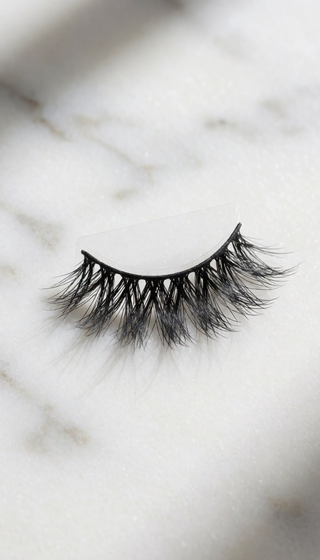
Everything above points to one conclusion: the lift comes from the map, the curl and the weight. PHANSTA LASHES builds the map into the lash. The cat eye and kitten styles carry their length at the outer third and hold it there, so the peak sits above the outer iris instead of dragging the corner down. The band is featherweight and flexible, which means it follows the lid rather than pressing on it.
PHANSTA LASHES: A CAT EYE LIFT IN SECONDS, WITHOUT GLUE
Attachment uses glue-free micro-adhesion — no liquid adhesive, no liner, no magnetic hardware. The lash seats along the natural lash line in seconds per eye and lifts off clean at the end of the day, which is exactly what sensitive-eyed wearers keep asking for. Because each pair is reusable for 30+ wears, the cost per wear lands under $2 even at $59.
- “Glue makes my eyes water.” There is no glue. Micro-adhesion grips the natural lashes mechanically, so there is no cyanoacrylate on your lid and nothing to patch-test.
- “Disposables end up costing more.” One pair, 30+ wears. That is under $2 per wear against a strip lash you throw away each night.
- “Will it survive a long day?” Waterproof and hypoallergenic, built for 12-hour wear and reused for a month.
SHOP PHANSTA LASHES — GLUE-FREE, 30+ WEARS →
FREQUENTLY ASKED QUESTIONS
What is the best lash style for downturned eyes?
A cat eye map is the most effective: length climbs from a short inner corner to a peak above the outer third of the iris, then holds rather than growing outward. A kitten eye is the softer version of the same idea, with a smaller length difference of roughly 2–3 mm.
How long should the outer lashes be for a cat eye?
Most natural eyes peak between 12 and 14 mm at the outer third, with the inner corner at 6–8 mm. Smaller eyes look better closer to 12 mm, larger eyes toward 14 mm. The outer edge should never be longer than the peak.
Can I wear cat eye lashes if my eyes are sensitive?
Yes, provided you avoid the adhesive rather than the lashes. Cyanoacrylate glues and magnetic liners are the usual irritants. Patch-test any liquid adhesive 24–48 hours ahead, or choose a glue-free micro-adhesion system that never touches the lid with a wet product.
Do cat eye lashes make eyes look smaller?
Only when they are mapped wrong. An apex placed too far out, or an outer lash longer than the peak, pulls the corner down and closes the eye. Peak at the outer third, keep the final cluster level, and the eye opens instead of shrinking.
How do glue-free lashes stay on without adhesive?
Micro-adhesion uses a fine mechanical grip that seats the lash band along the natural lash line and holds through the day. Prep matters most: the lash line should be clean, dry and free of oil or moisturiser before application, and the lash lifts off clean at night.
STILL COMPARING OPTIONS? Explore our guides on finding your perfect lash, magnetic vs strip, and sensitive eyes.
FIND THE PERFECT LASH — Not sure which style suits you? Take the 30-second lash finder quiz →
NOT SURE ABOUT YOUR EYE SHAPE?
Find your eye shape and get personalized lash recommendations:
FIND THE PERFECT LASH FOR EVERY MOMENT
Explore our occasion-specific lash guides:
EXPERIENCE THE DIFFERENCE
Join thousands of women who have made the switch. No glue, no damage, no salon appointments — just beautiful lashes in seconds.
SHOP PHANSTA LASHES →