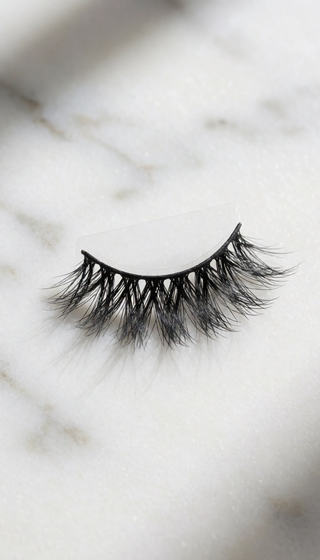
HANDMADE VS MACHINE-MADE LASHES: QUALITY CHECK

If you have ever bought lashes that looked fine in the package but shed unevenly, curled at the corners, or fell apart after a few wears, the manufacturing method is the likely culprit. Handmade lashes are tied strand by strand for a natural taper and flexible band, while machine-made are crimped in molds that often irritate and break down fast. You can learn to spot the difference in under five minutes and stop wasting money on pairs that fail early.
I USED TO THINK ALL LASHES WERE THE SAME
I spent years buying cheap lashes from random beauty supply stores. They looked fine in the package. But every pair had the same problems: the outer corners curled up no matter what I did, the band felt like a wire, and by the third wear they were practically unwearable.
Then a lash manufacturer showed me the process. I watched a pair being made by hand — each lash individually tied, the band pressed just right, the tips trimmed to a natural taper. I never looked at lashes the same way again.
HANDMADE: THE SLOW WAY THAT MAKES A DIFFERENCE
Handmade lashes are built one pair at a time. A worker ties each lash strand onto the band using a specialized knot. This is slow and expensive, but it creates something machine-made lashes can't replicate:
- Natural taper: Each lash is tipped by hand, so the ends are fine and blend invisibly with your real lashes.
- Flexible bands: Hand-tied knots use less adhesive, keeping the band soft and comfortable.
- Movement: Because each strand is individually secured, the lash moves naturally with your eyelid rather than sitting like a plastic strip.
MACHINE-MADE: SPEED, CONSISTENCY, AND THE CATCH
Machine-made lashes are mass-produced by crimping synthetic fibers into a pre-made band. The speed makes them cheap — often $3–8 per pair. The consistency means every pair looks identical.
But that consistency comes at a cost:
- Harsh eyes: The crimped base leaves tiny metal-like bumps on the band that cause irritation.
- No taper: Fibers are cut to one thickness, which makes the lash look stiff and uniform.
- Shorter lifespan: Machine crimping can't match the durability of a hand-tied knot. Strands fall out faster.
| Quality Marker | Handmade Lashes | Machine-Made Lashes |
|---|---|---|
| Strand attachment | Individually tied with knots | Crimped together in a mold |
| Tip taper | Naturally tapered, invisible blend | Even thickness, blunt ends |
| Band feel | Soft, flexible, low profile | Stiffer, thicker, more noticeable |
| Lifespan | 15–25 wears with care | 5–10 wears if you're lucky |
THE 5-MINUTE QUALITY CHECK YOU CAN DO AT HOME
You don't need a jeweler's loupe to spot a quality lash. Try these five tests:
- Run your finger across the band. Any loose strands? A quality lash should keep every strand in place.
- Bend the band gently. Does it snap back to its curve? Or does it stay twisted? Flexible = better.
- Look at the tips. Do they taper to a point like real lashes? Or are they blunt, like a wood plank?
- Pull one strand at the base. If it pops out with barely any effort, the lash won't survive event night.
- Wear them for 15 minutes. A quality lash becomes invisible. A cheap one makes you aware it's there.
If a lash fails even one of these, it's not worth your money.
WHAT TO LOOK FOR IN YOUR NEXT PAIR
Now that you know the difference, here's what separates a great lash from a one-time wear:
- Hand-tied strands that stay put.
- A band that flexes without folding.
- Tips that look like real eyelashes, not cut plastic.
- A construction that survives 15+ wears without shedding.
These are the quiet details that make a lash pair feel expensive — not because of the price tag, but because they work every single time.
FAQ
How can I tell if my lashes are handmade?
Look at the base where strands attach to the band. Handmade lashes have visible individual knots. Machine-made lashes have a smooth, crimped line with no knot detail.
Are handmade lashes worth the extra cost?
Yes, for most people. Handmade lashes last 15–25 wears versus 5–10 for machine-made. That makes the per-wear cost lower over time, plus you get better comfort and a more natural blend.
Can machine-made lashes still look good?
They can look great in the package and even on the first wear. But they won't hold their shape, shed less, or remain comfortable as quickly. If you wear lashes regularly, the quality gap becomes obvious within days.
GET LASHES THAT PASS EVERY QUALITY CHECK — WITHOUT GLUE IRRITATION
After learning what makes a lash truly well-made, the natural next step is finding a pair that meets every criterion and removes the common pain points of traditional application. PHANSTA LASHES are built to satisfy the hand-tied standard above while using glue-free micro-adhesion technology — no glue, no magnets, no liner. Each pair is hypoallergenic, waterproof, and engineered for 30+ wears, which works out to under $2 per wear across 17 styles at $59.
THREE COMMON CONCERNS, SOLVED
- Glue irritation: Traditional lash glue is the top cause of eye redness and sensitivity. PHANSTA LASHES use micro-adhesion that skips glue entirely, making them hypoallergenic.
- Durability: Worried about lashes shedding after a few uses? PHANSTA LASHES deliver 30+ wears per pair, outlasting typical handmade and machine-made numbers.
- Price: At $59 for 17 styles, the cost is under $2 per wear — less than a daily coffee, with none of the repeat purchases.
FIND THE PERFECT LASH FOR EVERY MOMENT
Explore our occasion-specific lash guides:
📚 Browse our complete library of lash guides →
📚 Browse our complete library of lash guides →
Experience the Difference of PHANSTA LASHES
Quick to apply, gentle on eyes, beautiful all day. Reusable 30+ wears per pair.
SHOP PHANSTA LASHES — GLUE-FREE, 30+ WEARS →