ALLERGY-SAFE LASH GLUE OPTIONS FOR HOME USE: HOW TO GET BEAUTIFUL LASHES WITHOUT THE ITCH, WATER, OR SWELLING

If standard lash glue leaves your eyes red, itchy, or swollen, this guide will show you exactly which ingredients trigger reactions, how to patch-test any adhesive at home, and what a truly allergy-safe option looks like — so you can wear lashes again without dreading the aftermath.

Let's talk about the not-so-cute side of lash adhesives: the red, itchy, watery eyes that show up thirty minutes after application. I once watched a friend's eyes swell shut thirty minutes before her sister's wedding — all because she skipped the patch test. If you have sensitive skin or a known latex allergy, standard lash glue can ruin your entire day.
The good news: your eyes are giving you useful information, not a life sentence. The safest lash glue is one with a short ingredient list, no latex, and a patch-test requirement — and knowing how to identify it takes about five minutes of label-reading. Here's how.
WHY STANDARD LASH GLUE CAUSES REACTIONS (AND WHICH INGREDIENTS TO AVOID)

Natural rubber latex is the biggest trigger for eyelid allergies, but it's not the only one. Many standard adhesives also contain formaldehyde resins, cyanoacrylate, or rosin — all of which can cause a reaction in sensitive eyes.
That doesn't mean every cyanoacrylate-based adhesive is off the table. Look for adhesives that list cyanoacrylate as the main ingredient but are specifically formulated for sensitive eyes — many brands now use a gentler derivative that doesn't cause the same histamine response.
HOW TO READ A LASH ADHESIVE LABEL LIKE AN ALLERGIST

Flip the bottle over. If you can't pronounce the first five ingredients, put it back.
Some adhesives label themselves "latex-free" but still contain a synthetic latex that behaves similarly in the body. The only way to know for sure is to read the ingredient list carefully — or choose a brand that specifically states "formaldehyde-free" and "ophthalmologist tested." These are helpful signals, but they are not guarantees. Do not rely on claims alone.
Also check whether the glue dries clear or dark. Clear-drying formulas are usually gentler, and they let you check the bond without scraping it off. In general, the shorter the ingredient list, the less there is in the formula to react to.
HOW TO PATCH-TEST ANY LASH GLUE BEFORE IT GOES NEAR YOUR EYE

Take a drop from the tube and place it on the back of your hand. Wait 30 minutes. If you see any redness or hives, or feel any discomfort, wash it off and skip that glue. Some experts recommend doing a 24-hour patch test behind your ear for an even more reliable read.
Yes, it takes extra time. It's worth it, especially if you have a known allergic reaction to cosmetics. A few minutes of testing can save you from a red, swollen eye on a day you can't afford one.
WHAT TO LOOK FOR IN AN ALLERGY-SAFE LASH SOLUTION
If you're shopping around, now you know what to look for. A good allergy-safe lash adhesive should have a short ingredient list with no latex, a clear-drying and gentle formula, a fine-tip applicator so you don't overload the lash line, and easy removal with a gentle lash cleanser — no tugging, no pulling.
It should feel like a whisper when you apply it, not a sting. If a product stings, burns, or makes you dread application, that alone is your answer.
COMMON QUESTIONS ABOUT ALLERGY-SAFE LASH ADHESIVES
What ingredients should I avoid if I have lash glue allergy?
Avoid natural rubber latex, formaldehyde, rosin, and certain cyanoacrylates. Look for latex-free and ophthalmologist-tested formulas that list a simple, short ingredient list.
Can I use a latex-free glue if I'm not allergic?
Yes, many people prefer latex-free formulas because they're less likely to cause irritation, even with occasional use. They also tend to dry faster and are easier to remove.
How do I patch-test a lash glue?
Put a small drop on the back of your hand or behind your ear. Wait 24 hours. If there's no redness, itching, or swelling, it's likely safe for your eye area.
THE ALLERGY-SAFE ALTERNATIVE: WHY THE SAFEST LASH ADHESIVE MIGHT BE NO ADHESIVE AT ALL
Here's a thought worth considering: if every adhesive you try still stings — no matter how short the ingredient list — the problem may not be the formulation. It may be the glue itself. Even the gentlest formula is still a chemical adhesive sitting millimeters from your lash line.
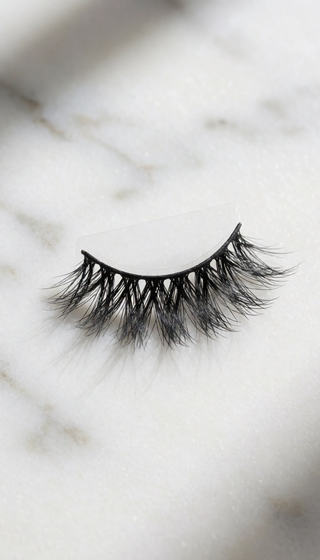
That's the problem PHANSTA LASHES was designed to solve. Instead of asking your eyes to tolerate glue, PHANSTA LASHES uses micro-adhesion technology to hold lashes in place — no glue, no magnets, no liner. The lash simply presses onto your lash line, stays there all day, and lifts off just as easily. It's the natural next step for anyone whose skin has had enough of adhesives.
- No glue means no irritation. PHANSTA LASHES are hypoallergenic and waterproof, with no latex, formaldehyde, or adhesive chemicals — so the most common allergy triggers never enter the picture.
- They stay put. Micro-adhesion holds each pair firmly for 30+ wears — through tears, sweat, humidity, and twelve-hour days — with no touch-ups and no accidental slips.
- They cost less than $2 per wear. At $59 a pair with 30+ wears, PHANSTA LASHES costs a fraction of salon extensions or a steady supply of single-use glue lashes.
With 17 styles to choose from, there's a PHANSTA LASHES pair for every eye shape and every occasion — from everyday soft definition to full-volume drama. Most people apply them in seconds per eye, with zero drying time and zero risk of waking up with puffy eyes.
Browse our complete library of lash guides →
📚 Browse our complete library of lash guides →
📚 Browse our complete library of lash guides →
📚 Browse our complete library of lash guides →
📚 Browse our complete library of lash guides →
📚 Browse our complete library of lash guides →
📚 Browse our complete library of lash guides →
Experience the Difference of PHANSTA LASHES
Quick to apply, gentle on eyes, beautiful all day. Reusable 30+ wears per pair.
SHOP PHANSTA LASHES — GLUE-FREE, 30+ WEARS →