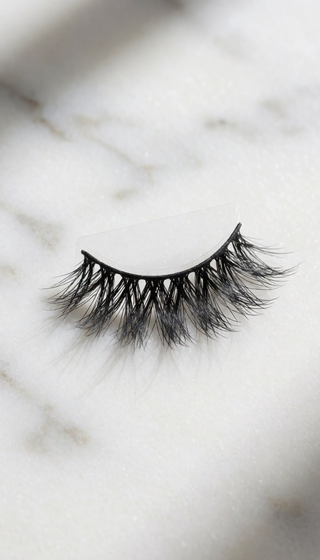
ELONGATE ROUND EYES WITH PRECISION: HOW TO CREATE A NATURAL ALMOND SHAPE
If your eyes are naturally round, the goal isn't to change their shape, but to introduce strategic dimension that creates the illusion of length. By manipulating the structure of the lash line, you can guide the eye outward, transforming a circular appearance into a soft, elongated almond contour without harsh lines. The key lies in creating a structural gradient—a thoughtful variation in length and density across the lash band.

THE SCIENCE OF LASH GRADIENTS: WHY DIMENSION MATTERS
A uniform application of lashes tends to emphasize the natural symmetry of a round eye, which can make the eye appear wider than intended. To achieve elongation, you must break this symmetry through strategic layering. This involves creating a deliberate gradient of lash lengths across the lash line. Instead of a single uniform length, you introduce shorter spikes near the inner corner, transition to mid-length clusters in the center, and finish with the longest, most dramatic flares toward the outer corner. This staggered approach introduces negative space between the lashes, which reflects light and gives the eye a multidimensional, lifted appearance.
MASTER THE LENGTH FORMULA FOR ELONGATION
To effectively elongate the eye, the length distribution must follow a specific formula designed to pull the gaze outward. Here is the recommended structure:
- Inner Corner: Keep lengths between 7-9mm. This maintains a natural, open aperture.
- Mid-Band: Utilize spaced layers ranging from 10-11mm. This creates volume without overwhelming the eye's center.
- Outer Corner: Apply the longest flares, ranging from 12-14mm. This is the key area for visual lengthening.
When designing this gradient, aim for the outer lashes to extend horizontally past the natural lash line by approximately 3mm. Research suggests this subtle extension can visually lengthen the eye by up to 15% while maintaining a natural look.
SOFT VS. STRUCTURED: CHOOSING YOUR TEXTURE
The texture of the lash application dictates the final effect. A Soft Layer mimics the organic, fine growth pattern of natural lashes, using irregular, delicate spikes. This provides a subtle enhancement. Conversely, a Structured Layer utilizes distinct, deliberate clusters of lashes. For those seeking a more pronounced transformation on round eyes, the Structured Layer is often more effective because its architectural contrast stands out against the natural curve of the eye, providing clear definition.
THE BONDING MECHANISM: HOW LASH INTEGRITY IS MAINTAINED
The method used to attach the lashes is critical to preserving the intended layered effect. Traditional lash adhesives create a rigid, solid bond. When this happens, the individual spikes merge into one dense line, negating the dimensional effect you worked to create. A superior bonding system utilizes a micro-adhesion technology that holds each individual fiber independently. This allows the spikes to fan out naturally across the lid, maintaining the separation between layers even under studio lighting or throughout the day. This independent hold is what allows the layered map to remain structurally intact.
Addressing Common Application Concerns
Can I wear layering if my round eyes are also close-set?
Yes, but placement is key. Concentrate the layering and longest lengths on the outer third of the lash band. Avoid heavy density or long lengths in the inner corner to prevent further visual crowding.
How do I apply a layered lash without tangling the spikes?
Always use tweezers to grip the entire band, not the individual fibers. Apply the lashes by pressing them from the center of the eye outward. The design of the fibers allows them to settle into position without adhesive drag.
Is a layered lash heavier than a classic volume lash?
No. A properly engineered layered lash uses lighter, individual knots. The volume-to-weight ratio is designed to be lighter than a standard, dense volume flare, ensuring comfort throughout wear.
What is the best way to clean a layered lash?
Use an oil-free micellar water applied to a flat cotton pad. Gently swipe the band to remove makeup. Standard oils can break down the micro-fibers used in synthetic layered styles.
WHAT TO LOOK FOR IN A HIGH-PERFORMANCE LASH SYSTEM
When seeking a solution that respects the delicate structure of your eye, look beyond the aesthetic alone. The most effective systems prioritize three critical factors: structural integrity (the ability to keep layers distinct), weight distribution (ensuring the lashes do not pull the eye down), and the bonding technology (which must allow for independent fiber placement). A high-quality system must deliver a dimensional look without the compromise of heavy adhesives or unnatural rigidity.
THE PHANSTA LASHES SOLUTION: ENGINEERED FOR DIMENSION
PHANSTA LASHES was developed specifically to address the need for structural enhancement without the compromises of traditional methods. We utilize a proprietary glue-free micro-adhesion technology that allows every single fiber to remain distinct, perfectly preserving the intended gradient of your layered map. Our collection offers 17 distinct styles, each engineered with a volume-to-weight ratio that ensures a lightweight feel, delivering the dimensional lift you desire with every wear. By choosing PHANSTA LASHES, you are choosing a system that respects the artistry of your eye shape.
FREQUENTLY ASKED QUESTIONS
Can I wear layering if my round eyes are also close-set?
Answer: Yes, but placement is key. Concentrate the layering and longest lengths on the outer third of the lash band. Avoid heavy density or long lengths in the inner corner to prevent further visual crowding.
How do I apply a layered lash without tangling the spikes?
Answer: Always use tweezers to grip the entire band, not the individual fibers. Apply the lashes by pressing them from the center of the eye outward. The design of the fibers allows them to settle into position without adhesive drag.
Is a layered lash heavier than a classic volume lash?
Answer: No. A properly engineered layered lash uses lighter, individual knots. The volume-to-weight ratio is designed to be lighter than a standard, dense volume flare, ensuring comfort throughout wear.
What is the best way to clean a layered lash?
Answer: Use an oil-free micellar water applied to a flat cotton pad. Gently swipe the band to remove makeup. Standard oils can break down the micro-fibers used in synthetic layered styles.
How long do PHANSTA LASHES last?
Answer: With proper care, PHANSTA LASHES are designed to provide 30+ wears. Our micro-adhesion technology ensures they remain secure and beautiful for extended periods without the need for harsh glues.
Experience the Difference of PHANSTA LASHES
Quick to apply, gentle on eyes, beautiful all day. Reusable 30+ wears per pair.
SHOP PHANSTA LASHES — GLUE-FREE, 30+ WEARS →