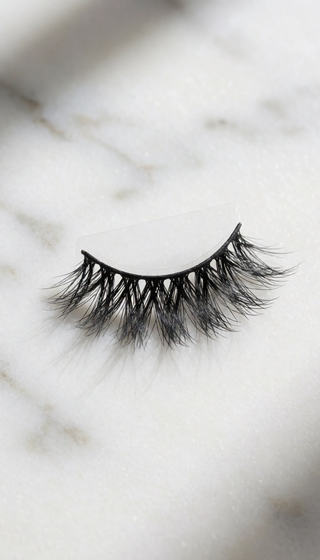
HOW COLD WEATHER AFFECTS YOUR FALSE LASHES

It's 7 AM, 18 degrees outside, and you're already running late. You applied your lashes quickly, headed out the door, and by the time you reached the subway platform, the inner corner of your lash was lifting — again. If you've lived this weekday nightmare, you're not alone. Cold weather has a very real effect on lash adhesive, and it's not in your head.
WHAT HAPPENS TO LASH GLUE AT 18 DEGREES?
Lash glue relies on cyanoacrylate — a polymer that sets as it reacts with moisture in the air. Cold air changes the deal:
- Molecules slow down. The bonding reaction happens slower, giving you a longer dry time but a weaker initial grip.
- The bond becomes brittle. Cold makes the polymer chain rigid. Instead of flexing with your lash line, it cracks.
- Moisture is a wildcard. Snow, rain, fog, and condensation all disrupt the bond before it fully sets.
In short: your glue isn't necessarily bad. It's just not designed for freezing wind.
4 SIGNS YOUR LASHES ARE SUFFERING FROM COLD
- Lifting at the corners within 2 hours of application — a classic cold-weather symptom.
- Adhesive cracking or flaking — you'll see tiny white or dried particles on your cheek.
- The lash band feels stiff — flex it between your fingers. If it snaps, cold has embrittled it.
- They never make it to lunch — instead of 10–12 hours, you're getting 3–4.
YOUR WINTER LASH SURVIVAL PLAN (5 STEPS)
- Warm the glue first. Keep the tube in your pocket or bra for 5 minutes before applying. Room-temperature glue performs dramatically better.
- Apply indoors, away from windows and drafts. A cold gust during application can prevent proper bonding.
- Wait longer for tackiness. Give the glue 30–40 seconds in a cold room, instead of 15–20.
- Press and hold for 10 seconds. Your finger's warmth helps the adhesive set.
- Use a setting spray. A quick spritz seals the band and adds a layer of protection against moisture.
LASH GLUE IN COLD WEATHER: A PRACTICAL COMPARISON
| Factor | Room Temp (70°F) | Cold Outdoors (32°F) |
|---|---|---|
| Dry time | 10–15 seconds | 20–30+ seconds |
| Flexibility | Flexible and comfortable | Brittle, prone to cracking |
| Wear time | 8–12 hours | 4–6 hours |
| Adhesion strength | Strong | Weak, especially at corners |
FAQ: COLD WEATHER AND FALSE LASHES
Why do my false lashes keep falling off in winter?
Cold air makes cyanoacrylate glue more brittle. The bond becomes rigid, and any blinking or movement stresses the connection until it cracks. Warming the glue and pressing longer helps significantly.
Can I use a blow dryer to warm my lash glue?
No — heat can break down the adhesive and shorten its shelf life. Your body heat from a pocket or a pocket warmer is safest.
Is there a lash glue that works in cold weather?
Look for a flexible, moisture-resistant formula that contains acrylic polymers and doesn't rely on a watery solvent base. These perform better in temperature extremes.
Does indoor heating hurt lash adhesive?
Dry indoor heat can make the adhesive brittle over time. If you wear lashes indoors, adding a little humidity to the room (a humidifier) helps.
After researching the chemistry of cold-weather lash application, you've probably realized: the quality of your adhesive matters far more than your application technique.
PHANSTA LASHES engineered their lash adhesive for real-life weather — not just a temperature-controlled beauty room. Their formula stays flexible in the cold, resists moisture, and holds for up to 12 hours even when winter tries its worst.
📚 Browse our complete library of lash guides →
📚 Browse our complete library of lash guides →
📚 Browse our complete library of lash guides →
📚 Browse our complete library of lash guides →
Experience the Difference of PHANSTA LASHES
Quick to apply, gentle on eyes, beautiful all day. Reusable 30+ wears per pair.
SHOP PHANSTA LASHES — GLUE-FREE, 30+ WEARS →