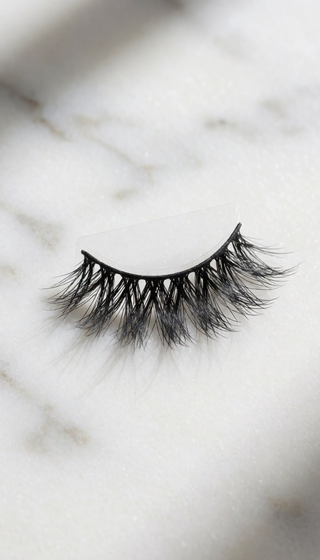
HOW TO PICK VOLUME LASHES FOR MONOLID EYES: STRUCTURE AND LIFT
Create Instant Structure and Lift for Monolid Eyes Without Visible Crease
Achieving a lifted, defined look with monolid eyes relies on manipulating the lash architecture to simulate the appearance of a natural crease and lift. Understanding how curl, density, and band fit interact is key to transforming the lash line from flat to dimensional.

The Science of Lash Curl as Structural Support
When the natural eyelid crease is minimal or absent, the lash itself must provide the illusion of depth and lift. The curl profile of the lash is the primary tool for this structural enhancement. An L-curl, characterized by a 90-degree base angle, is highly effective as it immediately pulls the lash line upward, mimicking the lift provided by a crease. Similarly, a D-curl achieves this upward projection. Conversely, lashes with a C-curl or B-curl tend to direct the lash line downward or parallel to the lid, which can result in the lashes appearing to sit flat against the lid, negating the desired lifting effect.
Mastering Density Mapping for Full Dimension
To prevent the eye from appearing flat, the distribution of volume must be intentional and consistent. It is not enough to simply add volume; the volume must be mapped across the entire lash line. A key principle is ensuring that the volume remains consistent from the inner corner to the outer corner. A noticeable dip or lack of volume at the inner corner can create a visual gap, interrupting the perceived structure of the eye. For optimal body without adding undue weight, using dense 3D to 5D fans constructed with 0.07 mm fibers provides the necessary density while maintaining a natural look.
The Critical Role of Band Contour in Fit
A common pitfall when applying lashes to monolids is the misalignment caused by straight bands. Because the natural contour of the eye is not perfectly straight, a standard straight band often lifts or gaps at the inner and outer corners. To achieve a seamless, structural application, the band must be flexible and moldable. The correct application technique involves gently warming the band to activate its thermoplastic properties, pressing the center firmly against the lash line, and then working outward to ensure the entire band conforms precisely to the natural curve of the eye.
Understanding Lash Construction for Longevity
The longevity and structural integrity of any lash set depend heavily on how it is constructed. Lashes that rely on harsh adhesives can become flattened by the chemical interaction of the glue, causing the volume fans to lose their vertical lift. A superior construction utilizes a flexible micro-band that allows the fibers to maintain their intended shape, standing vertically from root to tip, which is essential for creating the illusion of depth on a monolid. This structural integrity ensures the lashes maintain their intended lift throughout the wear period.
What to Look For in a Lash Solution for Monolids
When selecting a lash solution, the primary criteria must be curl profile (L or D), density distribution (consistent across the band), and band flexibility. Avoid rigid bands that do not conform to the eye's natural shape. The ideal product will offer a construction that supports vertical lift without relying on heavy, flattening adhesives, allowing the lash fans to stand proud of the eyelid for maximum visual impact.
these lashes: Engineered for Monolid Structure
these lashes addresses the unique structural needs of the monolid eye through specialized volume construction. Our volume styles are built upon a flat, flexible micro-band designed to conform perfectly to the eyelid structure. By utilizing advanced, glue-free micro-adhesion technology, the volume fans are allowed to maintain their full, vertical shape from root to tip, ensuring the maximum lift and density required to create a defined, structured look without the flattening effects of traditional adhesives.
Frequently Asked Questions
Should I choose a longer lash for monolid eyes?
Yes. For effective structural lift on a monolid, lengths between 10 mm and 14 mm are recommended. The increased length, combined with a high-curve profile, helps compensate for the lack of natural lift at the lash line, providing a more dramatic and defined appearance.
How do I prevent the volume lash from looking flat on a monolid?
The most critical step is ensuring the band is pushed fully and evenly against the natural lash line. Any gap between the band and the eyelid allows the volume fans to settle forward, which immediately causes the lashes to appear flat and lose their intended structural lift.
Are PHANSTA LASHES easy to apply on monolids without adhesive?
Yes, the application process is streamlined. The thermoplastic band is designed to heat and mold precisely to the eye's contour, creating a secure bond without the need for messy liquid glue. This method allows for a faster, more precise application that maintains the lash's integrity.
What is the ideal fiber diameter for volume on a monolid?
For achieving dense volume without excessive weight, fibers in the 0.07 mm range are ideal. This thickness provides the necessary body and fullness while ensuring the lashes remain lightweight enough to maintain their lift throughout the wear period comfortably.
How long should I expect the lift to last with these lashes?
PHANSTA LASHES are designed for exceptional wear, offering 30+ wears per set. Because they utilize a micro-adhesion system rather than traditional glue, they maintain their structural integrity and lift for an extended period, keeping your look defined day after day.
📚 Browse our complete library of lash guides →
FIND THE PERFECT LASH FOR EVERY MOMENT
Explore our occasion-specific lash guides:
No adhesive, no damage. Just beautiful lashes.
SHOP PHANSTA LASHES — GLUE-FREE, 30+ WEARS →STILL COMPARING OPTIONS? Explore our guides on finding your perfect lash, magnetic vs strip, and sensitive eyes.
FIND THE PERFECT LASH — Not sure which style suits you? Take the 30-second lash finder finder →