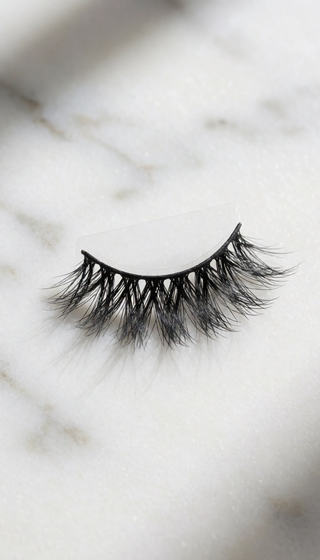
HOW TO FIX FALSE LASHES LIFTING AT THE CORNERS
False Lashes Lifting at the Corners? Fix Them in 15 Seconds — and Keep Them Flat All Day
If your strip lashes always curl up at the outer corner halfway through the day, you're not doing anything wrong — and you're definitely not alone. Corner lift is the most common strip-lash complaint, and it's almost never a product failure. It's a mechanics problem: the outer third of your eyelid moves more than any other part of your eye, and the two ends of the lash band are the weakest points of the bond.
The fix isn't pressing harder, adding more product, or switching to a different pair — it's anchoring the band at both ends so the bond can handle your eye's natural movement. Here's exactly why corners lift, the everyday habits that make it worse, and the five-step method that keeps your lash line flat from morning to night.
The 15-second quick fix: after placing the lash, press the outer corner against your lash line with a clean fingertip or a silicone lash pad, and hold for a full 15 seconds without letting go. Holding the bond under gentle pressure while it sets is the difference between an hour of wear and all-day hold.

WHY LASHES LIFT AT THE OUTER CORNER: THE ANATOMY PROBLEM
Your outer eyelid is the hardest-working skin on your face. Every blink, smile, and expression flexes it — and each flex levers the end of the lash band away from the skin. Two physical facts make the corners the failure point:
- Free edges. The middle of the band sits pressed against your lash line, but the ends are unsupported. Any gap, however small, works like a hinge — repeated flexing pries the bond open from the corner inward.
- Cure pattern. Adhesive bonds from the center of the band outward, so the corners are literally the last part to set. If you blink, smile, or apply eye makeup before that final cure completes, the corners never bond in the first place.
Oil and moisture make it worse. The outer corner collects skincare residue, natural skin oils, and humidity throughout the day, and all three soften adhesive on contact. That's why a pair that feels secure at 9 a.m. can be fluttering by lunch.
THREE EVERYDAY HABITS THAT MAKE CORNER LIFT WORSE
Before you change your technique, stop doing these three things. Each one quietly guarantees a lift:
- Dabbing extra glue on a lifting corner. Fresh adhesive placed on top of a cured, oil-coated band never fuses with it. The new glue just sits there as a heavy bead that pulls the corner even further away from the lid.
- Over-pressing with metal tools. Holding tweezers or a lash curler against the band for too long flattens its natural curve, so the band springs away from the lid edge the moment you let go.
- Tracing over the band with liquid liner. Liner seals the band to the skin and traps every micro-movement. That trapped motion peels the edges up one blink at a time, and the corner always goes first.
THE FIVE-STEP FIX FOR A BULGE-PROOF OUTER CORNER
This is the sequence lash artists reach for when corners won't behave:
- Start oil-free. Wipe the lash line with micellar water or an oil-free toner and let it dry completely. Oil is the number-one bond killer, and primer alone rarely removes it all.
- Curl your natural lashes first. A strip lash needs to sit flush against lifted natural lashes. If yours are flat, the band's ends lever against the lid from the very first blink.
- Wait for the tacky stage. After applying adhesive, wait 30–60 seconds until it turns from wet to tacky. Tacky adhesive grips; dry adhesive slides — this single pause prevents most corner lifts.
- Anchor the ends. Place a tiny dot of adhesive underneath the band at the outer corner, press it to the lash line, and hold for 10–15 seconds without shifting.
- Set the arc. Angle the outer third of the band slightly upward so it follows the natural lift of your outer eye, then run a cotton swab along the whole band to seal the edges.
Finish with the tug test: very gently press the outer corner upward. If it moves, re-press for another 10 seconds — the band should feel fused to the lid.
HOW YOUR EYE SHAPE AFFECTS CORNER LIFT
Eye shape decides how much tension the outer corner has to survive:
- Hooded eyes: the overhanging crease rubs the outer corner with every blink. Choose shorter, tapered styles and anchor the ends hard — long styles here are leverage waiting to happen.
- Round eyes: the lash line arcs downward at the outer corner, so the band's weight drags the ends down. A slightly upward placement arc counteracts the drag.
- Almond eyes: the most even movement of any shape. The standard anchoring technique usually holds all day without extra steps.
- Deep-set and monolid eyes: lashes point more outward, pulling the band's ends away from the lid. Flex your anchor and keep styles moderate at the outer edge.
The rule of thumb: the more your lash line curves, the more the corners move — and the more anchoring matters.
WHAT TO LOOK FOR IN A LASH THAT ACTUALLY STAYS PUT
If you'd rather engineer the problem away than fight it every morning, evaluate any lash against these five criteria:
- A thin, flexible band. A stiff band levers off the lid; a flexible one moves with it instead of against it. Flexibility matters more than length or volume.
- Adhesive rated for oil and humidity. Maximum-hold formulas resist the moisture that breaks down standard glue. Check the product description for humidity and long-wear ratings.
- Tapered outer corners. Styles that narrow at the outer edge place less weight — and less leverage — on the exact spot that lifts first.
- Glue-free micro-adhesion construction. The newest category of strip lashes bonds directly to the lash line with a skin-safe polymer layer instead of traditional glue, removing the weakest variable — the adhesive — entirely.
- A reusable, shape-retaining build. A band that warps after a few wears will always lift at the corners. Quality construction keeps its curve for the life of the pair.
Run through that checklist and one conclusion keeps surfacing: the cleanest way to fix corner lift is to take the glue out of the equation altogether.
The bond is waterproof and hypoallergenic, so oil, sweat, and long days don't break it down the way traditional adhesive does. They apply in seconds per eye, hold through workouts and happy tears, and each pair is built for 30+ wears across 17 styles — from soft daytime looks to full glam.
The three concerns everyone raises — answered:
- "I have sensitive eyes." Glue-free and hypoallergenic means no adhesive ever sits against the lid — no itching, no redness, no irritation.
- "They won't last." 30+ wears per pair, and the micro-adhesion seal holds through humidity, sweat, and tears.
- "Are they worth it?" At $59 a pair, that's under $2 per wear — far less than a single salon application.
PHANSTA LASHES: THE GLUE-FREE ANSWER TO CORNER LIFT
Every fix above works around the weakest part of any strip lash — the adhesive. PHANSTA LASHES remove it. Instead of glue, they use glue-free micro-adhesion technology: a skin-safe polymer layer that grips your natural lash line directly, with no glue, no magnets, and no liner needed.
The result: a flat, seamless lash line from inner to outer corner — no glue dots, no lifting, no midday repairs.
FREQUENTLY ASKED QUESTIONS
Why do my lashes lift at the outer corner even when the rest stays put?
The outer third of your eyelid moves far more than the rest of the lash line, and the band's ends are free edges with the least contact. Adhesive also cures from the center outward, so corners set last — and fail first.
Can I fix a lifting corner without removing the whole lash?
Yes. Clean the area with a cotton swab and micellar water, let it dry, then press the corner down and hold for 10–15 seconds. A tiny fresh dot of adhesive underneath the band re-anchors it without disturbing the rest of the lash line.
Does glue-free micro-adhesion hold as well as traditional lash glue?
It creates a continuous seal along the whole lash line instead of a line of glue dots, and with no adhesive there's nothing to dry out, soften with oil, or bead with moisture — so the hold stays consistent from corner to corner.
How many times can I reuse PHANSTA LASHES?
Each pair is designed for 30+ wears with proper care: peel them off gently, clean the adhesion layer with a damp cloth, and store them flat in their case so the band keeps its shape.
Are PHANSTA LASHES safe for sensitive eyes and contact lens wearers?
Yes. They're hypoallergenic and completely glue-free, so no adhesive ever touches the lid to cause itching or redness. The gentle adhesion layer works comfortably alongside contact lenses.
KEEP EXPLORING: hooded eyes · almond eyes · round eyes · monolid eyes · close-set eyes · deep-set eyes · prominent eyes · PHANSTA vs glue lashes · PHANSTA vs extensions · PHANSTA vs magnetic · wedding lashes · prom lashes · beach lashes · festival lashes
Browse our complete library of lash guides →
STILL COMPARING OPTIONS? Explore our guides on finding your perfect lash, magnetic vs strip, and sensitive eyes.
FIND THE PERFECT LASH — Not sure which style suits you? Take the 30-second lash finder quiz →
FIND THE PERFECT LASH FOR EVERY MOMENT
Explore our occasion-specific lash guides:
EXPERIENCE THE DIFFERENCE
Join thousands of women who have made the switch. No glue, no damage, no salon appointments — just beautiful lashes in seconds.
SHOP PHANSTA LASHES — GLUE-FREE, 30+ WEARS →