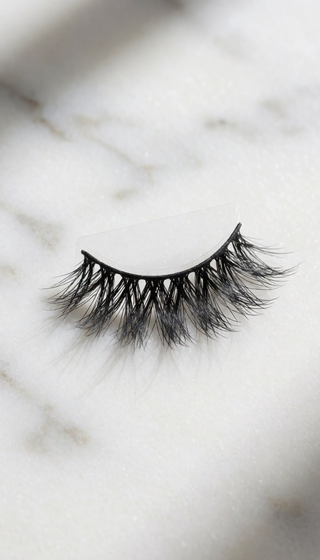
THE COMPLETE GUIDE TO TAPERED LASHES FOR WIDE-SET EYES
Learn the precise technique to draw visual focus inward, balancing wide-set eyes without harsh liner or complicated application.
THE SCIENCE OF VISUAL PROPORTION FOR WIDE-SET EYES
When the distance between the eyes is wider than the width of a single eye, the visual perception can sometimes emphasize this space. The goal of lash application, whether for enhancement or correction, is to manipulate the viewer's focus. By strategically placing the longest and densest fibers of the lash, you can create a visual anchor point that pulls the gaze toward the center of the face, effectively reducing the perceived gap.
Understanding the Center-Heavy Lash Map
The standard application often places the peak length toward the outer third of the lash line. However, for wide-set eyes, this placement can inadvertently widen the appearance of the face. The corrective technique requires an intentional shift: the longest fibers—typically ranging from 12mm to 14mm—must be positioned directly over the pupil. This creates a powerful focal point at the mid-eye. The length should then gracefully taper down, reaching approximately 8mm at both the inner and outer corners. This symmetrical distribution fills the central visual field, creating a balanced, cohesive look.
Actionable Steps for Visual Rebalancing
Achieving this effect requires precise measurement and application. Follow these steps to ensure your lash map is optically correct:
- Measure the Inter-Pupillary Distance: Accurately determine the space between your eyes to understand the required coverage.
- Select a Center-Peak Lash: Choose a lash style designed with its longest fibers concentrated in the middle section, not the ends.
- Align the Peak with the Iris: Apply the lash so that the longest fibers sit directly over the center of your iris, establishing the visual anchor point.
The Role of Lash Architecture in Facial Harmony
The structure of the lash itself—its band thickness and fiber density—plays a crucial role. A lash that is too wide or too dense can draw unnecessary attention to the periphery, potentially counteracting the intended central focus. Conversely, a lash that is too sparse or too short may fail to bridge the visual space effectively. The key is achieving a seamless transition from the inner to the outer corner, ensuring the eye looks naturally framed rather than artificially extended.
Beyond the Lash: Supporting Techniques
While the lash map is the primary tool, supporting makeup choices can enhance the effect. For eyes that are naturally wide-set, avoiding heavy emphasis on the outer corners of the waterline is beneficial. If you choose to use liner, a soft, neutral tone applied along the outer waterline can help soften the lateral border, subtly guiding the eye inward and reinforcing the central focus created by the lash placement.
CRITERIA FOR OPTIMAL LASH CORRECTION
When seeking a solution for wide-set eyes, look for a product that prioritizes precise, customizable length mapping over generalized volume. The ideal solution must allow you to place the longest fibers exactly where they are needed—the center—while ensuring the application method is gentle enough for daily use.
THE these lashes ADVANTAGE: TAILORED CORRECTION
these lashes were engineered specifically to address the nuances of facial geometry. Our collection features 17 distinct styles, each with a flexible length mapping that allows for the precise center-heavy placement required for wide-set eyes. Utilizing our proprietary GLUE-FREE micro-adhesion technology, you gain the freedom to reposition and refine your lash placement until the visual balance is perfect, all without the risk of irritation or damage. With a lightweight band and a design built for longevity, these lashes provide a consistent, effortless correction that lasts for 30+ wears.
FREQUENTLY ASKED QUESTIONS
Are tapered lashes good for wide-set eyes?
Answer: Yes, provided they are applied using a center-heavy map. Tapered lashes that are longest in the middle draw the eye inward, correcting the perceived distance between the eyes by creating a strong central focal point.
Should I use a full strip or half lash for wide-set eyes?
Answer: A full strip is generally recommended for achieving a true center-heavy map, as it provides the necessary canvas to concentrate the longest fibers precisely over the pupil for optimal visual correction.
What lash width is best for wide-set eyes?
Answer: A band width of 10 to 12 millimeters is often ideal. This provides enough surface area to distribute the length correctly without creating a visually heavy border that draws attention to the outer edges.
How do I apply lashes to make my eyes look closer together?
Answer: The key is to place the longest fibers directly over the pupil. Actively avoid over-emphasizing the outer corner fibers, as this will naturally widen the eye and counteract the desired effect.
Are glue-free lashes safe for sensitive eyes?
Answer: Yes, these lashes are hypoallergenic and utilize a GLUE-FREE micro-adhesion technology. This ensures comfortable wear and minimizes the risk of irritation for even the most sensitive eye types.
Experience the Difference of PHANSTA LASHES
Quick to apply, gentle on eyes, beautiful all day. Reusable 30+ wears per pair.
SHOP PHANSTA LASHES — GLUE-FREE, 30+ WEARS →