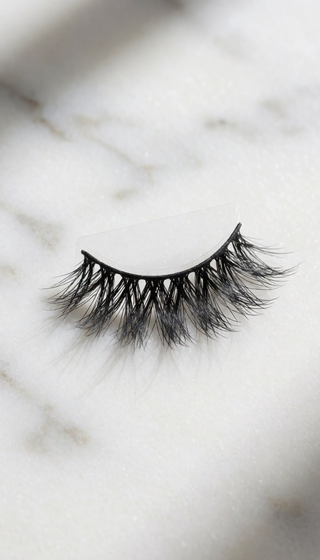
WHAT NOBODY TELLS YOU ABOUT LASH CLUSTERS AT HOME
GET LASH CLUSTERS THAT HOLD — WHAT NOBODY TELLS YOU ABOUT DOING THEM AT HOME
A practical guide to cleaner preparation, steadier placement, gentler removal, and fewer pillow-pile surprises.
DIY lash clusters rarely fail for one mysterious reason. They lift when natural oils, skin residue, moisture, or a crowded base interrupt contact; they shift when fans are placed too close together; and they deform when removal tugs the base. The practical answer is to treat clusters as a system: prepare the natural lashes, match placement to the available spacing, and remove each fan without force.
If a traditional glued cluster begins to feel slippery, gently cleanse the lash line with an oil-free micellar product or suitable cleanser, let it dry fully, and use only the adhesive amount specified. Natural lashes produce sebum, and that oil can interfere with a conventional bond. Harsh stripping is not the answer; it can leave the lashes and surrounding skin less comfortable.
Product format matters too. Adhesive strips, glue-based clusters, liners, and magnetic lashes are separate systems with different preparation and removal rules; one method should not be transferred to another. Match the band, weight, and curl to your natural lashes, then use a light, steady hand. Cleaner preparation and precise placement make retention more predictable.
WHY LASH CLUSTERS LOSE THEIR HOLD BEFORE THEIR POTENTIAL
Natural lashes are not laboratory surfaces. Sebum, skin-conditioning residue, moisture, and daily rubbing can interrupt contact between an adhesive and the lash line. Sweat and humidity may soften a conventional bond, while rubbing during sleep or face cleansing adds mechanical stress. The same cluster can therefore perform differently on two people, or on the same person on different days.
That variation is normal; it does not automatically mean a cluster set is poor quality. Separate four causes: the natural lashes were not clean and dry, too many fans competed for limited spacing, too much adhesive was used, or removal damaged the base. Check those variables before changing the style. A dense, heavy set placed at an incorrect spacing will not become secure simply by pressing harder.
PREP AND PLACE CLUSTERS FOR AN EVEN, SECURE WEAR
Use this sequence to reduce common placement errors:
- Clean the lash line. Close your eye and use an oil-free micellar product or a lash-line cleanser suited to your skin. Avoid oily conditioners and makeup residue near the roots; do not scrub or repeatedly strip the lashes.
- Let it dry completely. A wet or damp interface can dilute conventional adhesive and leave an uneven bond. Use clean hands and make sure the natural lashes are dry before mapping placement.
- Map the spacing first. Follow the natural lashes from the outer corner inward, leaving room between fans. Crowding creates pressure and overlap, while placing several tiny fans on one natural lash makes removal less predictable.
- Use less pressure and less adhesive. For a traditional glue system, place the cluster and rock and roll it gently so the base makes broad, 360-degree contact with the natural lash instead of bonding at one central point. Excess adhesive can slow curing and leave a tacky residue. For a glue-free system, follow its directions and do not add glue.
Wait or set the bond only as the product instructions require. Then check from the side and below: the fan should sit comfortably in line with neighboring lashes, with its weight distributed rather than hanging from one point.
REMOVE, CLEAN, AND STORE CLUSTERS WITHOUT DAMAGE
Release the bond before it becomes a tug. Work slowly, support the fan with your fingers, and never pull a cluster straight from the natural lash or twist the band. When a remover is compatible with the system, use the recommended formula gently; silicone-based removers are common, but oils and residue can interfere with some bonds.
Clean the band without crushing the fibers, let it dry fully on a flat surface, and store it where it will not be bent. A wear claim describes the total reuses possible with correct handling; it does not promise that every fan will stay attached for the same number of days. Preparation, natural oil production, humidity, rubbing, cleansing, and sleep all affect an individual application.
If you use a traditional setting spray or sealer, check compatibility first. A thin, compatible layer may add moisture resistance, but an unapproved product can soften the bond. Compare long-term value by dividing total cost by documented wears, then factor in comfort and application time rather than relying on one dramatic claim.
THREE MYTHS THAT MAKE DIY CLUSTERS FAIL
HOW LONG SHOULD LASH CLUSTERS ACTUALLY LAST?
A cluster set may offer many total wears while behaving differently from one day to the next. Check the product’s documented wear guidance; do not assume every set provides 30+ wears or that every wear lasts the same length of time. Preparation, natural oils, humidity, and friction explain most day-to-day variation.
CAN I REUSE THE SAME CLUSTER FANS?
Yes, if the band and fibers remain intact and you remove them gently. Reuse is limited by cleanliness, storage, makeup buildup, and physical damage, not only by the original material. Follow the maker’s cleaning and storage directions, and stop using a fan whose base has torn or lost its shape.
WHY DO MY CLUSTERS FEEL STICKY HOURS LATER?
For traditional glued clusters, stickiness often means too much adhesive was applied. Excess bond can cure slowly and remain tacky. Use the smallest effective amount and spread it evenly according to the instructions; adding more later usually masks the application error rather than correcting it. Glue-free systems need a completely different method.
MATCH THE CLUSTER SHAPE TO YOUR EYE SHAPE
Eye shape is a starting point, not a rule. Wispy, mixed-length styles can flatter almond and upturned eyes; added outer lift may suit hooded or downturned eyes; elongated definition can balance a round shape; monolid eyes often benefit from testing comfortable lengths and flexible-looking fans. Compare the silhouette in daylight before committing to a style.
For more specific comparisons, use the eye-shape and wispy guides:
Broader shape-specific reading is also available for:
Treat these as visual guides rather than fixed rules. Natural lash direction, density, eyelid position, and the effect you want all influence which silhouette looks balanced.
WHAT TO LOOK FOR IN A RELIABLE CLUSTER SOLUTION
After preparation and technique, the remaining decision is the lash system itself. Use four checks:
Adhesion mechanism: Identify whether the system uses glue, a liner, or a separate magnetic closure, and follow only its matching preparation method. Each format has different bulk, placement, and removal demands. A cleaner experience comes from a mechanism that suits your comfort tolerance and routine, not from stacking several products together.
Total wear potential: Look for a clear number of wears, care conditions, and a replacement policy. Treat total reuses separately from hours per application so a long lifespan is not confused with an indefinite bond.
Application practicality: Favor clear steps and few tools. A method you can repeat in a few calm minutes is usually more consistent than one that requires adhesive curing, extra sealer, or complicated alignment.
Skin safety profile: Hypoallergenic and waterproof materials can be useful criteria, but neither label means zero risk. Contact-lens wearers should follow their eye-care professional’s guidance, avoid rubbing the eye area, and stop if irritation develops.
The right solution is therefore not simply the strongest bond. It is a compatible mechanism, documented durability, skin-friendly materials, and a routine you can follow consistently.
The routine is designed for quick placement, and the waterproof, hypoallergenic construction supports wear through humidity and the movement of daily life. Careful removal and storage help preserve each fan for the stated reuse window.
INTRODUCING PHANSTA LASHES: A GLUE-FREE PATH TO MORE RELIABLE WEAR
The checklist leads to a system that removes several common variables at once. PHANSTA LASHES offers 17 styles built around glue-free micro-adhesion technology. Each cluster attaches directly to a clean, dry lash line, so there is no separate glue, magnet, or liner and no need to judge an adhesive curing window.
A SHORT APPLICATION ROUTINE
- Clean the natural lashes and allow the lash line to dry fully before application.
- Place each cluster directly against a clean, dry natural lash, following the product directions without adding glue or sealer.
- Remove gently without pulling, then clean, reshape, and store the cluster as directed.
THREE CONCERNS WORTH CHECKING FIRST
- Glue or irritation: PHANSTA LASHES use no adhesive, magnets, or liner. The materials are hypoallergenic and waterproof, which is relevant when you prefer a minimal routine around the eye.
- Durability: The sets are made for 30+ wears when handled as directed. Waterproof construction supports wear around humidity, while day-to-day security still depends on clean preparation and gentle care.
- Value: PHANSTA LASHES are priced at $59, with 17 styles available. The documented 30+ wears works out to under $2 per wear.
FREQUENTLY ASKED QUESTIONS
DO PHANSTA LASHES USE GLUE, MAGNETS, OR A LINER?
No. PHANSTA LASHES use glue-free micro-adhesion technology. The clusters attach directly to a clean, dry lash line without adhesive, magnets, or a liner. Follow the preparation and placement directions rather than adding adhesive or sealer, because extra products can change the intended bond and wear pattern.
HOW MANY WEARS DOES ONE PHANSTA LASHES SET PROVIDE?
A PHANSTA LASHES set is designed for 30+ wears when handled and stored as directed. That figure refers to total reuses, not 30+ days from one application. Natural oil production, humidity, rubbing, cleansing, and application technique can still change how secure a cluster feels during any given wear.
ARE PHANSTA LASHES SUITABLE FOR SENSITIVE EYES OR CONTACT-LENS WEARERS?
The materials are hypoallergenic and waterproof, but no cosmetic product should be treated as risk-free. Wash and dry your hands, remove contact lenses before application if that is your usual safety practice, and avoid rubbing the eye area. Stop using the product if irritation occurs and seek professional advice for persistent symptoms.
CAN I REUSE AND CLEAN PHANSTA LASHES AFTER EACH WEAR?
Yes. Gently release each cluster from the natural lash without pulling or twisting, then clean and dry it according to the product directions before storage. Keeping the band and fan in their shape helps support the documented 30+ wears. Do not use a remover or sealer unless the instructions specifically permit it.
WHAT DO THE 17 PHANSTA LASHES STYLES COST PER WEAR?
PHANSTA LASHES are priced at $59 and are designed for 30+ wears, which works out to under $2 per wear. There are 17 styles to compare, including different lengths and silhouettes. Cost per wear is useful, but fit, eye shape, comfort, and the product’s stated wear guidance should guide your choice.
STILL COMPARING OPTIONS? Explore our guides on finding your perfect lash, magnetic vs strip, and sensitive eyes.
FIND THE PERFECT LASH — Not sure which style suits you? Take the 30-second lash finder finder →