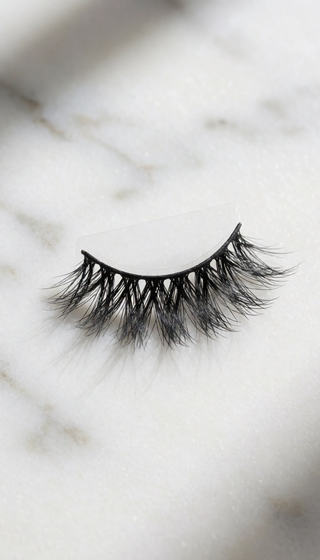
THIN BAND VS THICK BAND LASHES: STABILITY SHOWDOWN

Thin band or thick band — which one actually stays on?
I get this question constantly. And after testing both on every eye shape I could find, the answer is not what you'd expect. Let's sort out the stability question without guesswork.
THE REAL QUESTION: DOES IT MATCH YOUR EYE SHAPE?
The band's width matters less than its flexibility. A thick band that matches your eye curve is very stable. A thin band that doesn't follow the curve will pop off. The band's entire job is to stay flush against your skin from inner corner to outer corner. Any gap is a weak point.
That said, some eye shapes clearly prefer one band type:
- Thin band on round and almond eyes. These shapes have more curvature. A thinner band bends around them without pushing back.
- Thick band on hooded and deep-set eyes. These shapes have more skin support. A thicker band sits flush and feels extra secure.
THIN BANDS (0.3-0.5 MM): THE SNEAKY STABILITY
Thin bands feel like nothing. They hug the natural contour of your eye, so they don't push against your lash line. They're especially consistent on rounder eyes because they bend around the curve evenly.
They're also the best choice for people who squeeze their eyes shut — think naps, sunglasses, or allergy season. The only downside? They take a little more care when handling. If you're rough, they can stretch at the corners.
THICK BANDS (0.7-1.0 MM): WHEN THEY WORK AND WHEN THEY DON'T
Thick bands have a reputation for being “more stable,” but that only happens when they match the shape of your eye socket. On hooded eyes, where the brow bone gives more support, a thicker band can sit flush and feel very sturdy.
On round or protruding eyes, the thick band creates a visible gap between the band and your skin. That gap is where moisture gets in. After about four hours, you'll notice the gap causing a lift at the corners.
HOW TO CHOOSE IN 30 SECONDS
- Know your eye shape: Round or almond → thin band. Hooded or deep-set → thick band works.
- Know your plan: Short events (2 to 4 hours) → thick band is fine. Full day (8+ hours) → thin band is safer.
- Know your limits: If you touch your eyes a lot or wear glasses, a thin band is less noticeable all day.
THIN VS THICK BAND FAQ
Do thin bands work for dramatic looks?
Absolutely. The band has nothing to do with the density. You can get a dramatic fan effect with a thin band that still stays light. If you want a softer, rounded outcome, our doll eye lash tutorial pairs perfectly with thin bands.
Which band is easier for beginners?
Thick bands are easier to handle, but thin bands are easier to wear. For a beginner, I'd suggest practicing with a thin band that's shaped to your eye — it forgives mistakes better.
WHAT TO LOOK FOR IN A LASH BAND
From all my testing, the perfect band comes down to four things:
- Flexible enough to follow your eye curve.
- Not too visible — the band disappears against your lash line.
- No lifting at the corners after 4+ hours.
- Comfortable enough to forget you're wearing it.
If you find those four things, the band width becomes irrelevant. Your eyes will feel the difference immediately.
You know that moment when you forget you're wearing lashes?
That's the outcome worth buying. PHANSTA LASHES engineered their bands to disappear — flexible, eye-shaped, and stable enough to survive a full workday plus the commute. If you want lashes that feel like they're part of you, this is the pair.
📚 Browse our complete library of lash guides →
📚 Browse our complete library of lash guides →
📚 Browse our complete library of lash guides →
Experience the Difference of PHANSTA LASHES
Quick to apply, gentle on eyes, beautiful all day. Reusable 30+ wears per pair.
SHOP PHANSTA LASHES — GLUE-FREE, 30+ WEARS →