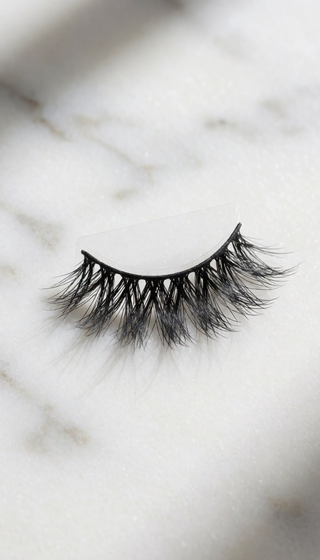
HOW TO STOP LASHES CURLING UP AT ENDS (WITHOUT STARTING OVER)
The short answer
NOT SURE ABOUT YOUR EYE SHAPE?
Take our 60-second quiz to find your perfect lash match — no glue, no commitment.
TAKE THE QUIZ →Trim the band to fit your eye shape by trimming the outer edge by 3–5mm. Then wait 60 full seconds after applying adhesive before pressing the lash on. Nail those two steps and most curling ends are gone before you even leave the house.
Your lashes looked perfect when you left the house. An hour later, you catch your reflection and the outer corners are pointing up like a cartoon villain's mustache. It's one of the most frustrating lash problems — and it's far more common than you think. The good news: in most cases you can fix a lifted corner in under a minute, and prevent it entirely on your next application. Here's exactly why it happens and what to do about it.

WHY YOUR LASHES CURL UP IN THE FIRST PLACE
There are four culprits behind lash curling, and chances are you're dealing with more than one at a time:
- Natural oils from your eyelids. This is the #1 reason. Your eye area produces natural moisture all day, and it slowly seeps into the lash band until the edges lose grip and curl upward.
- Humidity and sweat. Water and moisture break down the hold — especially at the outer corners, where your lashes already angle upward and constantly pull against the band.
- Your eye shape. If you have almond or slightly upturned eyes, the outer corner naturally puts more tension on the band than the inner corner, so it's always the first to lift.
- Application technique. Pressing the lash straight on instead of following your eye's curve stores tension in the band — and that stored tension releases by popping the ends up.
Once you know your cause, the fix is straightforward. Here's the exact sequence that addresses all four.

5 FIXES FOR LASHES THAT CURL UP
- Start with a completely clean, oil-free lash line. Swipe your eyelids with a water-based cleanser or micellar water, then let them dry fully before applying. Even a tiny bit of leftover skincare oil can cause the band to curl within 30 minutes.
- Wait 60 full seconds after applying adhesive before pressing the lash on. Most people rush this step. When the adhesive is still gooey it never bonds at the edges — but after a full minute it turns tacky, and that tack is what grips the corners and holds them down all day.
- Press along the curve of your eye, not just the middle. After placing the band, use a fingertip to gently massage the outer and inner corners down for 10 seconds. This molds the band to your eye's natural shape instead of forcing it flat against your curve.
- Curl your natural lashes first. When your naturals point straight down, they fight the false lashes' upward angle — and that conflict pushes the ends up. A quick curl of your naturals removes the pressure. A coat of mascara can act as a light cast that holds the natural lash in its curl.
- Trim the band to fit your eye shape. The most skipped step of all. Most bands are cut longer than the average lash line, and the excess sits at the outer corner — where the tips have zero support, so they curl. Trim the outer edge by 3–5mm and the problem disappears.
6 APPLICATION MISTAKES THAT CAUSE CURLING ENDS (AND THE FIX FOR EACH)
Before you reapply, run through this checklist — each of these quietly sabotages your corners:
- Applying over eye cream. Let moisturizer absorb fully first — a full 10 minutes — or apply lashes on bare, dry skin only.
- Skipping the outer-corner press. Ten seconds of firm pressure on both corners after application is the difference between lifting and locking.
- Using too much adhesive. A thin, even layer bonds best. Excess pools at the edges and takes far longer to turn tacky.
- Choosing a style that's too long for your eye. Long, dramatic lashes on an upturned eye act like a lever — length at the outer corner multiplies the lift.
- Reusing a warped band. A band that's lost its curve will always fight your eye. If trimming and pressing don't restore the shape, the pair is done.
- Touching your eyes throughout the day. Every rub and readjustment loosens the corners first. Set them once and leave them alone.

WHAT TO LOOK FOR IN LASHES THAT STAY IN PLACE
Technique only goes so far — the lash itself decides whether the corners hold past hour two. Here's what separates lashes that stay flat from lashes that don't:
- A flexible, lightweight band that curves with your eye instead of fighting its natural shape.
- Pre-curved design that already matches the arch of your eyelid, so no tension gets stored in the band.
- Featherlight weight — heavier bands curl more, because gravity plus daily motion equals lift.
- A hold system that doesn't depend on liquid adhesive, which always breaks down first where oil and sweat concentrate: the outer corner.
The right pair of lashes should feel like they disappear. If you're constantly aware of the outer corners lifting, it's not you — it's the lash. Weight matters more than length here: a short, feather-light style almost never curls, while a long, heavy one almost always does.
GLUE, MAGNETS, OR MICRO-ADHESION — WHICH HOLD ACTUALLY LASTS
Every hold method fails somewhere. Here's how the three main approaches compare when it comes to the curling-end problem:
| Hold method | How it works | Where it fails first |
|---|---|---|
| Traditional lash glue | Liquid adhesive bonds the band to your skin | Outer corner — natural oils break the bond down within hours |
| Magnetic lashes | Magnets clamp the band over your natural lashes | Band weight and magnetic pressure pull the ends upward; can feel heavy on the lid |
| Glue-free micro-adhesion | A pre-curved band grips the lash line directly — no glue, no magnets, no liner | No adhesive layer to break down with oil, sweat, or humidity |
Notice the pattern: the two most common methods both rely on something that degrades — glue dissolves, magnets pull. A band that grips your lash line directly removes the weakest link, which is exactly where curling ends come from. If you've tried every fix above and your lashes still lift by lunch, the hold method itself — not your technique — is the bottleneck.
That combination — glue-free, pre-curved, feather-light — is rare, but it exists. Here's the system built around it.
THE LASH SYSTEM THAT STAYS FLAT AT THE CORNERS — GLUE-FREE, REUSABLE, 30+ WEARS
A GLUE-FREE LASH THAT APPLIES IN SECONDS, STAYS FLAT ALL DAY, AND LASTS 30+ WEARS PER PAIR
Every pair is waterproof, hypoallergenic, and built to last 30+ wears. At $59, that works out to under $2 per wear — and with 17 styles, there's a shape for every eye and every occasion.
- Glue and irritation: no liquid adhesive ever touches your skin, so there's nothing to cause itching, redness, or the oily breakdown that lifts your corners in the first place.
- Durability: the micro-adhesion band grips through sweat, humidity, and workouts — each pair holds up for 30+ wears with proper care.
- Value: $59 per pair drops to under $2 per wear across 30+ applications, which undercuts most single-use options.

PHANSTA LASHES were engineered around one outcome: lashes that go on in seconds and stay exactly where you put them — at every corner — with zero glue involved.

Instead of liquid adhesive, PHANSTA LASHES use one soft, flexible adhesive band along the spine of the lash: the band itself is the hold. There's no glue to break down from oils, sweat, or humidity — the three things that cause curling ends in the first place. No magnets and no liner.
FREQUENTLY ASKED QUESTIONS
Why do my lashes curl up only on the outer corners?
The outer corner of your eye produces the most natural oil and moves the most when you blink, squint, or smile, so that's where the band's grip gives out first. The inner corner stays anchored partly because the tear duct area keeps the band cooler and drier.
Can I rescue curling lashes without removing them completely?
Press the curling corner down with a clean fingertip for 10 seconds. If it lifts again, add one tiny dot of adhesive to the very tip of the band and press down once more. In most cases the lash re-seats and holds for the rest of the day — no need to remove it and start over.
Will a different lash style stop the curling?
Yes. Shorter outer corners — as in a natural or wispy style — are far less likely to curl than long, dramatic lashes, which put more leverage on the band's edge. Choosing a style that tapers at the outer corner removes the leverage that causes the lift in the first place.
How do glue-free lashes stay on without any adhesive?
PHANSTA LASHES are lashes with an integrated adhesive band, and no separate glue, no magnets and no liner. The pre-curved band is designed to grip your lash line directly, the way a soft clip holds without bonding to the skin. There is no glue, no magnets and no liner.
How long does one pair actually last?
With proper care, each pair lasts 30+ wears, which brings the cost to under $2 per wear. They go on in about 5 seconds per eye, and they come in 15 styles, so you can rotate shapes all week without replacing the pair.
NOT SURE ABOUT YOUR EYE SHAPE?
Find your eye shape and get personalized lash recommendations:
FIND THE PERFECT LASH FOR EVERY MOMENT
Explore our occasion-specific lash guides:
STILL COMPARING OPTIONS?
See how PHANSTA compares to traditional lashes:
EXPERIENCE THE DIFFERENCE
STILL COMPARING OPTIONS?
See how PHANSTA compares to traditional lashes:
Join thousands of women who have made the switch. No glue, no damage, no salon appointments — just beautiful lashes in seconds.
This is a hold problem, not a technique problem
PHANSTA Lashes keep the band flat with micro-adhesion instead of glue.