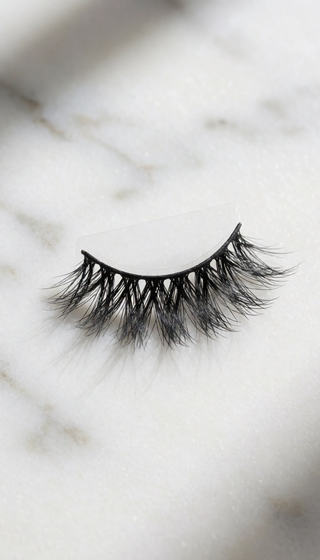
STOP SORTING YOUR EYES BY SHAPE — LEARN THE 1-MINUTE FRAMEWORK THAT FINDS YOUR BEST LASH STYLE

You've seen the charts: almond, hooded, monolid, round, deep-set. You follow the recommendation, and the lashes still look off. That's because eye shape gets all the attention, but lash style does the heavy lifting. The differences between lash styles change your eye's appearance far more than the precise curve of your socket. This guide shows you the five reasons lash style beats eye shape, when eye shape still matters, and a 60-second framework to choose the right pair — without becoming an eye-shape expert.
FIVE REASONS LASH STYLE BEATS EYE SHAPE
- Eye shape is static; lash style is dynamic. You can't change your socket depth, but you can choose a different lash tomorrow. Focus your energy where you have control.
- Most eye shapes can wear most lash styles. A natural 8mm pair works on almond, round, and hooded eyes. The differences between eye shapes are smaller than the differences between lash styles.
- The lash style determines the optical effect. A cat-eye makes round eyes look longer. An open-eye lash makes deep-set eyes look wider. The style is doing that, not your eye shape.
- Lash style is where makeup mistakes happen. Too long, too thick, wrong band stiffness — these are lash style errors, not eye shape errors.
- Eye shape guides are often wrong for your actual face. A chart can't measure your brow height, lid space, or lash density. But a lash style can be adjusted in seconds to fit those measurements.
WHY EYE SHAPE STILL MATTERS (AND WHEN)
Eye shape matters when it changes the geometry. Hooded eyes have less visible lid space, so a straight band can poke the crease. Prominent eyes have a shorter distance to the brow bone, so 15mm lashes don't fit. Monolids need a curl that lifts straight up. But once you know those boundaries, the lash style does the design work. Eye shape sets the limits; lash style creates the transformation.
THE ONE-MINUTE LASH DECISION FRAMEWORK
- Check the brow gap: If you have less than a finger-width between your lash line and brow bone, keep lashes under 12mm.
- Find your focus: Round eyes look great with an outer-corner cat-eye. Narrow eyes pair well with a center-heavy open-eye lash.
- Decide the vibe: Natural workday vs event glam. The occasion matters more than your eye shape.
- Trust the band: A flexible band will adapt to whatever curve your eye has.
A LASH DECISION FRAMEWORK THAT IGNORES TRENDS
| Eye shape (limits) | Lash style (solution) |
|---|---|
| Hooded — little visible lid space | Open-eye lash with a natural curl, 8-10mm |
| Round — naturally large | Cat-eye lash to lengthen the outer corner |
| Deep-set — eyes shadowed | Natural flare lash to add light and depth |
| Prominent — eyes project forward | Light, wispy lash under 12mm |
| Almond — balanced shape | Anything works; let the occasion decide |
This framework works because it treats eye shape as a constraint, not a personality type. Once you know your limits, the style does the rest. The same logic applies to every lash system you try.
FAQ
Which eye shape is the hardest to fit for lashes?
Hooded eyes are trickiest because the band needs to follow the natural curve without pressing into the crease. A flexible, thin band solves it.
Do lash styles need to match eye shape perfectly?
No. A style can be tweaked — trim length, adjust the band curve — to fit within your eye's natural boundaries.
What should I try first if I have round eyes?
A cat-eye lash with more length at the outer corner. It visually balances the roundness without adding width to the center.
WHAT TO LOOK FOR IN A LASH SYSTEM
When you compare glue, magnetic, and glue-free options, three factors separate a lash that works daily from one that ends up in a drawer.
- No glue, no irritation. The most common reason people abandon lashes is irritation from adhesive. Look for a method that doesn't rely on glue or magnets near your lash line.
- Reusable durability. A single-use lash isn't a system; it's a splurge. The best value comes from pairs that can be worn repeatedly without losing shape.
- Cost per wear. A $59 pair that lasts 30+ wears costs under $2 per wear — less than one cup of coffee. Compare that to salon visits or daily disposables.
These are the criteria that will steer you to a lash that respects your time, your eyes, and your budget.
MEET PHANSTA LASHES: THE NATURAL NEXT STEP
PHANSTA LASHES was built on the logic you just practiced. Instead of writing an eye-shape essay for every pair, each of its 17 styles is designed to work across the eye shapes that share the same boundaries. The bands use micro-adhesion — no glue, no magnets, no liner — to cling to your lash line in seconds. They're hypoallergenic and waterproof, and they hold up for 30+ wears, bringing the cost per wear under $2. That's the way the lash industry should work.
Glue-free, 30+ wears, seconds per eye.
FIND THE PERFECT LASH FOR EVERY MOMENT
Explore our occasion-specific lash guides:
📚 Browse our complete library of lash guides →
📚 Browse our complete library of lash guides →
Experience the Difference of PHANSTA LASHES
Quick to apply, gentle on eyes, beautiful all day. Reusable 30+ wears per pair.
SHOP PHANSTA LASHES — GLUE-FREE, 30+ WEARS →