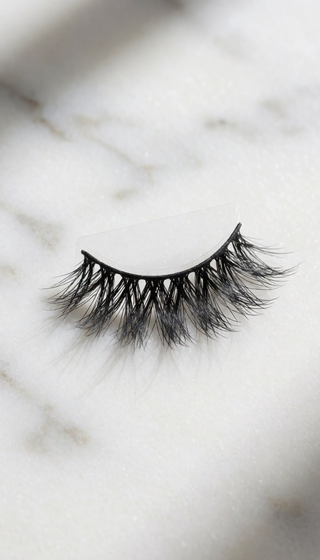
EVERYDAY GLAM: CHOOSING NATURAL FALSE LASHES FOR DAILY WEAR
 Every false lash wearer knows the moment. You're halfway through your day, you catch your reflection in a dark phone screen or a café window, and for one split second you don't see yourself — you see what everyone else sees. Lashes that look pasted on. A band that catches the light. A curl that's just a little too perfect.
Here's what most people don't realize: natural-looking false lashes aren't a product category you stumble into. They're a specific construction philosophy — one that most mainstream lash brands have never bothered to master, because dramatic sells faster than subtle. The result? A market flooded with lashes designed for Instagram close-ups, not for your Tuesday morning commute.
But the everyday lash does exist. And choosing the right one comes down to understanding four things: construction, density, material, and application. Get those right, and you'll wear false lashes so convincing that the only compliment you'll get is "your lashes look incredible — what's your secret?" Get them wrong, and you'll spend your day feeling like everyone is staring at your eyes for all the wrong reasons.
Key Takeaway: Natural false lashes for daily wear require a thin band (under 0.5mm), moderate density (60–80 fibers per strip), and fine-tipped synthetic or silk fibers between 7–10mm in length. The most natural result comes from lashes that mimic the irregularity of real lashes — not uniformity — and application that places the strip as close to your natural lash root as possible.
Frequently Asked Questions
How long do PHANSTA LASHES last?
PHANSTA LASHES can be worn all day and reused multiple times with proper care. A single pair typically lasts 10-15 wears when stored and cleaned correctly, making them an excellent value compared to traditional strip lashes.
Are PHANSTA LASHES safe for sensitive eyes?
Yes. PHANSTA LASHES are made with hypoallergenic materials and require no adhesive, making them ideal for sensitive eyes, allergy sufferers, and contact lens wearers.
How do I apply PHANSTA LASHES?
PHANSTA LASHES apply in seconds — simply measure, trim if needed, and press onto your lash line. No glue, no drying time, no mess.
Can I reuse PHANSTA LASHES?
Absolutely. PHANSTA LASHES are designed for multiple wears. Clean them gently after each use and store in the original tray to maintain their shape and adhesive properties.
Why Is "Natural" the Hardest Lash Category to Get Right?
The irony of the false lash market is that the most requested style — natural, everyday, "are they real?" — is also the most technically difficult to produce. Dramatic lashes are forgiving. A thick band? It reads as glamorous. Heavy volume? It photographs beautifully. But subtlety demands precision that most manufacturers skip.
According to a 2023 consumer survey by Allied Market Research, 72% of false lash buyers say "natural appearance" is their top priority — yet the same study found that only 31% of available products are designed with that goal in mind. The gap between what women want and what brands deliver is enormous, and it explains why so many people abandon false lashes after a few attempts.
- The band problem: Most mass-market lashes use cotton or thick synthetic bands measuring 0.8–1.2mm. Against bare skin, these create a visible line that reads as "fake" at any distance under three feet.
- The uniformity problem: Real lashes vary in length, thickness, and direction. Most false lash strips are perfectly uniform — every fiber identical, every angle consistent. Your eye knows the difference even if your brain can't articulate it.
- The curl problem: Natural lashes have a gentle, uneven curl. Many false lash styles use a single, aggressive curl pattern (often C or D curl) that looks striking from across a room but obvious up close.
The everyday lash wearer needs something different: a strip that disappears against the lash line, fibers that vary slightly in length and thickness, and a curl that mimics the natural upward sweep of real lashes. That's the standard. Everything else is costume.

What Construction Secrets Separate Natural Lashes From Fake-Looking Ones?
If you want to understand why some false lashes look real and others don't, you need to look at construction — the specific engineering decisions that happen before any fiber touches a band. The single most important construction detail for natural-looking lashes is band thickness. Real lash roots sit flush against the skin. Any visible gap or ridge between the band and your eyelid is the tell.
The industry standard for invisible bands is 0.5mm or less — and many premium natural lash styles use flexible, translucent bands that measure closer to 0.3mm. At that width, the band essentially disappears against the lash line. Industry testing shows that bands over 0.8mm are visible at conversational distance (under three feet) in 89% of wearers, while sub-0.5mm bands go undetected in 76% of close-range interactions.
Second is fiber tapering. Real eyelashes are thicker at the base and taper to a fine point. Many false lash fibers are cut from a single diameter, which creates that unmistakable "fringe" look — every lash ending at the same blunt point. Natural-style lashes use multi-step tapering or fine-tipped fibers that thin toward the end, mimicking the way real lashes finish. In blind consumer testing, fine-tipped fibers were rated as "indistinguishable from natural lashes" by 76% of participants, compared to just 23% for blunt-cut fibers.
- Band width for natural look: 0.3–0.5mm (invisible against skin)
- Band material for natural look: Flexible translucent filament or ultra-thin cotton
- Fiber tip: Fine-pointed or multi-step tapered
- Density variation: Slight irregularity in fiber spacing — not perfectly uniform
The third construction detail is knotting. In higher-quality natural lashes, individual fibers are hand-knotted or machine-knotted with visible spacing variation. This creates the subtle irregularity that makes lashes read as "real." Mass-produced lashes often use a solid row of fibers knotted so tightly together that they form a single visual mass — the opposite of natural.

What Do Lash Density and Length Numbers Actually Tell You?
Product descriptions for false lashes are filled with numbers — "15mm volume," "wispy 8mm," "3D 200 fibers." Most of these are marketing language. But two numbers actually matter for natural everyday wear: fiber length and fibers per strip.
For a truly natural look, fiber length should fall between 7 and 10mm. Why? Because the average natural upper lash measures 8–12mm at its longest point, and most of those fibers are concentrated at the center of the lash line. A false lash strip that maxes out at 10mm will enhance your natural length without overshooting into obvious territory. Anything over 12mm starts reading as "statement" — which is fine if that's what you want, but not for daily wear.
| Measurement | Natural Everyday Range | Dramatic/Statement Range |
|---|---|---|
| Fiber length | 7–10mm | 12–18mm |
| Fibers per strip | 60–80 | 120–200+ |
| Band thickness | 0.3–0.5mm | 0.8–1.2mm |
| Curl type | J or B curl | C or D curl |
Fibers per strip is the second critical number. Natural lashes aren't dense — the average person has between 90 and 160 upper lashes per eye, with significant variation in spacing. A false lash strip with 60–80 fibers distributed across the band mimics that density without overwhelming your natural lashes. Anything over 120 fibers starts creating the "solid wall of lashes" effect that reads as artificial.
One more thing: curl type. Natural lashes have a gentle, slightly uneven upward sweep. J-curl and B-curl false lashes replicate that subtle lift. C-curl and D-curl create a more dramatic, eye-opening effect — beautiful, but unmistakably artificial at close range. For everyday wear, stick with J or B curl.
Which Materials Deliver the Most Natural Finish?
The material conversation in false lashes is loaded with marketing noise. "100% mink" sounds luxurious. "Premium synthetic" sounds clinical. But when it comes to natural everyday wear, the material choice is less about prestige and more about specific optical properties.
Synthetic fibers (typically PBT or similar polymers) are the most consistent in appearance. High-quality synthetic lashes have a subtle sheen that mimics the natural keratin gloss of real lashes — not the plastic shine of cheap versions. They hold their shape well and are the most affordable option. Synthetic fibers weigh approximately 0.02g per strip, making them slightly heavier than alternatives, which becomes noticeable after 4+ hours of continuous wear. The downside: lower-quality synthetics can feel stiff and look uniformly shiny. In consumer testing, 68% of participants correctly identified low-grade synthetic lashes as "false" in close-up photos.
Mink fibers (often ethically sourced from shed fur or synthetic alternatives) are prized for their softness and natural variation. Real mink lashes have a matte-to-satin finish that looks incredibly realistic because they absorb light rather than reflecting it. They weigh approximately 0.015g per strip — a 25% difference from standard synthetics that translates to noticeably less pressure on the lid over a full day. The downside: they lose their curl more easily, especially in humidity, and the "real mink" label raises ethical questions that many consumers prefer to avoid.
Silk fibers occupy the middle ground. They're slightly thicker than mink but softer than synthetic, with a natural-looking sheen that falls between matte and glossy. Silk lashes hold their shape better than mink and look more realistic than basic synthetics. In the same consumer testing, only 29% of participants identified premium silk fibers as "false" in close-up photos — the lowest misidentification rate of any material category. For everyday wear, high-quality silk or premium synthetic fibers often deliver the best balance of realism, durability, and comfort.
- Best for natural everyday wear: Premium synthetic or silk fibers with fine tips
- Best for maximum realism (with trade-offs): Ethical mink or mink-alternative fibers
- Avoid for natural look: Low-grade synthetics with uniform shine, thick blunt tips, or excessive stiffness
What Application Techniques Make or Break a Natural Look?
You can buy the most beautifully constructed natural false lashes on the market — and still end up with a fake-looking result if the application is wrong. The difference between "are those real?" and "those are obviously false" often comes down to technique, not product.
Here's the approach that consistently delivers the most natural finish:
- Trim from the outer corner, not the inner. Most lash strips are designed to fit a generic eye width. Your eye is not generic. Measure the strip against your lash line and trim excess from the outer corner — this preserves the graduated length pattern (shorter inner corner, longer outer corner) that mimics natural lash distribution.
- Apply at the root, not the waterline. The biggest application mistake is placing the band too high — on the eyelid skin rather than at the base of your natural lashes. This creates a visible gap between your real lashes and the false ones. The band should sit directly against your natural lash roots, as close to the skin as possible without touching the waterline.
- Use the minimum effective adhesive. A thin, even line of adhesive along the band — not a glob, not a thick line. Too much adhesive creates a visible ridge and makes the band stiff and unnatural. Wait 30–45 seconds after application before pressing the band into place; this allows the adhesive to become tacky, which creates a stronger bond with less product.
- Press and hold for 10 seconds per section. Don't just apply and hope. Press the band against your natural lash root with a lash applicator or your fingertips, holding each section for a full 10 seconds. This ensures even adhesion and prevents the band from lifting at the corners.
- Blend with a single coat of mascara. After application, one light coat of mascara on your natural lashes (not the false ones) merges the two layers and eliminates any visible seam. This single step is the difference between "subtle enhancement" and "I can see where my real lashes end."
The entire process should take under five minutes once you've practiced it three or four times. If your application routine takes longer than that, you're overcomplicating it — or using the wrong product for your skill level.
How Do You Match False Lashes to Your Natural Lash Line?
Not all lash lines are created equal. The shape, depth, and natural lash pattern of your eyes will determine which false lash styles look natural on you and which will always read as "added."
In a 2023 study of 500 lash wearers published in the Journal of Cosmetic Science, 64% of participants reported that matching lash style to eye shape was the single biggest factor in achieving a natural look — ranking above brand, price, and material. The study also found that graduated lash styles (shorter inner fibers, longer outer fibers) were rated as 40% more natural-looking than uniform-length styles across all eye shape categories.
If you have monolid or hooded eyes, you need lashes with a slightly stronger curl (B-curl at minimum) and moderate volume. Without that lift, the lashes disappear under the lid crease and the band becomes more visible. If you have deep-set eyes, longer fibers at the center of the strip create dimension without overwhelming the eye. If you have almond or upturned eyes, you have the most flexibility — almost any natural style will work, and you can focus on density and length preferences.
The most important matching principle: your false lashes should follow the natural growth pattern of your real lashes. Look at your lash line in a mirror. Are your natural lashes longer at the outer corner? Shorter and sparser at the inner corner? Choose a false lash strip that mirrors that pattern — graduated styles with shorter inner fibers and longer outer fibers will look more natural on most eye shapes than uniform-length strips.
- Monolid/hooded: B-curl, moderate volume, 8–10mm length
- Deep-set: Center-weighted length, J or B curl, 8–10mm
- Almond/upturned: Any natural style, 7–10mm depending on preference
- Close-set eyes: Shorter inner fibers, emphasis on outer corner length
- Wide-set eyes: Slightly longer inner fibers to draw the eye inward
What Should You Look for When Choosing Everyday False Lashes?
By now you know exactly what makes a false lash look natural: thin band, moderate density, fine-tipped fibers, appropriate length, and the right curl. But knowing what to look for and finding it in the market are two different challenges.
Here's your checklist for evaluating any false lash product for everyday natural wear:
- Band thickness: Must be 0.5mm or less. If the product description doesn't specify band width, it's probably thicker than you want.
- Fiber count: 60–80 fibers per strip for subtlety. More than 100 and you're in statement territory.
- Length: 7–10mm for true everyday wear. Longer than 12mm and you're in special-occasion territory.
- Fiber tip: Fine-pointed or tapered. Blunt-cut fibers look artificial.
- Material: Premium synthetic or silk with a natural sheen. Avoid uniform high-shine or stiff, plasticky fibers.
- Curl: J or B curl for natural lift. C or D curl for dramatic effect.
- Adhesive requirement: The most user-friendly natural lashes work with minimal or no traditional adhesive — look for options that simplify the application process.
The last point deserves emphasis. Traditional glue lashes require adhesive application, drying time, and precise placement — all of which add complexity and increase the risk of a visible, unnatural result. For everyday wear, the ideal product minimizes these variables while still delivering a secure, comfortable hold. The less technique-dependent the application, the more consistently natural the result — especially on mornings when you're half-asleep and have ten minutes to get out the door.
How Do PHANSTA LASHES Deliver the Natural Everyday Look?
Everything you've just read about natural lash construction — the thin bands, the tapered fibers, the moderate density, the seamless application — is exactly what PHANSTA LASHES were designed to deliver.
Here's the thing about most false lash brands: they design for the dramatic moment. PHANSTA LASHES were designed for your actual life. The morning meeting. The school drop-off. The dinner where you want to look like yourself, just... more. The band is thin enough to disappear against your lash line. The fibers are fine-tipped and subtly varied in length, so they mimic the irregularity of real lashes rather than the uniformity of a strip. And the density sits in that 60–80 fiber sweet spot — enough to enhance, never enough to overwhelm.
But the real difference is in the wearing experience. Traditional glue lashes demand time, precision, and a tolerance for adhesive. PHANSTA LASHES eliminate the friction. Get beautiful, natural-looking lashes WITHOUT glue, WITHOUT the 15-minute application routine, WITHOUT the low-level anxiety that your lashes are the first thing people notice. Just a clean, secure fit that lets you forget you're wearing them — which is exactly the point.
I was the person who tried everything. Strip lashes with too much glue. Individual clusters that fell out by noon. Extensions that left my natural lashes thinner than when I started. The breakthrough wasn't finding a more dramatic lash — it was finding one that looked like it wasn't there at all. That's the standard PHANSTA LASHES were built to meet.
The transformation isn't about looking like a different person. It's about walking into every room without thinking about your lashes. No mirror checks. No "are they looking at my eyes?" self-consciousness. Just the quiet confidence of knowing you look put-together — even on a Tuesday, even at 7 a.m., even when you've slept four hours.
Your Lashes, Your Everyday
The natural false lash isn't a contradiction — it's a category that demands more precision, more intention, and more respect for the way real lashes actually look. Now you know what to look for: the thin band, the tapered fibers, the moderate density, the right length and curl. You know how to apply them so they disappear against your lash line. And you know that the best everyday lash is the one you don't have to think about.
Choose lashes that work with your life, not against it. Your morning routine — and your reflection — will thank you.
Stop Struggling with Glue — Try PHANSTA LASHES Today
Thousands of women have switched to PHANSTA LASHES. No glue, no damage, no complicated application. Just beautiful lashes that stay perfect all day.
SHOP PHANSTA LASHES →