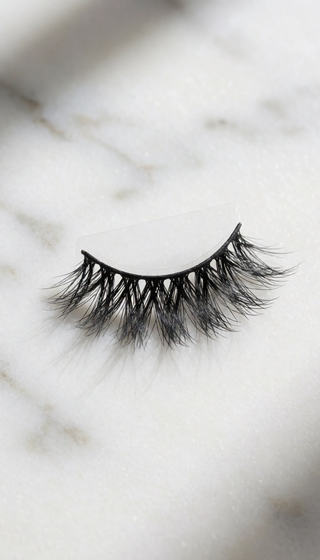
4 MAGNETIC FALSE EYELASH MYTHS DEBUNKED BEFORE YOU BUY
NOT SURE ABOUT YOUR EYE SHAPE?
Take our 60-second quiz to find your perfect lash match — no glue, no commitment.
TAKE THE QUIZ →
Here’s the direct answer: Magnetic false eyelashes can hold securely, look natural, and take less time than traditional glue lashes—but only when the system, fit, and application method are right. “Magnetic” does not automatically mean glue-free, hypoallergenic, invisible, or faster. Some magnetic styles attach to a magnetic eyeliner without separate glue, while others still require an adhesive. The finished look depends more on length, density, curl, and placement than on the type of closure.
Think about the last time you opened lash glue before an event. One hand holds the bottle, the other steadies your eyelid, and you are trying not to breathe too deeply in case a wet brush travels toward your pupil. Add drying time, glue remover, and a bathroom cleanup afterward, and a five-minute lash change becomes a project. Magnetic systems solve much of that handling problem, but only when you know exactly what you are buying.
Key takeaway: Magnetic false eyelashes are not a universal shortcut: a secure, comfortable, natural result depends on the magnetic system, lash-band fit, and careful preparation. They can reduce mess and separate glue steps, but they still require thoughtful selection, clean application, and prompt removal if your eyes feel irritated.
Frequently Asked Questions
How long do PHANSTA LASHES last?
PHANSTA LASHES can be worn all day and reused multiple times with proper care. A single pair typically lasts 10-15 wears when stored and cleaned correctly, making them an excellent value compared to traditional strip lashes.
Are PHANSTA LASHES safe for sensitive eyes?
Yes. PHANSTA LASHES are made with hypoallergenic materials and require no adhesive, making them ideal for sensitive eyes, allergy sufferers, and contact lens wearers.
How do I apply PHANSTA LASHES?
PHANSTA LASHES apply in seconds — simply measure, trim if needed, and press onto your lash line. No glue, no drying time, no mess.
Can I reuse PHANSTA LASHES?
Absolutely. PHANSTA LASHES are designed for multiple wears. Clean them gently after each use and store in the original tray to maintain their shape and adhesive properties.
Why Do Magnetic False Eyelash Myths Keep Circulating?
Magnetic-lash myths persist because “magnetic” describes one component, while shoppers often treat it as a promise about hold, safety, speed, and invisibility. In reality, each outcome depends on the magnetic eyeliner, band construction, lash-line fit, natural lashes, and application technique. No single term can guarantee all four.
The biggest source of confusion is a category shortcut. A magnetic lash has metal components designed to attach to another magnetized surface. That surface may be a magnetic eyeliner, which replaces a separate lash-glue step. However, some “magnetic” lash styles are attached to the natural lashes with traditional adhesive first. The magnet is then used to attach a second lash or accent piece.
That distinction changes the entire routine:
- No separate glue means you do not apply an independent bottle of lash glue to the band. A magnetic eyeliner still has to be applied and allowed to set.
- No glue at all would mean no adhesive is placed near the eye. Most products described as magnetic false eyelashes do not fall into that category.
- Better hold comes from several correctly spaced contact points, accurate alignment, and a fully set liner—not from the word “magnetic” alone.
Eye-product handling also deserves more attention than most beauty content suggests. In a 2024 American Academy of Ophthalmology survey of 300 U.S. adults, 40% reported an eye injury connected with makeup, and more than half said the injury happened during application rather than removal. The FDA separately lists six common warning signs of an eye reaction: burning, redness, swelling, discharge, light sensitivity, and blurred vision.
So the useful question is not simply, “Are magnetic lashes better?” It is: “Which system reduces handling, suits my eyes, and gives me the finish I want?”

Myth 1: “Magnetic False Eyelashes Can’t Stay Put”—What’s Really True?
They can stay put, but magnets are not stronger under every condition. Secure wear depends on direct contact between the lash magnets and a fully set magnetic surface. Band flexibility, lash-line shape, oils, movement, and drying time all affect the result. A well-fitted set can be dependable; a poor fit will lift even if its magnets are technically strong.
Magnetic force weakens as the distance between two magnetic surfaces increases, a basic principle described in OpenStax physics materials. A tiny gap matters. If the liner has not set, the skin is oily, or only one point of the band makes contact, the rest of the lash can peel away.
A common full-band design has approximately five small magnets distributed along its base. Segmented styles often place one magnet at each end of a segment, creating two contact points per piece. More than one point is useful because lashes naturally move with the eyelid.
Use this application sequence for a more stable result:
- Start with a clean, dry lid. Remove makeup, skincare, and excess oil. If you have just washed your face, wait until the skin no longer feels damp or tacky.
- Apply the magnetic surface in a continuous line. Gaps weaken the visual effect and can encourage the band to lift between contact points.
- Honor the product’s drying instructions. A quick- or long-drying formula should be treated differently. Generic internet timers are less reliable than the manufacturer’s directions.
- Align before pressing. Look straight ahead in a mirror, bring the lash band close to the liner, and press the center and ends rather than pushing only on one corner.
Test hold at three checkpoints: immediately after placement, after two hours, and during your longest planned wear period. If the inner corner rises, the band may be too wide. If the outer corner lifts, inspect the liner, remove excess oil gently, and press the full band again. Avoid rubbing the eye area, since friction lifts the liner’s edge.
The FDA’s general advice to follow cosmetic labeling applies here. If a lash begins lifting during a short trial, do not assume you need stronger glue or a different style; adjust the fit or system first.

Myth 2: “No Glue Means No Risk”—What Does the Evidence Say?
No separate glue removes one source of exposure, but it does not make an eye cosmetic risk-free. Magnetic eyeliner still sits close to the eyelid, and hands, applicators, containers, and rubbing can introduce irritation or infection. Safety comes from clean handling, compatible products, and stopping when the eye reacts—not from assuming “no glue” equals “hypoallergenic.”
Traditional lash glue can be irritating because it is placed near the lash line and must be removed with rubbing or a solvent. Eliminating that bottle can reduce mess and direct contact. However, a magnetic liner can still cause a reaction if residue gets in the eye, if the applicator is contaminated, or if the product is used over irritated skin.
The American Academy of Ophthalmology reported in its 2024 survey that 7 in 10 respondents who experienced a makeup-related symptom said it lasted longer than 24 hours. That finding does not mean every magnetic system causes injury. It shows that a reaction should not be treated as a minor inconvenience to push through.
Use a careful safety routine:
- Wash your hands first. The CDC recommends scrubbing with soap for at least 20 seconds before touching your face or eye area.
- Do not share eye products or applicators. The FDA specifically warns against sharing cosmetics because bacteria can be transferred directly to the eye.
- Inspect the product. Do not use a dry, damaged, contaminated, or previously used item after an eye infection.
- Observe a new product for 24 to 48 hours. Allergy organizations such as the American Academy of Allergy, Asthma & Immunology recommend testing a new cosmetic on a small area of skin when appropriate. This cannot guarantee safety around the eye.
- Respond to symptoms. Stop using the product if you develop pain, burning, redness, swelling, discharge, light sensitivity, or blurred vision.
Those six symptoms are listed by the FDA as reasons to stop using eye cosmetics and seek medical advice. Pain or changes in vision need prompt attention rather than another attempt to remove the product at home.
Wearers of contact lenses should be especially cautious about using any new product near the eye. If you have an active infection, persistent dry eye, or ongoing irritation, wait until the condition is resolved or ask an eye-care professional for guidance.
Myth 3: “Magnetic Lashes Always Look Fake”—How Do You Control the Finish?
Any lash can look artificial when its length, density, or placement ignores the eye. Magnetic and traditional styles made from similar fibers can create nearly identical finishes. The visible result depends on five design choices: the length map, density, curl, band shape, and where the longest fibers land.
Natural-looking lashes are not created by searching for the biggest style. The average eyelid grows roughly 100 to 150 eyelashes, according to the American Academy of Ophthalmology. A full false lash already supplies most of that visual density, so excessive length and thickness can quickly change the eye’s proportions.
Use millimeters rather than vague labels such as “short” or “dramatic.” These are editorial starting ranges, not fixed rules:
| Desired finish | Starting length range | Useful pattern |
|---|---|---|
| Barely-there | About 6–9 mm | Airy fibers with only 1–2 mm of variation |
| Soft, defined | About 8–11 mm | A gentle length increase of 2–3 mm toward the outer third |
| Editorial or evening | About 11–14 mm | Visible curl and a deliberate long-to-short gradient |
Eye shape changes the outcome. A long outer corner can make a round eye look more lifted, while excessive outer-corner length can exaggerate drooping. On a hooded eye, a very high band and dense center may hide the lashes instead of framing them.
Before buying, check three points:
- Compare the inner, middle, and outer length against your own natural lashes.
- Look for gradual variation rather than one abrupt jump in fiber length.
- Ask whether the band is flexible enough to follow the curve of the eyelid.
For the most believable result, curl your natural lashes first, choose a moderate curl for the false lash, and keep the densest area near the center or outer third. The adhesive should disappear into the finished look—not announce itself through a stiff band or overly dark liner.
Myth 4: “Magnetic Lashes Are Always Faster”—Which Routine Takes Less Time?
They are often faster than traditional glue lashes, but speed comes from the complete system. A pre-magnetic liner can remove glue application, glue-drying, and glue-removal. A magnetic lash that still requires separate adhesive saves nothing. Formula drying time, band fit, and makeup skill determine the real result.
Compare the processes by task rather than by a 30-second social-media demonstration:
| Step | Traditional glue lashes | Magnetic liner system |
|---|---|---|
| Product setup | Open and control lash glue | Apply a thin line of magnetic liner |
| Waiting | Wait for the adhesive to become tacky | Wait for the liner to set as directed |
| Placement | Press the glued band into place | Align the band and close the magnetic connection |
| Cleanup | Remove glue and massage away residue | Remove the liner and lash together |
The traditional process contains five major actions: prepare, apply glue, wait, place, and clean. A complete magnetic liner routine has four: prepare, line, set, and attach. The difference is more than a label; it changes what you carry, what you wait for, and how you remove the lashes.
To compare honestly, run each routine three times and record four numbers:
- Time spent applying the adhesive or liner
- Time spent waiting for it to set
- Time spent positioning the lash
- Time needed for complete removal and cleanup
Use the median result—the middle of your three times—rather than your fastest attempt. Magnetic application wins when the liner reaches its required set time without a separate glue stage. It loses when the formula takes longer to dry, the band is poorly fitted, or you spend extra time trimming and repositioning it.
There is no universal set time for every cosmetic formula. The FDA recommends using products according to their labeling, so a quick-dry instruction and a longer-set instruction should not be treated as interchangeable.
How Do Magnetic False Eyelashes Compare With Other Lash Options?
The most important difference is process, not magical performance. A magnetic system using its matching liner usually offers less adhesive handling, while traditional glue lashes provide very direct control over the finished look. Individual clusters increase placement time, and adhesive strips simplify the routine
Stop Struggling with Glue — Try PHANSTA LASHES Today
Thousands of women have switched to PHANSTA LASHES. No glue, no damage, no complicated application. Just beautiful lashes that stay perfect all day.
SHOP PHANSTA LASHES →📚 Browse our complete library of lash guides →
NOT SURE ABOUT YOUR EYE SHAPE?
Find your eye shape and get personalized lash recommendations:
STILL COMPARING OPTIONS?
See how PHANSTA compares to traditional lashes:
FIND THE PERFECT LASH FOR EVERY MOMENT
Explore our occasion-specific lash guides:
EXPERIENCE THE DIFFERENCE
Join thousands of women who have made the switch. No glue, no damage, no salon appointments — just beautiful lashes in seconds.
SHOP PHANSTA LASHES →