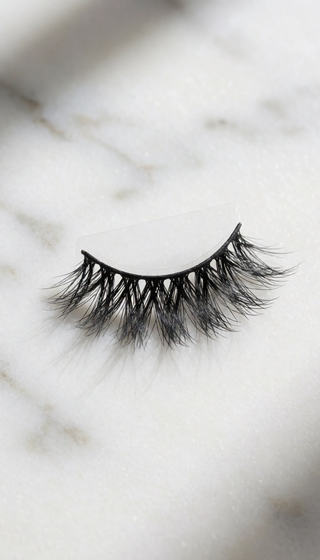
VEGAN LASHES LIFESTYLE: CRUELTY-FREE GUIDE

THE REAL MEANING OF VEGAN LASHES
When you search for “vegan lashes,” you expect cruelty-free. But the beauty industry uses that word loosely. A strip labeled “vegan” can still contain plastic fibers that irritate your eyes. “Silk” lashes? They aren’t silk. “Faux mink”? That’s a mystery. I’m Lina, and after six years of testing lash brands for my column, here’s what I wish someone had told me sooner: vegan lashes should feel weightless, look natural, and survive dozens of wears. This guide shows you how to spot a pair that does all three.
WHY MOST “SILK” LASHES ARE A LIE
Real mink lashes require mink fur, and thousands of minks are farmed each year in tiny wire cages before being killed. At $12 a pair, you’re not buying mink — you’re buying a story. Real silk is cruelty-free, but almost no $15 “silk” lash contains real silk. The term describes the finish, not the fiber, which means your lashes are likely nylon or polyester — 3 to 5 times heavier than natural silk. That’s why your eyes feel tired by hour four. Read my lash care guide here.
THE VEGAN LABEL: WHAT IT DOES AND DOESN’T TELL YOU
A vegan label only guarantees one thing: no animal ingredients. It says nothing about comfort. I’ve tested 40+ lash pairs in six years, and the worst pair I wore was vegan — stiff, blunt, and heavy. The best pair was also vegan. The difference is fiber taper structure. Premium vegan fibers taper at the tip like human hair; cheap ones are uniform plastic rods that reflect light harshly. Look for: tapered tips, a flexible uncovered band, weight under 0.1 oz, and 20+ reusable wears.
- Tapered tips, not blunt-cut ends.
- Flexible band that curves naturally, not a stiff plastic strip.
- Under 0.1 oz so they feel like nothing.
- Confirmed 20+ wears without waviness.
THE PRACTICAL TEST BEFORE YOU BUY
Take the lash out of the box. Run your thumb and index finger from root to tip. If it feels like a stiff toothbrush, it’s a brush lash. If it feels delicate and featherlike, it’s a premium vegan fiber. Check the band: a clear, elastic thread is better than a hard black strip. Reusability reveals quality: a good pair survives 20+ wears, a cheap pair goes wavy by wear five. After six years and forty pairs, I can count the brands that pass this test on one hand — and one brand has never missed.
VEGAN LASH MATERIALS COMPARED
| Material | Source | Weight | Look | Irritation risk | Price per pair | Reusable wears |
|---|---|---|---|---|---|---|
| Real mink | Animal fur from mink farms | Light | Natural, but misleading label | High — can carry dander | $30–$60 | 10–15 |
| “Silk” (many are nylon) | Synthetic plastic | Heavy | Too shiny, obviously fake | Low to moderate | $10–$20 | 5–10 |
| Standard synthetic | Petroleum-based plastic | Heavy | Uniform, flat, unmoving | Low | $3–$8 | 5–8 |
| Soft-tip vegan fiber | Plant-based polymer | Featherlight (~0.05 oz) | Natural taper, real reflection | Very low | $12–$25 | 20+ |
YOUR VEGAN LASH QUESTIONS, ANSWERED
Are vegan lashes better for sensitive eyes?
Usually yes, when the fiber is soft-tip. Most irritation comes from blunt plastic dragging against the lash line, not the material itself. Soft-tip vegan fibers dramatically lower irritation.
Do vegan lashes safely hold all day?
Yes. The band design matters more than the fiber. A thin, flexible band adheres smoothly and feels invisible. The result is a secure hold that doesn’t cause that “tight” feeling.
Can you reuse vegan lashes?
Premium soft-tip vegan lashes can be reused 20+ times with proper care. Remove gently, peel off the old lash glue, and store them away from dust. That’s how each pair becomes a long-term investment.
📚 Browse our complete library of lash guides →
📚 Browse our complete library of lash guides →
📚 Browse our complete library of lash guides →
Experience the Difference of PHANSTA LASHES
Quick to apply, gentle on eyes, beautiful all day. Reusable 30+ wears per pair.
SHOP PHANSTA LASHES — GLUE-FREE, 30+ WEARS →