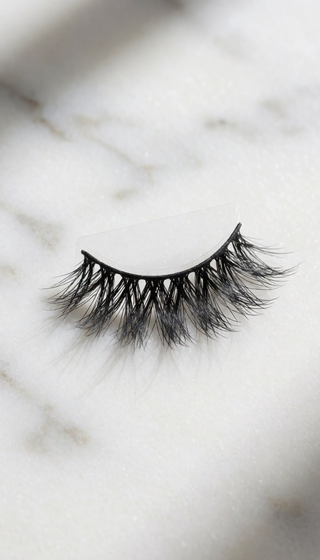
FALSE LASHES FOR HOODED EYES: THE FIT FORMULA THAT KEEPS THEM VISIBLE ALL DAY
MEASURE YOUR LID SPACE, LENGTHEN WITHIN IT, AND WATCH THE NOON DISAPPEARANCE STOP
Here is the short version: if your lid fold swallows your crease the moment you open your eyes, the fix is a shorter graduated fiber, a thin flexible band, and an adhesion system that survives oil. Below you get the measurement that sets your length ceiling, the five fit factors, the full application sequence, and the four predictable failures with their fixes.
NOT SURE ABOUT YOUR EYE SHAPE?
Take our 60-second quiz to find your perfect lash match — no glue, no commitment.
TAKE THE QUIZ →Hooded lids are a fit challenge with a learnable solution. The three signature failures — disappearing fibers, lifting corners, irritated skin — all trace back to length, band, and adhesive. The visible lid space between your lash line and your crease fold is narrow, and most mass-market styles are built for a deeper eye set entirely.
Try this 30-second self-check right now: with your eyes open and relaxed, look straight ahead and measure the distance from your lash line to the fold. On most hooded lids that visible space is only 5–8mm. Any fiber longer than that will tuck the moment you blink. Treat that number as your hard ceiling when evaluating any style — it explains more about lash failure than any product description ever will.
One more habit worth starting today: oil control. Sebum pools along a curved lash line and degrades adhesive faster than on a flatter lid. Blot the lash line and use an oil-free eye primer before application — thirty seconds of oil removal can noticeably extend wear.
THE ANATOMY OF HOODED EYELIDS — AND WHY LASHES FAIL THERE
A hooded eye has a skin fold that partially or fully covers the natural crease when the eye is open. That single structural fact drives every other decision. Lashes that are too long or too dense tuck under the fold and disappear the instant the eye opens, no matter how carefully they were applied.
The curve of the hooded lid also creates a hostile environment for adhesive. Natural oils accumulate near the lash line, breaking down traditional glue faster than on a flatter lid, and the crease skin is thinner and more reactive — latex-based glues become a genuinely high-risk choice for irritation. Any successful application has to account for support, adhesion longevity, and skin sensitivity at the same time.
Hooded lids also vary enormously. Some carry a subtle fold that only appears when the eye is relaxed; others have a deep, permanent hood. Your measured lid space is the only reliable guide — never the style name on the tray.
FIVE FIT FACTORS THAT DECIDE WHETHER A LASH WORKS ON A HOODED LID
Evaluate any lash against these five indicators. Each one addresses a physical reality of hooded anatomy rather than a marketing promise.
1. LASH LENGTH VS. VISIBLE LID SPACE
The most common error is choosing a length that exceeds the visible lid area — a long lash folds straight into the crease. Select 8–12mm with a graduated shape: shorter at the inner corner, slightly longer toward the outer corner.
2. BAND FLEXIBILITY AND CONFORMITY
Hooded eyes feature a pronounced lash-line curve, so a stiff or straight band will not sit flush and peels at the corners. The ideal band is thin and flexible enough to bend with the eyelid's contour on contact.
3. ADHESION SYSTEM INTEGRITY
Liquid glues irritate sensitive hooded skin and break down quickly under oil buildup. A superior system is waterproof, oil-resistant, and free from harsh chemicals so the hold lasts all day without touching the crease.
4. VISUAL WEIGHT AND SHAPE
On a narrow lid, excessive volume overwhelms the eye and looks heavy. Wispy, crisscross textures with moderate volume add fullness while keeping an open, lifted appearance.
5. APPLICATION PRECISION
The band must sit directly on the natural lash line — never on crease skin. Placing it on the fold is the primary cause of lashes flipping upward when the eye opens.
STEP-BY-STEP HOODED-EYE LASH APPLICATION
A successful application is a systematic process that compensates for anatomical limitations. Follow these steps for maximum hold:
- Prep and Base: Curl your natural lashes and apply a thin coat of mascara — a supportive foundation that blends false lashes with your natural growth.
- Measure and Trim: Measure the band against your eye and trim from the outer corner inward so it fits exactly — excess length lifts throughout the day.
- Adhesion: With traditional glue, coat the band and let it turn tacky; with a micro-adhesion strip, press it directly onto the lash line.
- Strategic Placement: Position the band as close to your natural lash line as possible — never on crease skin, which guarantees upward flipping.
- Secure All Points: Press the band at the inner corner, center, and outer corner, holding each point for several seconds for maximum contact.
- Blend and Conceal: Merge natural and false lashes with a curler or fingertip, then draw a thin eyeliner line along the band to camouflage any gap.
If you are new to hooded-eye application, do a dry run first: place the bare band along your lash line without adhesive. It trains your hand to find the root line by touch alone — the biggest single factor in avoiding the upward flip.
LASH TECHNOLOGY COMPARISON FOR HOODED LIDS
Not all lash technologies perform equally on hooded eyes. Here is how each system handles fit, comfort, and longevity.
| Lash Type | Band Characteristics | Hooded-Eye Suitability | Key Advantage |
|---|---|---|---|
| Traditional Glue Strip | Stiff, rigid structure | Often problematic | Band rigidity prevents conforming to lid curve; glue can irritate thin skin. |
| Magnetic Lashes | Varies by design | Situational | Can add weight that pulls away from the lash line on curved lids; fit is not universally guaranteed. |
| Glue-Free Micro-Adhesion | Thin, highly flexible | Optimal | Conforms to lid curve; eliminates glue irritation; maintains lightweight hold. |
For hooded eyes, band and adhesion matter more than the fiber itself. Glue-free micro-adhesion addresses the primary failure points: rigidity, weight, and sensitivity. A premium fiber on a rigid band with harsh glue will underperform a modest fiber on a flexible, oil-resistant base every single time.
HOODED-EYE LASH SHAPES THAT OPEN THE EYE
The goal is an illusion of lift and openness without the lash getting trapped under the fold. Some shapes work with the anatomy; others work against it.
Winged, Cat-Eye, and Graduated Shapes: Highly recommended. A shorter inner corner prevents catching under the fold, while a smooth length transition toward the longer outer corner adds lift and elongation that visually opens the eye along the hooded lid's natural curve.
Wispy, Crisscross Fibers: Ideal for volume without heaviness — delicate, flutter-like fullness that opens the eye without the weight dense clusters impose on a narrow lid. Avoid uniform-length styles, which tuck under the fold; even 2mm of excess length can cause lifting.
THE FOUR HOODED-EYE LASH FAILURES AND THEIR FIXES
Most hooded-eye lash failures trace back to four predictable causes. Identify yours, then apply the fix.
1. LASHES DISAPPEAR THE MOMENT YOU OPEN YOUR EYES
The style is too long for the visible lid space, so fibers tuck under the fold. Fix: switch to a graduated 8–12mm style — shortest at the inner corner, longest at the outer third — so every tip stays above the crease line.
2. THE BAND LIFTS AT THE INNER OR OUTER CORNERS
A stiff or oversized band cannot follow the lid's curve, and the exposed corner works loose like a lever. Fix: trim the band to your exact lash-line width and choose a thin, flexible band that conforms on contact.
3. REDNESS, ITCHING, OR SWELLING PARTWAY THROUGH THE DAY
Liquid glues contain latex and preservatives that thin crease skin tolerates poorly, and oil production accelerates breakdown. Fix: use a waterproof, hypoallergenic, glue-free adhesion system that never touches the crease.
4. THE WHOLE LASH FLIPS UPWARD
The band was placed on crease skin above the lash line, so opening the eye folds it back. Fix: apply directly against the natural lash root and hold each corner for several seconds until set.
PREP AND AFTERCARE FOR HOODED-EYE LASHES
Longevity on a hooded lid depends as much on what you do before and after application as on the lash itself. Because the curved lid traps oil and the crease skin is thin, small habits make an outsized difference.
Before application: Remove every trace of eye makeup and moisturizer, then blot the lash line with an oil-free wipe. Skip creamy primers — they leave residue that interferes with adhesion. Keep mascara to one thin coat on natural lashes only; mascara on the band weakens the hold.
After removal: Peel from the outer corner inward, clean the band with an oil-free remover and a cotton bud, and let it dry fully before storing it in the tray. Lashes stored flat in a case keep their curve; lashes tossed loose in a bag lose it and start peeling at the corners. Rotate pairs rather than wearing one set daily — the band recovers its shape between wears and holds longer overall.
WHAT TO LOOK FOR IN A HOODED-EYE LASH — YOUR FIVE-POINT CHECKLIST
You now know the failure points. Here is the shortlist to hold any option against before you commit, whether that is a strip, a cluster set, or a micro-adhesion pair:
- Length capped by your measurement. Graduated 8–12mm, with the shortest fibers at the inner corner. If the style only comes in one uniform length, it is not built for your eye.
- A band that bends on contact. Thin, flexible, and able to follow a pronounced curve without springing back.
- Adhesion that resists oil. Waterproof and hypoallergenic, with no latex and nothing that sits on the crease skin.
- Light visual weight. Wispy and crisscross over dense and uniform.
- Reusability you can verify. A band that survives cleaning and holds its shape is the difference between a one-night purchase and a wardrobe staple.
If a pair clears all five, the application sequence you already learned will do the rest. If it fails even one — usually length or band rigidity — no amount of technique will save it.
GET LASHES BUILT FOR YOUR LID: MEET PHANSTA LASHES
What you get: a lash wardrobe that clears all five checklist points in seconds per eye — no glue, no magnets, no liner, no waiting for tack. PHANSTA LASHES was built around exactly the constraints hooded eyes impose: a flexible micro-adhesion band that bends with your lash-line curve, fibers kept light enough to stay above the fold, and a hypoallergenic, waterproof hold that does not break down when sebum pools on a curved lid.
The range covers 17 styles at $59, engineered for 30+ wears — under $2 per wear across the life of the pair. Every set is waterproof and hypoallergenic, so the redness-and-itching failure on your list simply does not apply. Because the band adheres by micro-adhesion rather than glue or magnetic closure, application takes seconds per eye and never touches the crease skin that causes the upward flip.
Three things hooded-eye wearers ask before they switch, answered in order of how often they come up:
- 1. "Will it irritate my sensitive, thin crease skin?" No glue, no latex, no liner — the band sits on the lash line, not the fold. Hypoallergenic and waterproof, so oil and tears do not turn it into a midday irritant.
- 2. "Will it actually stay on all day?" 30+ wears per pair, with a micro-adhesion hold designed to survive the oil buildup that kills glue on a curved lid. Clean the band after each wear and it keeps its grip.
- 3. "Is it worth the spend?" $59 across 30+ wears works out under $2 per wear — less than the drugstore strips you replace weekly, and the styles are graduated for hooded lids rather than adapted to them.
SHOP PHANSTA LASHES — GLUE-FREE, 30+ WEARS →
17 styles · $59 · under $2 per wear · glue-free, waterproof, hypoallergenic
FREQUENTLY ASKED QUESTIONS
WHAT LENGTH OF FALSE LASH SUITS HOODED EYES?
Stay within your measured visible lid space, usually 5–8mm, and choose a graduated style in the 8–12mm range. The inner corner should be shortest and the outer third longest. Anything longer than your visible space will tuck under the fold the moment you blink.
WHY DO MY LASHES LIFT AT THE CORNERS?
A band that is too stiff or too long cannot follow the pronounced curve of a hooded lash line, so the exposed corner works loose like a lever. Trim the band to your exact lash-line width and choose a thin, flexible band that conforms on contact.
ARE GLUE-FREE LASHES SAFE FOR SENSITIVE HOODED EYES?
Removing glue removes the most common irritant, since latex and preservatives in liquid adhesive are what thin crease skin reacts to. A hypoallergenic, waterproof micro-adhesion band that sits on the lash line — never on the fold — is the lower-risk option for reactive eyes.
HOW DO I STOP MY LASHES FROM FLIPPING UPWARD?
Upward flipping almost always means the band was placed on crease skin above the lash line, so opening the eye folds it back. Apply directly against the natural lash root, press the inner corner, center, and outer corner, and hold each point for several seconds.
HOW OFTEN CAN I REWEAR A PAIR?
With proper care — peeling from the outer corner inward, cleaning the band with oil-free remover, and storing flat in the tray — a quality micro-adhesion pair is built for 30+ wears. Rotating two sets extends the life of both and helps the band recover its curve between wears.
STILL COMPARING OPTIONS? Explore our guides on finding your perfect lash, magnetic vs strip, and sensitive eyes.
FIND THE PERFECT LASH — Not sure which style suits you? Take the 30-second lash finder quiz →
NOT SURE ABOUT YOUR EYE SHAPE?
Find your eye shape and get personalized lash recommendations:
FIND THE PERFECT LASH FOR EVERY MOMENT
Explore our occasion-specific lash guides:
EXPERIENCE THE DIFFERENCE
Join thousands of women who have made the switch. No glue, no damage, no salon appointments — just beautiful lashes in seconds.
SHOP PHANSTA LASHES →