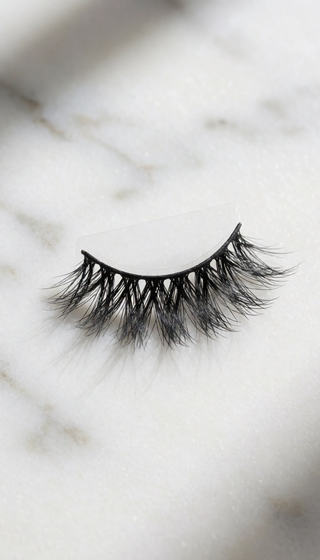
FALSE EYELASHES MAKEUP MYTHS: WHAT ACTUALLY HELPS LASHES LAST
If you've ever peeled a lash off mid-event, re-glued a lifting corner in a bathroom mirror, or given up on a pair after a single wear, you're not alone — and it's probably not your fault. Most false lash failure comes down to three fixable things: the adhesion method, your application technique, and your aftercare routine. The lashes themselves are rarely the problem.
The single most useful thing to know before reading another word: lash longevity is a system problem, not a product problem. When you understand how adhesion actually works — and why it fails — you can make any pair last longer, whatever the style you choose.
Below, we break down the most persistent myths about lash longevity — the ones that keep you replacing pairs that should last far longer — and replace them with what the science of adhesion actually says.
MYTH #1: "ALL LASH ADHESIVES ARE THE SAME"
This is the most expensive myth in the lash aisle. Traditional strip lash glue relies on cyanoacrylate — the same family of compounds found in super glue — to bond a band to your skin. It works, but it comes with trade-offs: it can irritate the delicate eyelid, it degrades quickly when it meets the natural oils your skin produces all day, and it turns brittle in humidity and heat.
That's why a pair that feels secure at 6pm can be lifting by noon. The adhesive isn't failing because you did something wrong — it's failing because it's fighting your skin's biology every minute it's on. Adhesives also vary widely in formulation: latex-free options exist for sensitive eyes, and waterproof versions resist moisture better, but none of them escape the fundamental weakness of liquid glue meeting living skin.
Temperature swings make it worse: a lash applied in an air-conditioned room can fail faster once you step into summer heat, because the bond never fully stabilizes across the change.
MYTH #2: "MAGNETIC LASHES ARE ALWAYS THE EASIER, SAFER CHOICE"
Magnetic lashes solved the glue problem by clamping tiny magnets around your natural lashes or bonding to a magnetic liner. But "glue-free" doesn't automatically mean "better." The clamping pressure can weaken natural lashes over time, the magnets add weight that pulls at the lash root, and magnetic liner is still a liquid adhesive — it just moves the formula from the band to your lash line.
If your eyes are sensitive, swapping one irritant for another isn't a solution. The real question isn't "glue or magnets?" — it's "what holds the lash without stressing the eye at all?" That question is what drove the development of entirely new adhesion categories.
MYTH #3: "YOU NEED A PROFESSIONAL APPLICATION FOR LASHES THAT LAST"
Salon application is beautiful, but longevity is mostly technique, not venue. The three steps that determine whether a pair survives a full day happen in your bathroom, not a salon chair: a clean, oil-free lash line; a band trimmed to your exact eye width; and a full 30–60 seconds of drying time before you blink against the bond.
Skip any one of those and even the most expensive pair will fail early. Master them and an affordable pair can outlast salon results. Professionals simply repeat these steps hundreds of times until they're instinct — which means you can learn them too.
MYTH #4: "MORE GLUE MEANS LONGER WEAR"
It's intuitive — more adhesive, stronger hold. But excess glue is actually the fastest way to shorten a pair's life. A thick layer takes longer to dry, stays tacky, collects dust and oil, and creates a hard, visible edge that lifts first. The ideal bond is a thin, even layer that cures completely before the lash meets your skin.
The same logic applies to any adhesive system: the goal is full contact between band and lash line, not maximum product. Less, applied well, almost always outlasts more, applied hastily.
WHAT ACTUALLY HELPS LASHES LAST: THE SCIENCE OF ADHESION
Strip lash adhesion works through one of three mechanisms: traditional glue (cyanoacrylate bonding to skin), magnetic clamping (pressure around natural lashes), or micro-adhesion (a pressure-sensitive coating that grips the lash line without any liquid adhesive). Each has a different failure point — and understanding those failure points is the key to making any pair last.
Glue fails when it meets oil and moisture. Magnets fail when their weight and pressure fatigue the natural lash. Micro-adhesion fails only when the lash line is dirty or the band is the wrong width — which means both of its failure points are within your control.
The other half of longevity is the band itself. A stiff, heavy band fights gravity and your natural blink reflex. A flexible, lightweight band moves with your eye instead of against it, which is why material matters as much as the adhesive. When you evaluate any lash, you're really evaluating the system: band, coating, and fit working together.
Environmental factors matter more than most people realize. High humidity softens traditional glue bonds, while dry air makes them brittle. Oil-based makeup removers and heavy creams near the lash line are silent bond-breakers. If you live in a humid climate or have oily skin, the adhesion method you choose matters more than the lash style itself.
HOW TO EXTEND THE LIFE OF EVERY PAIR
Regardless of which lash type you wear, these five habits will measurably extend each pair's usable life:
- Start with a clean, oil-free lash line. Remove all makeup and let your skin settle for a few minutes before application. Even a trace of foundation or serum breaks the bond before it forms.
- Trim the band to your eye. A band that extends past your outer corner lifts first. Measure against your lash line and cut from the outer end, never the inner corner.
- Let the adhesive cure fully. Wait 30–60 seconds after applying glue or activating the adhesive before pressing the band into place. A tacky bond is a strong bond.
- Remove gently, never pull. Use an oil-based cleanser or warm water to dissolve the bond first. Pulling strips the coating off the band and can take natural lashes with it.
- Clean and store the band. After removal, peel off dried adhesive, wipe the band with a cotton pad, and return the pair to its case. A clean band re-adheres far better than a dirty one.
WHAT TO LOOK FOR IN A LONG-LASTING LASH
Now that you know what actually drives longevity, you can evaluate any lash against a clear checklist:
- Glue-free adhesion. If you have sensitive eyes or wear lashes daily, a liquid adhesive you never have to touch is the single biggest upgrade you can make.
- Hypoallergenic materials. The band and fibers should be free of common irritants, especially if you wear contacts or have reactive skin.
- Waterproof construction. Humidity, sweat, and tears shouldn't degrade the bond within hours.
- A lightweight, flexible band. It should follow your lash line without stiffness or visible edges.
- Enough styles to match your eye shape. A lash that fits your eye geometry stays put; one that fights it never will.
If a pair checks every box, you've found something worth keeping. Which brings us to the option that checks all of them.
- Glue-free, so nothing irritates. No cyanoacrylate, no latex, no liquid adhesive touching your lid — the most common cause of lash-day discomfort simply isn't there.
- 30+ wears, so durability is built in. The micro-adhesion coating re-grips cleanly after gentle cleaning, so one pair replaces dozens of single-use ones.
- Under $2 per wear, so the value adds up. At $59 per pair, the cost per wear is a fraction of a salon appointment or a steady rotation of disposable pairs.
PHANSTA LASHES: THE GLUE-FREE ANSWER TO EVERY FAILURE POINT ABOVE
Every failure point you just read about — oil degrading glue, magnets weighing down the lash root, brittle bands fighting your blink — is exactly what PHANSTA LASHES was designed to eliminate. Instead of liquid glue, magnets, or liner, PHANSTA LASHES use a glue-free micro-adhesion technology: a pressure-sensitive coating that grips your lash line directly, with nothing to irritate, nothing to degrade, and nothing to clean off at the end of the night.
The result is a pair that holds through humidity, sweat, and long days — and lasts far longer than a single evening. With proper care, each pair delivers 30+ wears, which at $59 works out to under $2 per wear. The range comes in 17 styles, so there's a fit for every eye shape, and the construction is hypoallergenic and waterproof throughout.

FREQUENTLY ASKED QUESTIONS
How do I make my false lashes last longer?
Start with a clean, oil-free lash line, trim the band to fit your eye width, and let the adhesive cure for 30–60 seconds before pressing it into place. Remove gently with an oil-based cleanser, clean the band after each wear, and store the pair in its case. These five habits alone can dramatically extend the life of any pair.
Are glue-free lashes as secure as traditional glued lashes?
Glue-free lashes that use micro-adhesion technology grip the lash line through a pressure-sensitive coating rather than liquid adhesive. When applied to a clean, oil-free lash line, the bond is strong enough to survive humidity, sweat, and long days — without the irritation, brittleness, or degradation that comes with traditional glue.
Can I wear false lashes if I have sensitive eyes?
Yes, as long as you choose hypoallergenic materials and avoid liquid adhesives that contain common irritants like cyanoacrylate or latex. Glue-free options eliminate the adhesive entirely, which removes the most frequent cause of lash-day discomfort. If you wear contacts, look for lightweight bands that won't press against the lens.
How many times can I reuse a pair of false lashes?
With proper care — gentle removal, cleaning the band after each wear, and storing the pair correctly — a well-made glue-free pair can deliver 30+ wears. That's the difference between a pair that lasts one evening and one that becomes a reliable part of your routine for weeks.
What's the difference between magnetic and glue-free lashes?
Magnetic lashes clamp tiny magnets around your natural lashes or bond to a magnetic liner, which adds weight and pressure at the lash root. Glue-free lashes use micro-adhesion to grip the lash line directly — no magnets, no clamping, no liquid adhesive — so there's nothing to irritate the eye or fatigue natural lashes over time.
STILL COMPARING OPTIONS? Explore our guides on finding your perfect lash, magnetic vs strip, and sensitive eyes.
FIND THE PERFECT LASH — Not sure which style suits you? Take the 30-second lash finder quiz →
NOT SURE ABOUT YOUR EYE SHAPE?
Find your eye shape and get personalized lash recommendations:
FIND THE PERFECT LASH FOR EVERY MOMENT
Explore our occasion-specific lash guides:
EXPERIENCE THE DIFFERENCE
Join thousands of women who have made the switch. No glue, no damage, no salon appointments — just beautiful lashes in seconds.
SHOP PHANSTA LASHES →