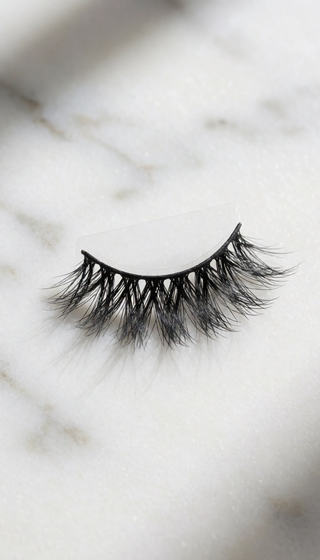
False eyelash and eyeliner myths busted: learn when liner hides a band, when to skip it, and how to create a seamless lash line.
No—you do not need eyeliner with false eyelashes unless you want to camouflage a visible band, fill a deliberate gap, or create a more defined shape. If the fibers blend into your natural lashes, adding a dark line does nothing except create a second edge. The most convincing finish comes from continuity, not extra pigment.
The irritating part is watching a beautiful lash set look expensive in the package and then suddenly appear to be floating above your own lashes under bathroom light. That harsh strip is usually the band, a small gap in the fibers, or a color mismatch—not a failure in the lash style itself.
Key Takeaway: Eyeliner is optional camouflage, not a required step. Skip it when the lash line already looks continuous; use a slim, soft line only where contrast or a gap interrupts the result.
Frequently Asked Questions
How long do PHANSTA LASHES last?
PHANSTA LASHES can be worn all day and reused multiple times with proper care. A single pair typically lasts 10-15 wears when stored and cleaned correctly, making them an excellent value compared to traditional strip lashes.
Are PHANSTA LASHES safe for sensitive eyes?
Yes. PHANSTA LASHES are made with hypoallergenic materials and require no adhesive, making them ideal for sensitive eyes, allergy sufferers, and contact lens wearers.
How do I apply PHANSTA LASHES?
PHANSTA LASHES apply in seconds — simply measure, trim if needed, and press onto your lash line. No glue, no drying time, no mess.
Can I reuse PHANSTA LASHES?
Absolutely. PHANSTA LASHES are designed for multiple wears. Clean them gently after each use and store in the original tray to maintain their shape and adhesive properties.
Why Does a False Lash Set Look Fake Even When the Lashes Look Beautiful?
Eyeliner earns its place only when it solves a visible problem. If the fibers meet your natural lashes and the band disappears, stop there. If you see a hard line, a small gap, or an abrupt change in density, a slim line can make the set appear continuous. The goal is camouflage, not another layer of makeup.
Human lashes are extremely fine. Cosmetic research summarized in the International Journal of Cosmetic Science places adult upper-lash diameter at approximately 0.06–0.10 millimeters, although individual follicles vary. At that scale, a dark band can appear more prominent than several rows of delicate fibers.
| What you notice | What is probably happening | Best correction |
|---|---|---|
| A hard line beneath the fibers | The band contrasts with your skin or natural roots | Skip liner if it blends naturally; use a 1–2 mm soft line only if the band still shows |
| A bright gap at one or both ends | The lash is too narrow, shifted sideways, or lacks graduated fibers | Reposition it first; fill only a remaining gap |
| A sudden jump from thin to thick | The style or density does not match your natural lashes | Choose a softer or more graduated set rather than coating the entire lid |
| A black “root” under the set | Eyeliner is too opaque or extends beyond the gap | Reduce it to short, broken sections beneath the transition area |
A useful cosmetic guidepost is a soft line approximately 1–2 millimeters wide. That is narrow enough to disguise contrast without becoming the dominant feature. Check the result from about 15 centimeters away and again at arm’s length; eyeliner that looks necessary up close may be invisible in a normal social distance.
A 2006 lash-biology review in the British Journal of Dermatology describes the active growth phase as roughly 2–7 months and the resting phase as about 4–9 months. Your natural lashes therefore do not form a perfectly uniform ruler at all times. Avoid using one heavy line to “correct” every natural variation.

Which False Eyelash and Eyeliner Myths Should You Ignore?
The most persistent false eyelash and eyeliner myths treat liner as a cure-all. It cannot make a hard band disappear, equalize sparse fibers, or rescue a set positioned at the wrong angle. Its actual job is much narrower: soften contrast, connect empty spaces, and clarify the shape you want.
| Myth | The fact |
|---|---|
| “Eyeliner is mandatory with false eyelashes.” | It is optional. A continuous, well-matched lash line needs no added color. |
| “The blackest pencil makes every lash set look better.” | Maximum darkness can emphasize both the band and the liner. A softer charcoal or brown tone in a 1–2 mm line is more forgiving. |
| “If the band shows, keep drawing until it disappears.” | More pigment creates a sharper edge. A mismatched or high-contrast band is better handled by changing the fit or lash style. |
| “Tightlining makes natural lashes grow faster.” | No cosmetic line changes the documented growth cycle. Research places the active phase at about 2–7 months and the resting phase at 4–9 months. |
| “Waterproof liner is automatically safer.” | Water resistance does not guarantee gentleness. A formula that demands hard rubbing is a poor choice around the eye. |
| “Only traditional glue lashes need eyeliner.” | Band visibility matters regardless of the application method. Any set with a contrasting band can benefit from subtle camouflage. |
| “A long line makes short lashes look longer.” | Actual length comes from the fibers. Eyeliner can define the tail, but painting far past the natural endpoint often looks exaggerated. |
| “Constant adjusting keeps lashes secure.” | Repeated pulling adds friction to an area measured in fractions of a millimeter. The FDA advises against sharing eye cosmetics and using them over an active eye infection. |
The practical lesson is simple: correct contrast, not skin. Before reaching for eyeliner, ask whether the problem is color, position, spacing, or shape. Eyeliner can soften the first issue and refine the last two, but it cannot physically move fibers or change a band’s construction.

Where Should Eyeliner Go If You Decide to Use It?
Place eyeliner where it improves the silhouette, not across the entire lid. Use a narrow line to connect the natural roots, a slightly wider shadow to soften the transition, or a short wing to extend the outer corner. Keep product away from the eye opening and avoid filling the tear duct.
| Technique | How to do it | Cosmetic guidepost |
|---|---|---|
| Band camouflage | Fill only the visible spaces beneath the fibers, using short strokes rather than one solid block | Approximately 1–2 mm |
| Soft definition | Trace just above the roots with a blurred pencil or shadow and keep the pressure light | Approximately 2–3 mm |
| Tightlining | Place a soft product between visible natural roots, not deep inside the eyelid margin | Dashes of roughly 2–3 mm |
| Winged finish | Begin at the outer third of the lash line and connect the tail before filling the inner section | Extend 2–5 mm for most everyday looks |
These millimeter ranges are styling references, not medical limits. A wax pencil offers more control over placement; liquid liner produces a sharper edge but leaves less room for correction. If a no-glue lash is designed to adhere directly to bare skin, assume that liner residue can interfere with the bonding area unless its instructions say otherwise.
For safety, the U.S. Food and Drug Administration recommends clean hands, clean applicators, and eye cosmetics that are not shared. The American Academy of Ophthalmology advises removing the products and seeking medical care if eye-area makeup is accompanied by pain, marked swelling, light sensitivity, discharge, or changes in vision.
Does Every False Eyelash Style Need a Little Eyeliner?
No. The closer the style matches your natural lash pattern, the less likely you need liner. Half lashes usually need attention only where they meet the inner edge, while dense or sharply defined sets often look better without one. Eyeliner becomes useful when you want to change the shape—not simply add darkness.
| Lash style | Why the line may look uneven | Liner decision |
|---|---|---|
| Half lash | The style commonly covers only the outer 50–75% of the lid, leaving a deliberate inner transition | Use a 1–2 mm wispy line only across that junction |
| Natural or wispy | A solid black root contradicts the feathery fibers | Usually skip liner or use a barely visible tint between roots |
| Dense statement lash | A dark band plus opaque liner creates two heavy horizontal edges | Skip it when the band blends; otherwise use the narrowest line that closes the gap |
| Short or straight natural lashes | The set can end abruptly at the outer corner | Define the outer third first; extend only if you want a wing |
| Long or upward-curled lash | The fibers already supply length, curvature, and visual movement | No liner is needed for a clean, soft-glam finish |
- No visible transition? Leave the lid bare.
- A gap only at the inner junction? Conceal just that area.
- The entire band contrasts? Reassess the style before adding a broad line.
- The outer corner looks unfinished? Add definition there before touching the rest of the eye.
Your natural lashes measure only about 0.06–0.10 mm in diameter, according to cosmetic lash research. A harsh line around fibers that fine can look heavier than the lashes themselves, which is why restraint usually creates a more seamless result.
How Do Lash Color and Band Visibility Change the Eyeliner Decision?
Color matching matters more than using the same exact shade. A warm brown lash can disappear against a cool black liner, while a black band beneath taupe fibers becomes more obvious. Judge contrast from both close and conversational distance, then decide whether eyeliner is genuinely disappearing or simply adding another dark element.
| Color situation | Why it looks obvious | Useful approach |
|---|---|---|
| Black fibers with a black liner | The two products merge into one heavy root | Skip liner or use a very thin, broken line only at a gap |
| Dark-brown fibers with black liner | The cooler, darker pigment increases contrast | Choose warm brown or a soft charcoal within the same tonal depth |
| Blonde or taupe fibers | Black creates an immediate outline around the lash set | Use a neutral brown-gray tint sparingly or wear the lashes bare |
| Colored fibers | Neutral liner can drain color from the look | Skip it for a clean color story or repeat the lash tone in a 1–2 mm accent |
Test the combination under 2 lighting conditions: cool daylight reveals true color contrast, while warm indoor light shows how pronounced the line will look in photographs. Inspect the set at
Stop Struggling with Glue — Try PHANSTA LASHES Today
Thousands of women have switched to PHANSTA LASHES. No glue, no damage, no complicated application. Just beautiful lashes that stay perfect all day.