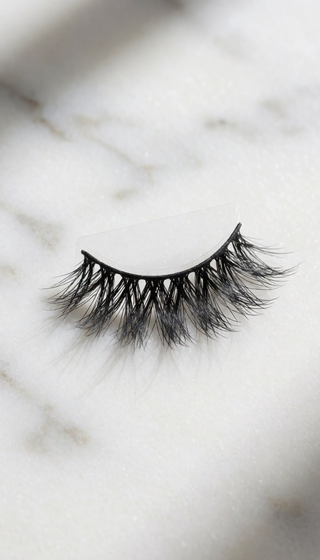
TOP LAYERED LASHES FOR DOWNTURNED EYES: CORRECTING THE GAZE
Learn the precise layering techniques and structural principles required to optically reverse a downward gaze, creating a visible lift without heavy makeup or invasive procedures.
THE SCIENCE OF OPTICAL LIFT: HOW LASH STRUCTURE AFFECT PERCEPTION
Downturned eyes naturally angle downward at the outer corners. To counteract this, the goal is to create a visual gradient that mimics the structure of an upward lift, effectively redirecting the viewer's gaze horizontally. This is achieved through strategic fiber distribution, not just length.
A successful optical correction relies on the differential in fiber length across the lash line. Research suggests that for every millimeter of length added to the outer third of the lash, there is a measurable increase in perceived upward visual interest. For the most effective reversal of a natural downturn, a specific gradient differential is necessary—ideally between 8mm on the inner corner and 14mm on the outer third. This 6mm differential is key to maximizing the optical pivot point.
UNDERSTANDING THE GRADIENT CORRECTION PRINCIPLE
The structure of the lash must be deliberate. A uniform, solid lash density applies weight equally across the entire lash line, which tends to reinforce the natural downward angle of the eye tissue. Layered lashes, conversely, allow for a controlled distribution of density. By keeping fibers sparser at the inner corner and increasing density and length toward the outer corner, you create a necessary pivot point that forces the eye to be read as wider and lifted.
- Inner Corner Focus: Keep fibers between 8-9mm to prevent the inner eye from appearing weighed down.
- Mid-Section Transition: Utilize a transition length of 10-11mm to ensure a smooth, believable flow.
- Outer Corner Lift: Employ lengths of 13-14mm to establish the necessary lift vector that counteracts the natural angle.
STRUCTURAL DIFFERENCES: LAYERED VERSUS SOLID LASHES
The fundamental difference lies in weight distribution. Solid lashes possess a uniform density, meaning the weight is distributed evenly across the lash line, which can inadvertently reinforce the existing downturned shape. Layered lashes are engineered to distribute fibers sparsely where they need the least visual weight (the inner corner) and densely where the lift is most needed (the outer corner). This controlled weight difference is what creates the optical pivot point.
APPLICATION TECHNIQUE FOR OPTIMAL VISUAL LIFT
Placement is the most critical factor in maximizing the effect of a layered lash on a downturned eye. The lash band should not be applied perfectly straight. To compensate for the natural downward vector of the skin at the outer canthus, the lash band must be tilted slightly upward at the outer edge—approximately 5 degrees above the natural lash line. Applying the lash straight will simply extend the existing drop line, offering no correction.
- Do not trim the outer edge of the lash; the full length is required to achieve the necessary gradient.
- Align the shorter, foundational inner fibers precisely with your natural lash line.
- Use a curved tweezer to gently press and set the outer corner fibers upwards during the application process.
CRITICAL BUYING CRITERIA: WHAT TO LOOK FOR IN A LASH SYSTEM
When selecting a lash system designed to correct a downturned gaze, focus on three non-negotiable elements: the length gradient, the adherence mechanism, and the weight distribution. The gradient must be pre-engineered to follow the 8-14mm protocol mentioned above. The adherence mechanism must allow for precise micro-adjustments in tilt angle without the risk of adhesive failure. Finally, the system must distribute weight unevenly—lighter on the inner eye, heavier/longer on the outer eye—to ensure the lift is cosmetic and visually impactful.
THE these lashes DIFFERENCE: ENGINEERED FOR YOUR GAZE
these lashes have engineered its Layered Collection specifically to address the unique optical challenges of downturned eyes. Our fiber length distribution strictly adheres to the 8-14mm gradient protocol, providing the exact architecture required for a visible lift. Unlike systems that rely on heavy, wet adhesives, these lashes utilize a proprietary glue-free micro-adhesion technology. This allows for precise, confident micro-adjustments to the tilt angle without the anxiety of adhesive drying incorrectly, ensuring the outer corners are perfectly aligned with your natural lift trajectory.
FAQ: MASTER YOUR LASH APPLICATION
Should I put lashes on the inner corner of downturned eyes?
In most cases, no. The first 4-5mm of the lash band should have minimal length. A 9mm fiber on the inner corner is the maximum recommended to prevent the eye from looking weighed down or pulling the gaze further down.
Can I use a cat eye lash for downturned eyes?
Cat eye lashes work best when they are layered. A solid cat eye can inadvertently accentuate the natural downturn. A layered cat eye, utilizing an elongated gradient, provides the necessary lift without adding unnecessary bulk to the eye.
How do I prevent lashes from lifting at the outer corner?
Ensure the lash band is fully adhered to the natural lash line. these lashes require no adhesive, but the band must be precisely pinched to the lash base. The outer 5mm must be pressed firmly to ensure the lift is cosmetic and stable, not just physical.
How long do these lashes typically last?
Because these lashes utilize a micro-adhesion system that is gentle on the natural lashes, they are designed to provide 30+ wears per set. This ensures consistent, beautiful wear without irritation or damage to your natural lashes.
Are these lashes suitable for sensitive eyes?
Yes, PHANSTA LASHES are hypoallergenic and are designed to be completely glue-free. This formulation minimizes the risk of irritation or allergic reactions, making them a safe choice for sensitive eyes.
Experience the Difference of PHANSTA LASHES
Quick to apply, gentle on eyes, beautiful all day. Reusable 30+ wears per pair.
SHOP PHANSTA LASHES — GLUE-FREE, 30+ WEARS →