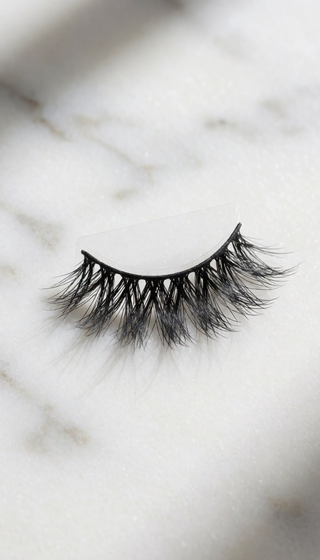
THE TRUTH ABOUT these lashes LASH DURABILITY
GET MORE WEAR: THE TRUTH ABOUT GLUE-FREE LASH DURABILITY
Glue-free lashes can last, but the wear count is only one part of the story. Learn how surface preparation, placement, band contact, and care determine whether a set stays secure.
QUICK ANSWER: Lash durability is not a fixed promise attached to a style. It is the result of four controllable variables: a clean, dry lash line, full band contact, a fit suited to the eye, and careful removal and storage. Oil, skincare, eye cream, moisture, rubbing, and folding can interrupt contact or damage the band. Two sets can behave differently because those variables differ. The practical goal is not endless wear; it is to remove avoidable failure points and assess any wear claim under realistic conditions.
- Clean, then dry: Remove oils, moisturizer, mascara, and cream from the lash line before placement.
- Press for contact: Seat the band where directed and press along its length without pulling the fibers.
- Treat the first minutes gently: Avoid rubbing or adjusting the band while the system sets.
- Remove and store carefully: Peel slowly, keep the shape protected, and do not crush the band.
WHAT ACTUALLY CONTROLS LASH DURABILITY?
Durability is a system, not a single material claim. Four things must work together: a residue-free lash line, a band that fits the eye, full contact along that band, and a wear-and-removal routine that protects it. If one variable fails, the set may lift even when another performs well.
SURFACE CHEMISTRY, OIL, AND FRICTION
Traditional liquid glue and micro-adhesion films work differently, but both rely on surface contact. A micro-adhesion film is designed around the skin’s natural texture, while oils, moisturizers, sweat, water, and rubbing can still interfere with an even bond. A stiff, folded, or twisted band creates uneven pressure; a flexible band that lies close to the lash line generally distributes contact more evenly.
- Surface: Residue prevents clean, even contact.
- Fit: Length and curvature determine whether the band stays aligned.
- Movement: Rubbing and touching create friction at the edge.
- Condition: Moisture, makeup, and handling can distort the band.
Think of adhesion as a chain: weak preparation, poor fit, or careless removal can break it before the stated wear cycle is tested.
PREP AND APPLY IN STEPS THAT SUPPORT EVERY WEAR
The sequence matters because each step protects the next one. Start with clean hands, a clean lash line, and enough time for the area to dry completely before touching the attachment surface.
- Clean the lash line. Remove oils, moisturizers, eye cream, and makeup residue rather than relying on a quick pat that may leave a film.
- Dry completely. Let the skin air-dry and confirm that no moisture remains before placement.
- Expose the bonding surface only when ready. If protective backing is present, remove it as directed and avoid touching the adhesive side.
- Let it settle briefly. Follow the system directions before seating the band so the specialized film can begin conforming to the lash base.
- Align and press. Guide the band along the natural lash line without pushing it onto wet skin, then press from the center outward without tugging individual fibers.
If a set lifts within hours, inspect the cause before blaming the lash. Oil residue, a poor fit, early touching, or forceful removal are controllable variables—not automatic signs that more pressure is needed.
REMOVE AND STORE THEM SO THE BAND STAYS USABLE
Durability is not only an application test. The way a lash comes off affects whether the band keeps its shape and whether the attachment surface remains even for the next wear.
- Remove gently. Loosen the band at the edge, then peel away slowly while supporting the fibers so one strand is not pulled loose.
- Follow the removal directions. Use the method specified for the system rather than forcing a glue-on technique onto a different type of lash.
- Store with shape protection. Keep the lashes in a clean, dry case or flat in their tray where the band cannot crease or collect dust.
- Inspect before reuse. Replace a set if the band is visibly bent, cracked, unevenly tacky, or no longer sits flat against the lash line.
Sharing is also unnecessary. Clean hands reduce avoidable transfer, and a lash should not continue being worn if the eye area is irritated or the band has contacted contaminated makeup.
DURABILITY MYTHS THAT NEED BETTER CONTEXT
These shortcuts can make two lash systems look comparable when their attachment methods and care requirements are completely different.
- Waterproof means indestructible: Water resistance does not cancel friction, oils, poor preparation, or physical damage to the band.
- More glue always means longer wear: Extra adhesive can add residue and does not correct a poor fit, uneven contact, or careless removal.
- Every secure feeling guarantees the same result: Comfort at first touch says little about preparation, band condition, and careful reapplication.
- A lifted set was necessarily poor quality: Application errors, skin products, rubbing, eye movement, and storage can all change the result.
A mechanism comparison keeps the categories clear:
| ATTACHMENT CATEGORY | HOW IT WORKS | WHAT TO EVALUATE |
|---|---|---|
| LIQUID-GLUE STRIP LASHES | Adhesive sits along the natural lashes. | Glue, preparation, drying, residue, and band fit. |
| MAGNETIC LASHES | Separate pieces attract magnetically. | Alignment, magnet strength, and eyelid movement. |
| MICRO-ADHESION LASHES | A specialized film contacts the lash line. | Surface cleanliness, full contact, and band condition. |
The mechanism alone does not guarantee a result; technique, fit, materials, and care complete the picture.
WHAT TO LOOK FOR IN A DURABLE, GLUE-FREE SOLUTION
After comparing mechanisms, use a practical checklist instead of relying on a broad durability promise.
- Clear mechanism: The description should state exactly how the lash attaches, including whether glue, magnets, or a liner are involved.
- Realistic wear language: Look for a specific wear count plus care conditions rather than an absolute promise of permanent use.
- Comfortable construction: A flexible, lightweight band that follows the eye without sharp edges improves alignment and reduces unnecessary lifting.
- Eye-area considerations: Clear waterproofing and hypoallergenic claims make it easier to compare systems suited to moisture and sensitive skin.
- Repeatable instructions: Preparation, activation, placement, removal, and storage guidance should be easy to follow and consistent with the stated durability.
A solution that combines a transparent mechanism, flexible construction, a realistic wear statement, and repeatable care addresses the whole durability problem rather than one symptom.
CHOOSE FROM 17 STYLES
For application, cleanse and fully dry the lash line, remove the protective backing as directed, allow about 30 seconds for the micro-adhesion layer to settle, then align and press the band into place.
NEED SHAPE DIRECTION? Explore the guides for Hooded Eyes, Almond Eyes, and Round Eyes.
PHANSTA LASHES: THE GLUE-FREE MICRO-ADHESION ANSWER
PHANSTA LASHES brings that checklist together with glue-free micro-adhesion rather than glue, magnets, or a liner. The specialized layer is designed to secure the band along a clean, dry lash line, addressing the same surface, fit, contact, and care variables that determine durability.
The lashes are waterproof and hypoallergenic, with a stated wear cycle of 30+ wears when used as directed. PHANSTA LASHES offers 17 styles for $59; based on that wear cycle, the cost is under $2 per wear.
FREQUENTLY ASKED QUESTIONS
HOW DO PHANSTA LASHES ADHERE Without adhesive?
PHANSTA LASHES use a micro-adhesion film rather than liquid glue, magnets, or a liner. The film is designed to attach to the natural texture around the lash line. Start with clean, fully dry skin, follow the activation and placement directions, and press the band into continuous contact. Preparation matters as much as the attachment mechanism itself.
CAN I WEAR PHANSTA LASHES THROUGH WATER OR SWEAT?
Yes. PHANSTA LASHES are waterproof, so the band is designed to tolerate normal moisture, humidity, and light activity. Water resistance does not make the lash indestructible or remove the effects of rubbing, oils, poor preparation, or forceful removal. If moisture collects at the edge, avoid rubbing it away and follow the stated application and removal directions.
HOW CAN I SUPPORT THE STATED 30+ WEARS?
Clean, fully dry skin and complete contact are the starting points. Remove oils, moisturizers, eye cream, and makeup residue, then follow the directions for exposing and activating the bonding surface. Press along the full band and avoid early adjustment. To support the stated 30+ wears, remove slowly, store the case, and replace a set with a distorted band.
ARE PHANSTA LASHES SUITABLE FOR SENSITIVE EYES?
PHANSTA LASHES are hypoallergenic, which means the material is formulated to reduce the likelihood of irritation-related concerns. It does not mean every person will react identically or that eye symptoms should be ignored. Stop use if you notice redness, itching, pain, discharge, or swelling, remove the lash, and seek qualified medical advice when symptoms persist or affect vision.
HOW DO PHANSTA LASHES DIFFER FROM MAGNETIC LASHES?
PHANSTA LASHES do not use magnetic attraction. Their glue-free micro-adhesion film attaches along the lash line without separate magnetic pieces, glue, or a liner. Magnetic lashes are a separate category that depend on magnets holding two pieces together. Comparing the mechanisms helps you identify the parts you handle, the attachment steps required, and the care each design needs.
STILL COMPARING OPTIONS? Explore our guides on finding your perfect lash, magnetic vs strip, and sensitive eyes.
FIND THE PERFECT LASH — Not sure which style suits you? Take the 30-second lash finder finder →