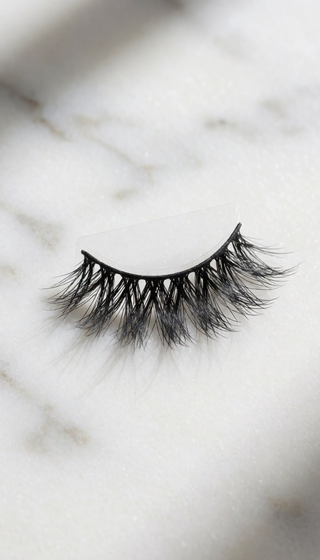
DISCOVER HOW TO CREATE A FEATHERY, EDGY LOOK WITH SPIKY SMALL LASHES

Spiky small lashes are a mixed-length style that makes natural lashes look fuller without creating one heavy, uniform fringe. Most maps pair a roughly 6–8 mm base with occasional 10–12 mm spikes. Shorter fibers add texture around the roots, while longer fibers create separation and movement. The goal is a feathery base with lightly edgy tips—not a spiky fringe sitting heavily over the eyelid.
This style can suit hooded, monolid, deep-set, round, and upturned eyes, but no single length is automatically right for everyone. Match the curl and direction to your natural lashes, then place the longest fibers where your lashes need visible lift. If you are new to the style, choose moderate spikes and compare two maps from both the front and side before choosing a shape.
A useful rule is to use short fibers for fullness, longer fibers for separation, and the few longest spikes for accent. A mixed map also makes a slightly irregular natural lash line look more intentional. That balance is why the style can read as “my lashes but better” rather than a full-glam transformation.
If your goal is an everyday look, keep the longest spikes toward the outer half and leave the inner corner shorter. This keeps attention on the iris rather than the lash band. For an evening look, a stronger central spike or an elongated outer tail changes the emphasis without changing the underlying mixed-length structure.
SPIKY SMALL LASHES, DEFINED IN PLAIN LANGUAGE
“Spiky small” describes a length pattern rather than one fixed lash category. A short, wispy set may be spiky if it has clear length variation; a longer set may also be spiky. Because the terms spiky, small, and wispy are sometimes mixed together, inspect the actual length map instead of relying on the style name alone.
Spacing determines how dramatic the result looks. Several long fibers grouped together create a noticeable point, while longer fibers scattered among short ones produce a softer, blended finish. For an everyday result, look for a gradual range instead of isolated dramatic spikes. For a more defined effect, concentrate the longest points at the outer third or just above the center of the eye.
Texture matters as much as length. Fine fibers blend into natural lashes and preserve a feathery finish; heavier fibers make each spike easier to see. A balanced map should look full in daylight and still appear intentional when viewed from the side.
MATCH THE SPIKE PATTERN TO YOUR EYES
Use a four-part fit check. First, confirm a genuine mix of short and long fibers rather than one uniform fringe. Next, look for C or CC curl, which can lift a mixed map without forcing it straight upward. Then note the fiber thickness: 0.05–0.07 mm generally creates a softer, feathery finish. Finally, favor a thin, flexible band that follows the lash line without poking the eyelid.
For hooded or monolid eyes, visibility matters more than maximum length. A taller curl or a few longer spikes may make the lash line easier to see from the front, but an overly long center section can disappear into the crease. Check the set in profile as well. If the fibers point upward while your natural lashes angle outward, the map may look detached.
Deep-set eyes often suit moderate length with a controlled outer tail. Place the strongest definition one-third to halfway from the outer corner rather than directly at the inner lash root. Round or upturned eyes can usually carry a slightly longer spike because the eye line already has lift. Compare every map against gaps in your natural lashes, and shorten any fibers that touch the lid.
APPLY THE LOOK WITHOUT RUSHING OR OVERPULLING
Application works best as a sequence rather than a race. Set out the sections, organize them from short to long, and keep the mirror, fingers, and lash line free of oil.
- Brush natural lashes upward and remove any remaining mascara or eye product.
- Measure each section against the natural lash line and trim only where necessary.
- Place shorter sections near the inner corner, then balance the center and outer sections.
- Follow the product’s placement method. With glue, allow the adhesive to become tacky as directed; with glue-free micro-adhesion, press each section into its intended position.
- Hold the band gently against the lashes for a few seconds. Do not pull the natural hairs outward to make the fit seem tighter.
Removal is where many sets fail. Loosen the bond using the method approved for that product, then lift the band straight away without pinching the fibers. If adhesive is involved, give it time to release. Peeling a dry set can bend the band, damage fibers, or pull natural hairs.
Do not apply eye-area products over irritated skin. Stop using the lashes if pain, swelling, persistent redness, or light sensitivity occurs. Eye shapes and tolerances differ, so comfort should take priority over forcing a dramatic map.
SPIKY SMALL VS. OTHER LASH STYLES: A QUICK COMPARISON
Choose by the finished effect rather than by the shortest or longest number on the package. These four categories can overlap, but their dominant shapes create noticeably different results.
| Style | Vibe | Best For | Maintenance | Length Range |
|---|---|---|---|---|
| Spiky Small | Feathery, lightly edgy | Natural texture with definition | Low | 6–12 mm |
| Classic | Clean and defined | First-time wearers | Medium | 8–13 mm |
| Volume | Fluffy and dramatic | Full-glam looks | High | 8–15 mm |
| Wispy | Soft and doll-like | Lightweight everyday wear | Low | 7–14 mm |
Spiky small suits someone who wants visible separation without full-glam density. Classic lashes create a cleaner, more uniform outline. Volume styles use greater density to change the entire eye shape, while wispy lashes soften the lash line with longer, diffused fibers. If the goal is “my lashes but better,” spiky small or wispy textures will usually feel more restrained than volume.
FIX THE COMMON MISTAKES THAT CHANGE THE LOOK
Placing every spike at equal intervals: Even spacing can look mechanical and overly twiggy. Group some longer fibers, then leave small areas of shorter texture between them. Randomness should look balanced rather than chaotic.
Ignoring the band: A thick or rigid band can lift at the corners and pull the entire map away from the lash line. Check flexibility before application and make sure each section sits close to the natural lashes.
Judging only from the front: Some spikes look attractive head-on but disappear into the crease or point toward the temple. Take a quick front photo and a side photo to evaluate lift, spacing, and projection together.
Removing or caring for the style roughly: Oil, water, sweat, and sleeping in lashes can weaken a bond or distort a band. Remove gently, clean according to the care directions, and store sections flat so their shape does not crease.
WHAT TO LOOK FOR IN A WEARABLE SOLUTION
A well-designed option should combine true mixed lengths, directional curl, fine and flexible fibers, and clear care guidance. It should let you control where the longest spikes appear rather than forcing one universal map onto every eye. Comfort matters just as much as appearance: the edges should sit against the lashes without lifting, poking, or dragging on the eyelid.
Before choosing, test the fit for a short period, move through your normal routine, and check the lash line from the front and side. Compare the intended texture with the completed look after movement, not only the initial application. Realistic reuse guidance is also more useful than vague longevity claims because proper storage and cleaning affect the result.
“I don’t want glue beside my eye.” Micro-adhesion keeps the lash map separate from the skin and removes the glue step. The hypoallergenic designation is relevant for sensitive eyes, although no eye-area product can promise zero reaction. Stop using the lashes if irritation develops and seek professional advice when symptoms persist.
PHANSTA LASHES: GLUE-FREE SPIKY SMALL LASHES WITH MICRO-ADHESION
Those fit checks narrow the field to a solution that combines a visible mixed-length map with a light, glue-free application. That is where PHANSTA LASHES fits naturally. The range offers 17 styles built around glue-free micro-adhesion, so there is no adhesive, magnet, or liner component. The lashes are waterproof and hypoallergenic, supporting a flexible routine without adhesive sitting on the skin.
“Will the style feel fragile after one use?” Each style is specified for 30+ wears when cared for as directed. That reuse allows you to rotate the map through workdays, weekends, and evenings instead of treating it as a single-event accessory.
“What does the cost work out to?” The set is $59 and delivers 30+ wears, putting the cost at under $2 per wear based on the stated reuse. The 17-style range lets you compare a softer spike with a stronger edge, while the glue-free format supports quick placement in seconds per eye.
FREQUENTLY ASKED QUESTIONS
What are spiky small lashes?
Spiky small lashes are a mixed-length style: shorter fibers build a feathery base while selected longer fibers create separation and a pointed outline. A typical map uses roughly 6–8 mm lengths with 10–12 mm accents. The exact look depends on spacing, curl, thickness, and placement, not the style name alone. Keep that map as your baseline when comparing options.
How long do spiky small lashes last?
Timing depends on the wearing method and care. Extensions remain only until your own lashes shed, while reusable strips vary with adhesive, application, and cleaning. PHANSTA LASHES are specified for 30+ wears when used as directed. Remove gently, clean the sections as instructed, avoid pulling the fibers, and store them flat between uses.
Can I wear spiky small lashes every day?
Yes, if the fit feels comfortable and you follow the care directions. Rotate placement so the same natural hairs are not forced in one direction every day, and remove the lashes before sleep. Water, sweat, and eye products can loosen the edges, so check the bond after moisture and follow the care directions rather than adding more product.
Which eye shapes suit spiky small lashes?
There is no single correct eye shape for the style. Hooded and monolid eyes often benefit from visible lift, deep-set eyes from moderate length and an outer tail, and round or upturned eyes from balanced central or outer spikes. Compare the map from the front and side, shorten any fibers that touch the lid, and prioritize comfort over maximum length.
Can sensitive eyes wear PHANSTA LASHES?
Hypoallergenic does not mean reaction-proof, so eye comfort still matters. PHANSTA LASHES use glue-free micro-adhesion and are labeled hypoallergenic, without adhesive, magnets, or liner. Test any new eye-area product cautiously, avoid using it on irritated skin, and stop if pain, swelling, persistent redness, or light sensitivity occurs.
KEEP LEARNING: 📚 Browse our complete library of lash guides →, plus guides for Wedding Lashes, Prom Lashes, Beach Lashes, and Festival Lashes.
STILL COMPARING OPTIONS? Explore our guides on finding your perfect lash, magnetic vs strip, and sensitive eyes.
FIND THE PERFECT LASH — Not sure which style suits you? Take the 30-second lash finder finder →
NOT SURE ABOUT YOUR EYE SHAPE?
Find your eye shape and get personalized lash recommendations:
FIND THE PERFECT LASH FOR EVERY MOMENT
Explore our occasion-specific lash guides:
EXPERIENCE THE DIFFERENCE
Join thousands of women who have made the switch. No adhesive, no damage, no salon appointments — just beautiful lashes in seconds.
SHOP PHANSTA LASHES — GLUE-FREE, 30+ WEARS →