LENGTHENING LASHES FOR HOODED EYES: THE GRADIENT APPROACH
Achieve Visible Eye Lift and Openness with the Correct Lash Gradient
If you have hooded eyes, the goal isn't just to make lashes longer; it's to create an optical illusion of lift. By strategically varying the length from the inner to the outer corner, you can break the horizontal line of the lid, making the eye appear more open and defined without heavy makeup.

Understanding the Physics of Visual Lift
The perception of eye shape is heavily influenced by where the visual weight of the lashes falls. For hooded eyes, a uniform lash length often blends into the crease, offering little visible change. The effective technique involves creating a deliberate diagonal tension. This is achieved by concentrating the longest, most voluminous lashes at the outer third of the eye. This concentration acts as a visual lever, drawing the eye upward and outward, effectively counteracting the downward pull of the hood.
The Science Behind the 5-Step Gradient Map
A successful lengthening map for this eye shape requires a precise, measurable progression. A standard approach dictates starting with a shorter length at the inner corner (e.g., 8mm). This length should then transition smoothly to a moderate length in the center (e.g., 10mm). The progression must accelerate toward the outer edge, reaching its peak length (e.g., 13mm to 14mm) at the very tip. This structured gradient is what creates the necessary diagonal line to visually lift the entire eye structure.
Optimizing Lash Structure for the Hood
The physical construction of the lash band is as important as the map itself. Look for bands engineered with a specific upward curve—ideally around 15 degrees—to ensure the lash sits in a naturally lifted position. Furthermore, the weight distribution must be weighted toward the outer third of the band to maintain this angled tension without causing discomfort or pinching at the inner corner. High-quality constructions often incorporate reinforced points to prevent the lash from sagging over time.
Addressing Common Application Challenges
When applying lashes to a hooded eye, the application distance matters. Applying the lash too close to the natural root can cause it to sit flat against the lid crease. The professional standard is to place the lash approximately 1mm above the natural lash root. This slight elevation creates a false crease, which helps open the lid visually. Additionally, if you need to customize the length, always trim from the outer edge first. Trimming the center compromises the engineered gradient that provides the lift.
What to Look For in a Solution
When selecting a lash system, prioritize three key elements: the engineered gradient, the adhesive technology, and the structural integrity of the band. The gradient must be pre-mapped for lengthening, not just a random mix of lengths. The adhesive must be reliable without causing irritation or compromising the lash's hold in the lid crease. Finally, the band itself needs to be designed to maintain its intended tension without requiring harsh adhesives that can damage the natural lash line.
The these lashes Engineered Solution
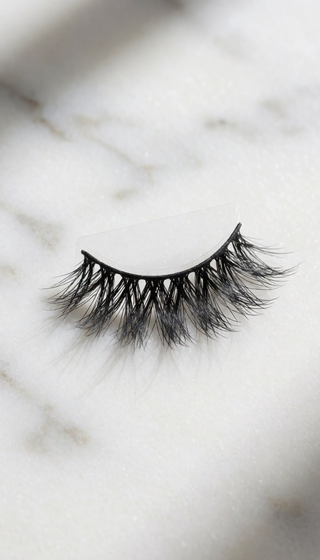
these lashes were developed specifically to address the structural demands of eye shapes like the hooded eye. We utilize a proprietary, glue-free micro-adhesion technology that adheres securely without the risk of adhesive seepage into the crease, a common issue with liquid formulas. Our collection features 17 distinct styles, including the Feline and Stiletto, which are engineered with the precise 14mm terminal spikes and angled tension required to create that visible, upward lift. With a design built for longevity, these lashes provide a high-impact look that lasts for 30+ wears, all while remaining hypoallergenic and waterproof.
Frequently Asked Questions
Question?
For hooded eyes, the lash curls up and out. A 14mm lash with an L curl sits parallel to the lens, not underneath it. Ensure the lash is curled to at least 45 degrees to achieve the desired lift.
Question?
The skinfold of the hood compresses the lash line, causing uniform lashes to fold over. A graduated lash with a high curl (D or L curl) aligns vertically with the hood, passing cleanly through the crease without collapsing.
Question?
Yes, you can trim, but always trim exclusively from the outer edge to preserve the essential inner gradient structure. A 5mm trim from the outer tip maintains the lift structure far better than trimming from the center.
Question?
For optimal visual effect, apply the lash 1mm above the natural lash root. This slight elevation creates a false crease, which helps to visually open and define the lid area for hooded eyes.
Question?
PHANSTA LASHES use a glue-free micro-adhesion system. This means there is no liquid adhesive to seep into the crease, ensuring the lash maintains its perfect position and lift throughout the entire wear period without irritation.
📚 Browse our complete library of lash guides →
FIND THE PERFECT LASH FOR EVERY MOMENT
Explore our occasion-specific lash guides:
No adhesive, no damage. Just beautiful lashes.
SHOP PHANSTA LASHES — GLUE-FREE, 30+ WEARS →