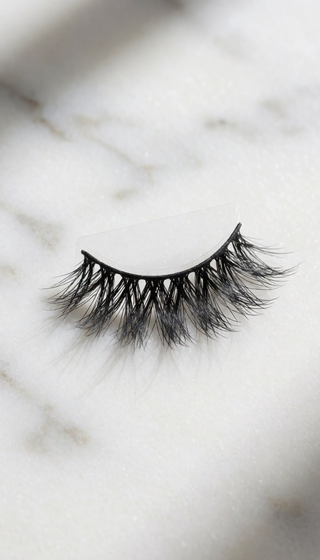
IMPROV THEATER LASHES: EXPRESSIVE EYES IN 30 SECONDS — WITHOUT STIFF STRIPS OR SWEAT-INDUCED SLIPS

Improv theater lashes should move with your face, not become the first thing you monitor before going onstage. The fastest reliable routine is simple: clean and fully dry the lash line, position the lash while the eye is half closed, secure it using its intended mechanism, then press along the band and test with a blink, smile, and eyebrow raise. With practice, that sequence can take about 30 seconds; allow extra time for a first fitting.
The most common backstage problem is not a dramatic failure. It starts when makeup residue, skin moisture, or a stiff band lets one corner separate, then movement pulls the rest away. Sweating under hot lights accelerates that process. A flexible band, correct preparation, and a full rehearsal are more useful than extra adhesive. If tears or costume rubbing are part of the scene, test those conditions rather than trusting a fit checked only at the mirror.
Use a four-part fit check before curtain: the skin is clean, the band flexes, the attachment sits evenly, and both corners stay seated when you change expression. A problem caught during rehearsal takes seconds to correct; the same problem during a scene can pull focus from the scene itself.
Before the audience arrives, test away from the mirror. Keep both sides mapped in the same orientation, press from the center toward the outer corner, and use a clean tissue or soft brush to check for residue. If one corner lifts, remove and reset from the beginning rather than forcing the edge back into place.
WHY SWEAT, TEARS, AND EXPRESSIONS BREAK THE SAME LASHES
A traditional glued strip depends on adhesive along its band. When you widen your eye, smile, or lift your brow, the skin and band move differently. A rigid strip can tug at the inner corner, while a band that sits unevenly creates snagging or pressure. Moisture can weaken many adhesives, and makeup oils, skincare, or primer residue can prevent the strip from sitting flat.
Tears are mostly water, but a heavy cry also brings salt, rubbing, and repeated hand contact. Sweat adds moisture that can mix with makeup. Neither proves that a particular lash will fail; it explains why even a well-chosen lash needs correct preparation. Dry the line, avoid rubbing, and rehearse with the makeup and costume you will actually wear.
Attachment method matters. Glue-on lashes need compatible adhesive and proper curing. Magnetic lashes are a separate category that uses matching magnetic components rather than an adhesive closure. Micro-adhesion is a third approach: no adhesive, no magnets, and no liner. Confusing these categories makes setup instructions unreliable, so identify the mechanism before applying any style.
Skin type also plays a role. Oily skin can break down adhesive faster than dry skin, and combination skin may produce more oil in the T-zone, including the lash line. If you know your skin tends toward oiliness, prepare the area with a gentle, oil-free cleanser and allow it to dry completely before application. Avoid applying moisturizer or primer directly on the lash line unless the lash system specifically calls for it.
Temperature and humidity backstage compound these factors. Hot stage lights raise skin temperature, which can increase oil production and perspiration. A crowded green room or quick-change area may have limited ventilation. These conditions do not make lash wear impossible, but they do mean that a fit tested in a cool, air-conditioned mirror may not survive the actual performance environment.
BUILD A FAST, REPEATABLE 30-SECOND LASH ROUTINE
Once you have chosen a lash for the look and mechanism, rehearse the same sequence until your hands can complete it without thinking:
- Prepare a clean, dry lash line. Remove eye makeup and use a gentle, residue-free remover where needed. Let skincare absorb, then confirm the skin is dry. Use primer only when the lash system specifically calls for it.
- Map the placement before attaching. Confirm the outer corner in the mirror. For a style designed to sit beneath natural lashes, place it below—not over—the naturals. This creates visible lift while allowing the fibers to blend with your own lashes.
- Follow the actual attachment system. Use compatible adhesive for a glue-on style, matching components for magnetic lashes, or the prescribed method for a micro-adhesion style. Do not assume one system's instructions or components apply to another.
- Press, blink, and check both corners. Use a clean fingertip to press along the band. Test slow blinks, quick blinks, a smile, and an eyebrow raise. If an edge lifts, remove the lash and reset it rather than adding pressure or adhesive.
For quick changes, prepare the lashes and tools on a clean tray and note the left and right orientation before you begin. Avoid adding heavy cream or powder to the lash line after attachment unless the system instructions allow it. A mapped, repeatable placement is faster than searching for the outer corner with one section already attached.
Timing improves with repetition. Run the sequence at home until you can complete it without looking at instructions. Then run it under performance conditions: standing, under lights, with costume and makeup already applied. The goal is muscle memory, so that backstage, your hands know the sequence even when your mind is on the scene.
RUN THE MOVEMENT TEST BEFORE THE AUDIENCE DOES
A mirror check tests stillness, not performance. Use a full rehearsal to reproduce the expressions and physicality of the scene:
- Blink slowly and quickly, then look up, down, and toward each side.
- Raise your brows, widen your eyes, squint, smile, laugh, and create an exaggerated double-take.
- Move through blocks that cause perspiration, but never scrub the lashes to test them.
- Wear the style for the entire rehearsal under the actual stage lights and makeup.
- Inspect the inner and outer corners after each sequence and carry a clean spare for a long run.
If a corner separates, note what caused it: oily skincare, a damp face, costume contact, or a heavy expression. Correct that variable before applying the lash again. Do not use extra adhesive as a substitute for diagnosing the fit.
The practical gain is freedom of attention. When the fit has been tested, you can listen, react, and commit to the scene instead of cupping one eye or checking the wing mirror after every line.
Improv adds another layer: you cannot predict every expression or physical choice a scene will demand. A lash that survives a scripted rehearsal may still fail when an unexpected laugh or exaggerated reaction pulls the skin in a new direction. This is why the movement test should include improvisational exercises—spontaneous facial expressions, sudden head turns, and physical comedy—not just the blocking you have planned.
COMFORT AND HYGIENE: PROTECT THE LASH LINE, NOT JUST THE LASH
Comfort depends on clean preparation, suitable weight, and prompt removal. A hypoallergenic label can reduce reaction risk but cannot account for every person or every product used around the eye. Waterproof describes resistance to water, not permission to ignore friction, oils, or rubbing.
- Wash your hands and keep fingers, tools, and storage surfaces clean.
- Do not share lashes or open used lashes with an unclean hand.
- Avoid rubbing your eyes and remove the lashes before sleep.
- Follow the system's removal and storage instructions after every wear.
- Discontinue use if you develop burning, swelling, redness, discharge, or pain.
People with a known eye allergy, recurring irritation, or a recent procedure should ask their eye-care professional for individualized guidance. A hypoallergenic designation is useful information, but it is not a personal medical guarantee.
Storage matters more than most performers realize. Lashes left on a counter or in a pocket collect dust, oils, and bacteria that can irritate the eye at the next application. A clean case that holds the band's shape preserves both hygiene and fit. If the band loses its curve during storage, the lash may not sit evenly on the lid, creating the same corner-lift problem that moisture or expression would cause.
WHAT TO LOOK FOR IN A LASH THAT MOVES WITH YOU
A stage-ready solution should satisfy the same practical criteria, regardless of its attachment technology. Before choosing a style, compare these details:
- A clear attachment method: Know whether the system uses adhesive, matching magnetic components, or micro-adhesion. Each method has different preparation, placement, and removal steps. "No adhesive" alone is not a complete specification.
- A flexible band: Follow the manufacturer's guidance and confirm the band follows the curve of your lid without forming a sharp edge. Do not force a bend test that could damage it.
- Balanced weight: Long fibers are not automatically comfortable. Weight should be distributed along the band without pulling the natural lashes toward one point.
- A deliberate length profile: Choose length and taper around your character, camera distance, and comfort level. A tapered profile can look more expressive than a blunt edge that adds unnecessary weight.
- Water resistance and clean removal: Consider whether ordinary water or perspiration will be present, then learn the removal process before curtain. A lash should detach without tugging or repeatedly pulling natural lashes.
- A rehearsed fit: Test both eyes through blinks, smiles, squints, eyebrow raises, and costume contact. A solution is only stage-ready after it survives your actual rehearsal.
The right system is not simply the one with the strongest adhesive. It is the one that combines clean preparation, flexible construction, balanced weight, understandable attachment, careful hygiene, and freedom of movement.
PHANSTA LASHES: EXPRESSIVE EYES WITH GLUE-FREE MICRO-ADHESION
Everything above points to one solution: a clearly explained, glue-free attachment that requires no separate liner or magnetic closure and can be tested under real performance conditions. PHANSTA LASHES meets that brief with micro-adhesion technology that holds the lash against natural lashes without adhesive, magnets, or a liner.
With practice, the application sequence can support a roughly 30-second change. PHANSTA LASHES offer 30+ wears when handled as directed. At $59, that works out to under $2 per wear across 30 wears, while still allowing comfort and reusability to factor into the decision.
THE THREE BIGGEST CONCERNS, MOST COMMON FIRST:
- GLUE AND IRRITATION: The lashes are glue-free and hypoallergenic, with no magnets or liner in the micro-adhesion system.
- DURABILITY: The waterproof lashes provide 30+ wears when cared for as directed, although cosmetic oils and rubbing can still affect the fit.
- VALUE: Seventeen styles are available at $59, placing the cost at under $2 per wear across 30 wears.
FREQUENTLY ASKED QUESTIONS
HOW DO PHANSTA LASHES WORK Without adhesive OR MAGNETS?
PHANSTA LASHES use micro-adhesion technology, which holds the lash strip directly against your natural lashes without adhesive, magnets, or a separate liner. The band sits beneath your natural lashes, creating lift and blend while staying secure through blinks, expressions, and movement.
HOW LONG DOES ONE PAIR LAST?
With proper care and handling as directed, each pair provides 30+ wears. At $59 per pair, that works out to under $2 per wear across 30 wears. Cosmetic oils, rubbing, and improper storage can reduce longevity, so follow the care instructions to maximize each pair.
CAN I WEAR THEM UNDER STAGE LIGHTS AND SWEAT?
Yes. PHANSTA LASHES are waterproof and designed to resist moisture from perspiration and tears. However, as with any lash, excessive rubbing or oil-based products can compromise the fit. Rehearse under actual performance conditions to confirm the hold before going onstage.
ARE THEY SUITABLE FOR SENSITIVE EYES?
PHANSTA LASHES are hypoallergenic and glue-free, which reduces common irritation triggers. However, individual sensitivities vary. If you have a known eye allergy or recurring irritation, consult your eye-care professional before use and discontinue if you experience burning, swelling, or redness.
HOW MANY STYLES ARE AVAILABLE?
PHANSTA LASHES come in 17 styles, offering different levels of length and volume for various character types, camera distances, and personal preferences. Whether you need a subtle enhancement for naturalistic work or a bold look for exaggerated character performance, there is a style designed for the range you need.
STILL COMPARING OPTIONS? Explore our guides on finding your perfect lash, magnetic vs strip, and sensitive eyes.
FIND THE PERFECT LASH — Not sure which style suits you? Take the 30-second lash finder finder →
NOT SURE ABOUT YOUR EYE SHAPE?
Find your eye shape and get personalized lash recommendations:
FIND THE PERFECT LASH FOR EVERY MOMENT
Explore our occasion-specific lash guides:
EXPERIENCE THE DIFFERENCE
Join thousands of women who have made the switch. No adhesive, no damage, no salon appointments — just beautiful lashes in seconds.
SHOP PHANSTA LASHES — GLUE-FREE, 30+ WEARS →