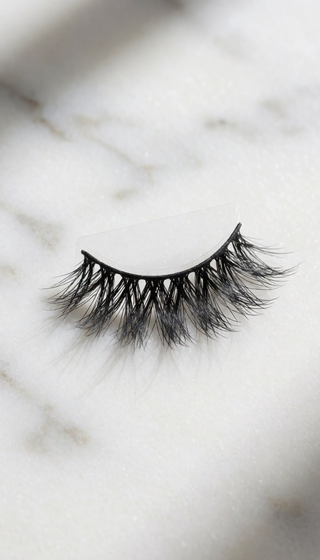
SELECTING FLARED LASH STYLES FOR PROMINENT EYES: A TECHNICAL APPROACH
Achieve a balanced, elongated look by strategically concentrating lash density on the outer third of your eye.

UNDERSTANDING THE PROMINENT EYE PROFILE
A prominent eye is characterized by its forward projection, where the eyeball extends beyond the brow bone. Unlike eyes that are deep-set, this shape presents a distinct convex curve, often exposing more of the upper eyelid area beneath the natural crease. The primary visual challenge is that dense, uniform lash application tends to mimic the roundness of the eye, which can inadvertently intensify the perceived protrusion. To counteract this, the goal of lash selection must be to shift the visual weight horizontally, creating an illusion of length rather than volume.
THE SCIENCE OF LASH CURVE AND TAPER
The correct lash architecture is crucial for framing a prominent eye without crowding the orbital space. Not all curl types are suitable; the curl must lift the lash upward to open the eye while ensuring the lash does not bend back toward the brow bone, which can visually shrink the eye. Furthermore, the transition from the lash base to the tip must be managed carefully.
- Curl Selection: Avoid overly sharp D-curls, as these can bend backward and crowd the limited vertical space. Opt for B-curls or L-curls, which lift the lash out and up, maintaining an uninterrupted line from the root to the tip.
- Tapered Points: The flare must be soft and gradual. A blunt or sharp cut at the tip increases the perceived density of the lash. A well-tapered point mimics the natural, delicate end of a lash, reducing the heavy, dense sensation often reported by wearers of prominent eye shapes.
MASTERING THE GEOMETRY OF THE FLARE
An effective flared style relies on a precise gradient distribution across the lash band. The mathematical application of length is what tricks the eye into perceiving horizontal extension. A classic gradient often utilizes a range such as 8mm to 14mm, but the placement of this increase is non-negotiable.
- Inner Corner (8mm-10mm): The density must be minimal here. Over-applying volume near the inner canthus can visually close the eye, which is counterproductive to the goal of elongation.
- Center Iris (10mm-12mm): This section should remain relatively flat or subtly curved. Excessive length here creates a circular pattern that emphasizes the eye's roundness.
- Outer Corner (14mm+): This is where the visual weight shifts. The spike length must increase rapidly in this outer third to create the desired wing effect and pull the gaze outward.
Research into visual perception confirms that horizontal elongation is the most effective method for reducing the perceived depth of the orbital socket, making the flared geometry the technically correct approach for this eye shape.
CRITERIA FOR OPTIMAL LASH SELECTION
When selecting lashes, look beyond the aesthetic description. Focus on the structural integrity of the band and the quality of the adhesion system. The most common failure point for those with prominent eyes is the outer corner lift—where the longest, most crucial spikes detach prematurely. A superior solution must provide comprehensive support across the entire band, especially where the length is greatest. You need a system that locks the entire flared structure in place without relying on harsh, drying adhesives.
THE these lashes DIFFERENCE: ARCHITECTURAL SUPPORT
these lashes were engineered specifically to address the structural demands of flared styles. We utilize a proprietary, glue-free micro-adhesion technology that extends fully to the fiber tip. This ensures 100% adhesive coverage along the entire length of the lash, providing unwavering support to those critical 14mm outer spikes. Unlike traditional adhesives that dry unevenly and leave long spikes unsupported, our design keeps the full flare locked in place from root to tip, allowing you to achieve the perfect geometric balance all day.
FREQUENTLY ASKED QUESTIONS
Can I wear a flared lash if my eyes are both prominent and round?
Answer: Yes. A flared style is specifically designed for this dual condition. The roundness is managed by the sparse center volume, while the prominence is managed by the horizontal drag of the outer spikes. Avoid any lash labeled Doll Eye as this focuses volume on the center.
What length is appropriate for a prominent eye?
Answer: Length depends on the distance between the lash line and the brow bone. If this space is more than 12mm, a 14mm flare is acceptable. If the space is less than 10mm, a 12mm maximum outer length is necessary to prevent irritation.
How do I keep the outer spikes curled throughout the day?
Answer: The glue-free band of these lashes provide a structural base that holds the curl at the root. If the spikes droop, it is usually because the band has shifted. A quick press against the natural lash line with a clean spoolie can reset the angle.
Does a prominent eye require a different removal technique?
Answer: Because the eye sits forward, the skin around the perimeter is under less tension than a hooded eye. Grip the lash at the inner corner and peel horizontally outward. Do not pull away from the skin, as this puts pressure on the fragile outer canthus skin.
📚 Browse our complete library of lash guides →
Experience the Difference of PHANSTA LASHES
Quick to apply, gentle on eyes, beautiful all day. Reusable 30+ wears per pair.
SHOP PHANSTA LASHES — GLUE-FREE, 30+ WEARS →