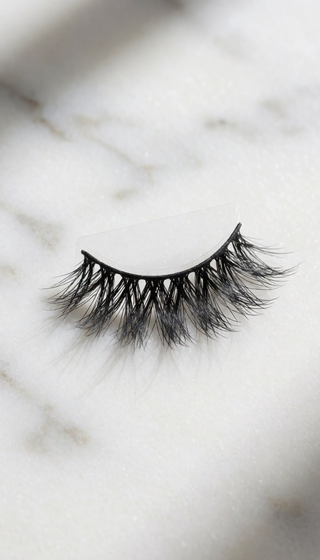
THE RIGHT FEATHERY LASH COLLECTION FOR DOWNTURNED EYES
ACHIEVE A VISIBLE LIFT FOR DOWNTURNED EYES WITHOUT ADD VISUAL WEIGHT
Discover how to use fiber geometry and light refraction to create an upward trajectory, counteracting natural eye slope.
UNDERSTANDING THE OPTICAL EFFECT OF LASH TEXTURE
Downturned eyes possess a natural downward slope at the outer corners. When choosing lash styles, the primary goal is to introduce a visual counter-force that guides the eye upward and outward, rather than adding density that emphasizes the natural downward pull. The way light interacts with the lash fibers determines whether the eye appears lifted or weighed down.
THE GEOMETRY OF LIFT: FEATHERED VS. BLUNT FIBERS
Lash texture dictates the visual trajectory. Spikey or blunt lashes utilize thick, dense fibers that create a hard, defined stop at the lash line. While this provides volume, it can add significant visual weight, which is counterproductive when trying to lift a downturned eye. In contrast, feathery lashes are characterized by tapered, separated fibers. These fibers are cut with an angled tip, often around 45 degrees, allowing them to catch light and create a soft, upward visual sweep. This staggered light refraction guides the viewer's gaze upward, creating an illusion of lift that feels organic rather than artificially propped.
MAPPING THE LASH FOR AN OUTWARD LIFT
The placement and length distribution of the lashes are critical for correcting an eye shape. A successful mapping strategy for downturned eyes must strategically place the longest, most voluminous fibers on the outer corners. This pushes the perceived weight of the eye outward, effectively counteracting the natural drop of the outer lid. A common effective mapping structure involves segment lengths such as 8mm (inner corner for stabilization), 10mm (mid-section for volume), and 12mm (outer feathers to create the lift vector). This specific distribution ensures the eye appears balanced and lifted from the inner to the outer corner.
ACTIONABLE GUIDANCE: TRIM AND FIT PROTOCOL
Precision in application is non-negotiable. If a lash is too long on the outer edge, it will inevitably droop, defeating the purpose of the lift. For downturned eyes, a diagonal trim on the outer edge is the recommended technique. This allows you to remove excess weight from the corner while preserving the longest, most impactful feather fibers situated near the center of the outer section. Furthermore, the band must fit the eye perfectly without any pinching or tension on the outer eye skin, as this can pull the lash down.
DISTINCT TEXTURES: FEATHERED VS. FLUFFY VS. SPIKY
It is important to distinguish between various textures. Feathery lashes feature distinct, separated tips that taper gracefully to a point, offering a light, airy lift. Fluffy lashes, conversely, are often crimped or curled to create a dense, cloud-like volume. Spikey lashes use thick, blunt fibers that create a sharp, hard stop. For the goal of a natural, lifted appearance on downturned eyes, the feathered texture is superior because it blends with natural lash direction while providing the necessary visual lift without appearing overly heavy or artificial.
WHAT TO LOOK FOR IN A LASH SOLUTION
When seeking a lash solution for this specific eye shape, prioritize these three criteria: 1) A fiber cut that tapers rather than stops abruptly, ensuring light refraction moves upward. 2) A mapping structure that places maximum length and volume toward the outer eye to counteract the natural slope. 3) A lightweight, flexible band that allows the fibers to flex independently without adding undue weight to the lid.
THE PHANSTA LASHES APPROACH TO LIGHT-LIFT OPTICS
PHANSTA LASHES has engineered a collection specifically around the principle of light-lift illusion. Our lashes utilize a unique 45-degree fiber tip cut, ensuring that each lash tip floats away from the natural lash line. This design creates an immediate, visible visual lift without requiring tension or heavy application. We have developed a glue-free micro-adhesion technology that allows these feathers to maintain their structural integrity and lift effect for 30+ wears, providing consistent, effortless beauty.
FREQUENTLY ASKED QUESTIONS
Question?
Feathery lashes have distinct, separated tips that taper to a point. Fluffy lashes are crimped or curled to create a cloud-like volume.
Question?
Yes. The lightweight nature of the feathers prevents the lash from weighing down the natural curl. The PHANSTA LASHES band also holds a structural memory.
Question?
Trim diagonally from the outer corner to remove weight. Keep the longest fibers at the center of the outer segment for maximum lift.
What is the primary benefit of using a glue-free adhesion method?
It eliminates the need for harsh adhesives that can irritate the delicate eye area, ensuring comfort and preventing damage to your natural lashes.
How long can I expect the lashes to last with proper care?
With consistent use and adherence to application guidelines, PHANSTA LASHES are designed to provide 30 or more wears.
EXPERIENCE THE PHANSTA DIFFERENCE
12,462 reviews | 4.8/5 rating
Experience the Difference of PHANSTA LASHES
Quick to apply, gentle on eyes, beautiful all day. Reusable 30+ wears per pair.
SHOP PHANSTA LASHES — GLUE-FREE, 30+ WEARS →