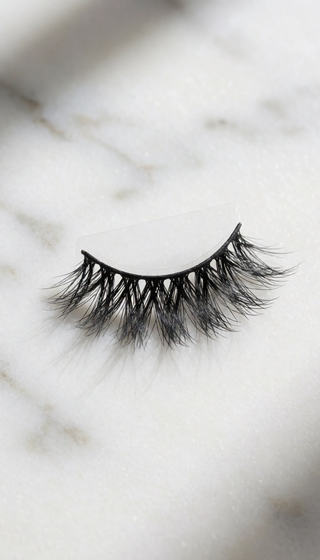
MAKE FALSE LASHES FOR HOODED EYES LOOK LIFTED, SECURE, AND VISIBLE
A practical guide to choosing, placing, trimming, and wearing false lashes so hooded eyes look lifted without relying on extra length or heavy density.
A hooded crease can cover the outer part of the upper lash line, so a false lash may look well fitted while you apply it and nearly disappear when you open your eye. More length or density is not the automatic answer. What matters is whether the silhouette, curl direction, and band position remain visible during a relaxed, straight-ahead gaze.
The quick fix is to curl clean natural lashes upward, choose a moderate tapered profile with its longest fibers toward the outer third, and place the band at the top of the visible lash line, just above the area hidden by the crease. If the inner edge feels heavy, trim the overhang or redirect short fibers away from the inner corner. These adjustments often matter more than adding extra length.
Check the result in a hand mirror and in a straight-on photo with your eyes fully open. A comfortable everyday finish should suit your natural gaze, not only the wide-eyed expression used during application.
Before replacing the whole lash, change one variable at a time: assess curl first, then band position, and only then consider shortening the lash or changing its profile.
WHY HOODED EYES HIDE PART OF THE LASH LINE
Hooded and deep-set eyes are not interchangeable. A hooded upper lid has a fold covering part of the upper lash line, while a deep-set eye sits farther back within the eye socket and may also have a visible fold. Either anatomy can reduce the space available to a false lash, but the visible opening—not a label—should guide your choices.
Notice how the mobile lid moves rather than judging only the lid at rest. Looking downward may reveal more lash line, while looking straight ahead may hide the outer fibers. A dramatic curl in the hand can still look flat when worn because the visible opening changes with gaze.
Compare both eyes in neutral light. Natural asymmetry can make one eye show more upper lid, so identical lengths may not create identical results. Small side-to-side corrections are usually more balanced than forcing both eyes to match perfectly.
CHOOSE A LASH PROFILE THAT FOLLOWS THE LID
Start with the silhouette rather than the density. A wispy, tapered profile is often easier to place on a hooded eye because its fibers can follow the visible lid without forming one solid block of weight. A lifted outer third also compensates for the visual pull of the crease.
On a hooded eye, the longest fibers usually belong near the outer third, while the inner and center sections remain shorter. This creates definition without asking the inner corner to carry as much length. Dramatic looks can work, but length should build gradually rather than jump from short to very long.
Check curl direction from the front. Upward-facing fibers remain more visible, while fibers that begin pointing downward can disappear beneath the fold. Avoid forcing a badly curved band to fit, because tension can create gaps, lifting, or an unnatural angle.
Density should follow the amount of visible lid space. A fuller profile can overwhelm a narrow opening, while a moderate lash may disappear if its fibers are too sparse or short. The best balance is the one you can still see with your eye open in a neutral gaze.
PLACE AND SECURE LASHES WITHOUT FIGHTING THE CREASE
Preparation changes the result more than forcing a band into an awkward position. Work with clean, dry lashes and follow the adhesive or attachment instructions supplied with the lash you are using.
- Inspect the band. Check that the curve sits naturally above the eye, the ends do not rise too sharply, and no excess material points into the inner corner.
- Prepare the natural lashes. Remove old residue, brush the lashes into one direction, and curl them gently if the material and attachment directions permit.
- Mark the visible line. Use a mirror or light makeup-pencil guide to identify where the lash remains visible when your eye is fully open at a natural gaze.
- Use the intended attachment method. With traditional lashes, apply a thin, controlled layer of purpose-made adhesive and wait for the tacky stage directed on the package. Never substitute household glue. For any glue-free format, follow its supplied directions.
- Set the band in stages. Press the center first, then the inner and outer ends. Check the open-eye position before the attachment fully sets and make small adjustments while movement is still possible.
If you have a known adhesive sensitivity, active eye irritation, or a history of significant lash reactions, do not introduce a new adhesive over irritated skin. Remove the product if burning, pain, swelling, or marked redness develops; persistent symptoms warrant professional medical advice.
THE QUICK CHECK: If the fibers disappear when you open your eye, change their direction or lift the band slightly before replacing the entire lash.
FIX THE COMMON PLACEMENT AND COMFORT PROBLEMS
Most problems with false lashes for hooded eyes come from a small mismatch between the profile, band, and lid. Use the visible result to identify which variable needs changing.
| WHAT YOU SEE | LIKELY REASON | USEFUL CHANGE |
|---|---|---|
| Lashes vanish beneath the fold | Fibers lie flat or sit too low | Lift, fan, and reposition the band |
| Outer corner points downward | Length or density is too uniform | Taper the center and add outer lift |
| Inner corner feels heavy | The band or fibers crowd the nose | Trim overhang or redirect short fibers |
| Band lifts before the desired time | Attachment or pressure is uneven | Use less attachment medium, if applicable, and press the full band as directed |
Apply eye makeup before the lashes when possible. This prevents liner or shadow from rubbing against the band while it sets. If mascara is compatible with the attachment instructions, a light coat can blend the natural and false lashes without forcing the fibers downward.
For a closer check, compare a daylight photo with a mirror view. Focus on the outer corner, inner-corner clearance, and whether the fibers remain visible during speech. These views reveal balance problems more clearly than checking only one isolated angle.
WHAT TO LOOK FOR IN A HOODED-EYE LASH SOLUTION
A useful lash should offer an upward or outward curve, enough control over length, and a band that can follow the visible lid without crowding the inner corner. Its density should also suit the space your eye can display when fully open.
Comfort depends on more than a “hypoallergenic” label. Consider the attachment method, known sensitivities, application instructions, removal process, and whether the product contacts the skin unnecessarily. A glue-free method can remove adhesive from the equation, but each format should still be evaluated on its specifications and fit.
Finally, look for clear information about application, care, expected wear, and cost per wear. The finished lashes should complement the visible lid rather than disappear beneath it. Those criteria narrow the field to a format that supports hooded-eye visibility, control, and a comfortable routine.
Micro-adhesion does not remove the need for a fit check: the band still needs to follow the visible lid, and comfort depends on following the application and removal directions. It provides a glue-free format for readers who want more control over placement and adhesive exposure.
Application is designed for seconds per eye. The three most common concerns can be compared directly:
PHANSTA LASHES: A GLUE-FREE FIT FOR HOODED EYES
PHANSTA LASHES brings that checklist together with 17 styles and glue-free micro-adhesion technology. The lashes use no glue, magnets, or liner, which removes adhesive from the application while leaving shape and placement in your control. For a hooded eye, begin with the most lifted-looking profile, compare both eyes in a neutral gaze, and make small adjustments before checking the open-eye result.
- Glue or irritation: The lashes are labeled hypoallergenic and use no glue, magnets, or liner. Hypoallergenic does not mean reaction-proof, so stop use if redness, itching, pain, or swelling develops.
- Durability: The lashes are waterproof and have a stated wear life of 30+ wears. Follow the supplied care directions, remove them as directed, and avoid treating the stated wear as a guarantee for every routine.
- Cost: The $59 set works out to under $2 per wear across 30+ wears, making the routine cost easier to compare than relying on the ticket price alone.
FREQUENTLY ASKED QUESTIONS
WHAT LASH LENGTH WORKS BEST FOR HOODED EYES?
Moderate, tapered lengths usually create the clearest lift because they add definition without overloading the outer corner. Favor a wispy or upward-curling style, then follow the visible lash line rather than the hidden edge of the crease. If fibers point down or disappear when you open your eye, redirect them or choose a more lifted profile.
WHERE SHOULD FALSE LASHES BE PLACED ON A HOODED EYE?
Start at the center of the visible lash line, secure the band, and adjust the inner and outer ends. Check with your eyes fully open in a neutral gaze, not only while looking down or wide. If fibers vanish beneath the fold, lift or fan them slightly and reposition the band before the attachment sets.
CAN HOODED EYES USE GLUE-FREE LASHES?
Yes, provided the band follows the visible lid and you follow the supplied application and removal directions. Glue-free does not guarantee a reaction-free experience or a universal fit. Compare both eyes in a neutral gaze, make small adjustments, and remove the lashes if burning, pain, swelling, or marked redness develops.
ARE PHANSTA LASHES SUITABLE FOR SENSITIVE EYES?
PHANSTA LASHES are described as hypoallergenic and use glue-free micro-adhesion without glue, magnets, or liner. Responses still vary, so stop use if redness, itching, pain, or swelling develops. If you have active irritation or a history of significant lash reactions, seek professional medical advice before trying another product.
HOW SHOULD I REMOVE AND CARE FOR FALSE LASHES?
Follow the supplied removal and care directions, keep the band from folding or being pulled at the ends, and store the lashes in their intended case. Clean, dry lashes are easier to handle and position. Do not introduce a new product over irritated skin, or reuse a band that has lost its shape.
SHOP PHANSTA LASHES — GLUE-FREE, 30+ WEARS →
STILL COMPARING OPTIONS? Explore our guides on finding your perfect lash, magnetic vs strip, and sensitive eyes.
FIND THE PERFECT LASH — Not sure which style suits you? Take the 30-second lash finder quiz →