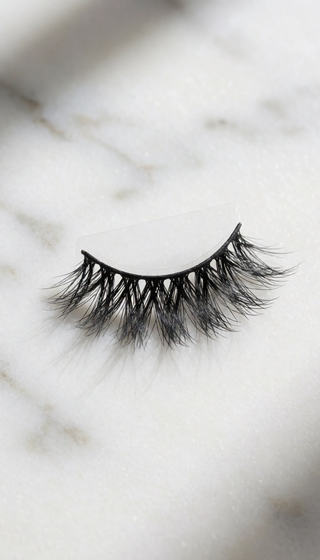
BUDGET LASH ROUTINE: MONTHLY COST BREAKDOWN
Get the lifted, full lash look for as little as $5 a month — no salon fees, no damage, no daily reapplication.

You want the lash look, and you shouldn't need a spreadsheet to afford it. So here's the honest answer to the question you Googled: a lash routine costs anywhere from $5 to $300 per month, depending on the method. The gap is huge, and the difference has almost nothing to do with the products — it's whether you're paying for a service, a disposable, or a reusable product.
Salon extensions run $200–$300 monthly with fills. Growth serums cost $15–$50 a month. Reusable strip lashes cost $5–$15 a month. At-home lift kits are $10–$20 a month if you DIY. The cheapest options all share one thing: they put control in your hands and skip the labor costs. That insight alone could save you thousands a year.
WHAT ACTUALLY DRIVES YOUR LASH BUDGET
Before we talk numbers, know this: the most expensive part of any lash routine isn't the product. It's the habits around it. Let's break it down.
- Pro services: An extension fill every 2-3 weeks adds $40–$75 each time. That's $160–$300 a month before you tip.
- Products that don't last: Cheap strips from fast-fashion sites might seem cheap at $8, but if they fall apart after one wear, that's $8 down the drain per day.
- Damage repair: Losing natural lashes means buying serums, conditioners, and patience. That's another $20–$50 monthly, easily.
I once dropped $80 on extensions, then $40 on fills, then sat in my bathroom wondering why my natural lashes looked thinner than before. I've also bought five packs of cheap strips that fell off by lunch. This isn't theory — it's the stuff I wish someone had told me. When you add it up, a "cheap" routine can cost more than a smart one.
REAL MONTHLY COSTS: EXTENSIONS VS STRIPS VS SERUMS
Here's a realistic look at the monthly price range for each common lash method. These are based on average prices in US salons and stores, plus what actual lash-lovers report spending.
- Extensions (classic or volume): Full set $120–$250. Fills every 2-3 weeks: $40–$75. Per month: $200–$300. If you baby them and stretch fills to 4 weeks? Maybe $150.
- Strip lashes (reusable): Good quality packs run $10–$30. If you reuse them 30+ times, that's under $1 per wear. Monthly cost: $5–$15.
- Lash growth serums: A tube costs $30–$130 and lasts 2-3 months. Monthly cost: $15–$50. You use it every night, no salon trips.
- At-home lash lift kits: Kits cost $30–$60 and do 2-3 lifts. Monthly cost: $10–$20 if you do it yourself, or $50–$80 if you practice on a friend first (please practice).
Notice something? The cheapest options are the ones that give you control. You're not paying for someone else's time.
BUDGET LASH COMPARISON TABLE
| Method | Monthly Cost | Time per Session | Upkeep | Risk to Natural Lashes |
|---|---|---|---|---|
| Extensions | $200–$300 | 1-2 hours at salon | Fills every 2-3 weeks | Moderate-High |
| Strip lashes | $5–$15 | 5-10 min | Apply and remove daily | Low |
| Growth serum | $15–$50 | 1 min nightly | Wait 6-8 weeks | Low (if used correctly) |
| At-home lift | $10–$20 | 20-30 min | Every 6-8 weeks | Low-Moderate |
FREQUENTLY ASKED QUESTIONS ABOUT LASH COSTS
Can I get good lashes on a tight budget?
Yes. The trick is to avoid paying for labor. Reusable strips and growth serums are the most budget-friendly options per month.
How much do salon lash extensions really cost per month?
Expect $200–$300 per month including fills and tips. Some salons charge $150 per fill in big cities, so it can climb fast.
Do lash growth serums actually work?
Most contain peptides or prostaglandin analogs. Results vary, but many users see longer, darker lashes after 6-8 weeks. Consistent nightly use is key.
How do I save money on lash care without damaging my lashes?
Focus on a routine that doesn't require constant product. Fewer products, fewer salon trips, and gentle removal at night will save both money and lashes.
WHAT TO LOOK FOR IN A BUDGET-FRIENDLY ROUTINE
After years of testing lash products, I've learned what actually matters. Look for a routine that gives you these five things:
- No damage to natural lashes. If a product pulls or tugs, it'll cost you later.
- Lasts through your day. A lash look that falls off by noon isn't affordable at any price.
- Fast application. If it takes over 20 minutes, you won't stick with it.
- No pro needed. Salon fees are the real budget killer.
- Reusable or long-lasting. One-and-done products are not budget-friendly.
Think about how much money you could save if you stopped paying for fills. What if a single product did the job for less than a coffee habit?
THE BUDGET-FRIENDLY SOLUTION: PHANSTA LASHES
Everything above points to the same conclusion: the smartest lash routine is reusable, fast, gentle on natural lashes, and requires no salon visits. That's exactly what PHANSTA LASHES was designed to deliver.
PHANSTA LASHES uses micro-adhesion technology — no glue, no magnets, no liner — so you get the lifted, full-lash look in seconds per eye. Each pair is built for 30+ wears, which brings the cost down to under $2 per wear. With 17 styles, hypoallergenic materials, and a waterproof hold, they're made to fit real budgets and real days.
- No glue, no irritation. The most common reason people give up on lashes — burning, tugging, red eyes — doesn't exist with micro-adhesion. Your natural lashes stay intact.
- 30+ wears per pair. Durability is what makes a lash routine affordable. At 30+ wears, each pair outperforms a month of single-use strips.
- Under $2 per wear. At $59 per pair, that's under $2 per wear — a fraction of the $200–$300 monthly cost of extensions.
You deserve lashes that last — and a wallet that survives. That's the whole point of a budget routine, and it's what PHANSTA LASHES delivers.
📚 Browse our complete library of lash guides →
📚 Browse our complete library of lash guides →
📚 Browse our complete library of lash guides →
Experience the Difference of PHANSTA LASHES
Quick to apply, gentle on eyes, beautiful all day. Reusable 30+ wears per pair.
SHOP PHANSTA LASHES — GLUE-FREE, 30+ WEARS →