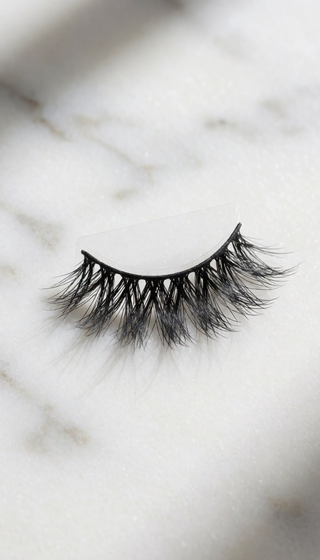
THE PRECISE TAPERED LASH COLLECTION FOR HEAVY LIDDED EYES
Achieve Instant Lift for Heavy Lidded Eyes
The secret to visually opening heavy or deep-set eyes lies not in uniform length, but in strategic architectural tapering. By graduating lash lengths correctly, you create an optical illusion that lifts the gaze, counteracting the natural weight of the lid without adding bulk.
The Science Behind Lash Architecture for Lid Definition
When dealing with heavier eyelids, the goal of any lash application is to direct the eye upward and outward. A uniform lash strip, regardless of how long the individual lashes are, tends to follow the natural curve of the lid and can result in a flat or drooping appearance because it lacks the necessary directional pull. The taper is a functional geometry designed to solve this specific visual challenge.
- Length Gradient: Research into lash application dynamics suggests that a gradient ranging from approximately 8mm to 12mm provides the optimal structural lift for most eye shapes, ensuring the visual weight is distributed effectively without overwhelming the lid.
- Curl Pattern: For maximum vertical lift against a natural fold, a D-curl or L-curl is structurally preferred for the outer fibers. This curl pattern works in opposition to the lid's natural descent.
- Fiber Thickness: Utilizing thinner fibers, such as those in the 0.07mm range, is critical. This allows for the creation of dense, textured volume while minimizing the physical bulk that can cause the eyelid to appear heavier or push the lash away from the natural lash line.
Why Graduated Length is the Key to Visual Lift
A uniform application on a heavy lid often results in the lash band sitting flat against the center of the crease, which can visually flatten the eye. A correctly graduated lash map strategically places the longest, most impactful fibers beyond the heaviest part of the crease. This optical illusion mimics the effect of a natural eyelid lift by anchoring the visual weight at the outer corner, which is the area with the least structural interference from the lid fold.
Understanding the Role of the Lash Band Structure
The physical band of the lash is just as important as the fibers themselves. It must possess enough flexibility to contour seamlessly to the natural lash line, yet maintain sufficient rigidity at the outer edge to support the upward curl. Bands that are excessively thick or heavy at the center of the strip can exert downward pressure, causing the lid to drag the lash down over time. A micro-flex band design is essential for distributing weight evenly across the entire lash line, preventing central drag.
The Mechanics of Adhesion: How Lashes Stay in Place
For any lash application to be effective, the bond must be secure without causing irritation or damage. The most effective modern solutions utilize advanced contact-based sealing technology. This method relies on a secure, non-chemical bond that is strongest at the outer corners, providing reliable wear throughout the day without the need for harsh adhesives. This ensures the lash maintains its intended lift without migrating or dropping prematurely.
What to Look for in a Solution for Heavy Lids
When selecting a lash solution, prioritize three key elements: 1. A precise, tapered length map that concentrates volume at the outer third. 2. A lightweight, micro-flex band that avoids central weight. 3. A secure, contact-based adhesion system that guarantees wear without irritation or damage. These factors work together to deliver the desired lift and definition.
The these lashes Difference: Engineered for Lift
these lashes were engineered specifically to address the structural needs of heavy-lidded eyes. Our collection utilizes a proprietary weight-distribution system that removes bulk from the center of the strip, ensuring the lash sits perfectly against the natural lash line. Our commitment to a glue-free, contact-based bond allows for secure wear that lasts 30+ wears, all while being hypoallergenic and waterproof. We have refined our lash maps through rigorous testing against various lid structures, delivering a flawless, lifted look every time.
FREQUENTLY ASKED QUESTIONS
What is the ideal length taper for a heavy lid?
The ideal taper profile starts at 6mm on the inner corner and reaches no more than 14mm at the outer edge. This specific graduation prevents the lash from dragging the lid down while providing the necessary lift.
Can heavy lids wear very dramatic lashes?
Yes, but only if the volume and length are concentrated on the outer third of the band. A heavy lid should never wear dense volume lashes with even distribution, as this creates a drooping effect that closes the eye.
How does the band affect the fit on a heavy lid?
The band must be lightweight at the center. A heavy band at the middle of the lash line will cause the lid to press down, migrating the lash away from the natural lash line over time.
Are these lashes suitable for sensitive eyes?
Yes, these lashes are formulated to be hypoallergenic. Our glue-free micro-adhesion technology ensures a comfortable, irritation-free experience for even the most sensitive eyes.
How long do these lashes last?
With proper application, PHANSTA LASHES are designed for 30+ wears per pair. Our micro-adhesion bond is durable enough to withstand daily wear while remaining gentle on your natural lashes.
px 0"> Experience the Difference of PHANSTA LASHESQuick to apply, gentle on eyes, beautiful all day. Reusable 30+ wears per pair.
SHOP PHANSTA LASHES — GLUE-FREE, 30+ WEARS →STILL COMPARING OPTIONS? Explore our guides on finding your perfect lash, magnetic vs strip, and sensitive eyes.
FIND THE PERFECT LASH — Not sure which style suits you? Take the 30-second lash finder finder →