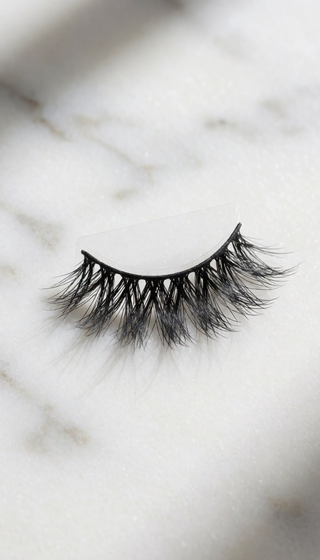
THE BEST CAT EYE LASHES FOR SMALL EYES: PROPORTIONS AND TECHNIQUE
CREATE THE ILLUSION OF LENGTH ON SMALL EYES: HOW TO ACHIEVE A PERFECT CAT-EYE WITHOUT OVERWHELMING YOUR LID SPACE
Master the art of lash proportion so your cat-eye enhances your natural features, making your eyes appear longer and more defined rather than smaller or heavier.
THE ANATOMY OF THE SMALL-EYE CAT-EYE: PROPORTION GUIDELINES
When working with a smaller eye canvas, the goal of a cat-eye is not to add bulk, but to create a precise, outward visual lift. The key lies in the angle and the density of the fibers. A high, thick wing consumes valuable lid space, which can actually make the eye appear smaller by drawing attention to the crease rather than the length. Instead, focus on a sleek, lateral extension that directs the gaze outward.
Understanding the Ideal Wing Angle
The outer corner of the eye has a finite amount of horizontal real estate. For a small eye, the wing extension must be purely lateral. If the angle tilts too steeply upward, it risks cutting off the natural outer corner of the eye, which can create a closed or heavy appearance. Professional application suggests an ideal lift angle between 15 to 20 degrees from the lash line. This specific angle draws the eye outward, creating the illusion of length, without forcing the shape into an unnatural, tight upward curve that emphasizes the crease.
Fiber Density and Band Width
The physical components of the lash are critical. A thick, dense band creates a visual break directly across the lash line, which inherently makes the eye look smaller. Opt for a very fine band width, ideally around 0.03mm, to maintain a seamless appearance. Furthermore, the fiber arrangement should utilize a center-to-outer gradient. The lashes must start at their shortest point in the center and gradually increase in length toward the outer corner. This distribution prevents the eye from being overwhelmed by volume.
Length Constraints for Optimal Extension
To ensure the lash extends the eye rather than dominates it, strict length limitations must be observed. The longest fibers should be carefully capped, typically not exceeding 10 to 12mm. Exceeding this limit risks the lash folding back against the brow bone or drooping prematurely, negating the desired lifted effect. A wispy or demi-spaced arrangement is often superior to dense volume for small eyes, as it allows the natural eye to remain visible through the lash structure.
Troubleshooting Placement and Fit
If you notice the wing drooping or folding inward, it is usually a sign that the lash is too long or the band is too stiff for your specific eye shape. The lash must fit seamlessly from the inner corner to the outer tip without lifting the band away from the waterline. Before committing to a full application, always test the lash against your eye to confirm the wing tip sits precisely on your natural outer crease, not forced upward.
WHAT TO LOOK FOR IN A HIGH-PERFORMANCE LASH SOLUTION
When selecting a lash system, you need a product engineered to respect the delicate proportions of your eye. Look for a system that prioritizes a fine, flush band and a meticulously calibrated gradient to ensure the extension feels like a natural enhancement, not an overlay. The best solutions offer durable wear without compromising the integrity of your lash line.
THE PHANSTA LASHES DIFFERENCE: ENGINEERED FOR PRECISION
PHANSTA LASHES were developed with the understanding that small eyes require specific engineering. Our cat-eye styles utilize a precisely calibrated gradient, starting fine and building length subtly to extend the eye laterally without overwhelming it. Because our technology relies on micro-adhesion rather than harsh adhesives, the fine band sits flush against the lash line, preserving the full width of your eyelid and ensuring a clean, natural look that lasts. With fibers capped at 12mm and a design built for longevity, PHANSTA LASHES provide the perfect balance of definition and subtlety.
FREQUENTLY ASKED QUESTIONS
Are cat-eye lashes too heavy for small eyes?
Only if the fibers are too dense or the band is too thick. A fine-band, spaced-fiber cat-eye specifically designed for small eyes will add length without weight, allowing for a natural lift.
What is the ideal lash length for a small eye cat-eye?
The optimal window is 8-12mm. Any length exceeding 12mm on the wing will typically fold back against the brow bone or droop, disrupting the intended shape.
Can I reuse cat-eye lashes on small eyes?
Yes, a quality lash can be reapplied multiple times. Simply clean the band gently after each wear to maintain the integrity of the shape and adhesion.
How does micro-adhesion differ from traditional glue?
PHANSTA LASHES use micro-adhesion technology which allows the lash to adhere securely without the use of traditional, harsh adhesives. This means no residue, no irritation, and a cleaner application process.
Are these lashes suitable for sensitive eyes?
Yes, PHANSTA LASHES are formulated to be hypoallergenic. The glue-free nature of the micro-adhesion technology minimizes the risk of irritation for sensitive eye types.
FIND THE PERFECT LASH FOR EVERY MOMENT
Explore our occasion-specific lash guides:
STILL COMPARING OPTIONS?
See how PHANSTA compares to traditional lashes:
EXPERIENCE THE DIFFERENCE WITH PHANSTA LASHES
FIND THE PERFECT LASH FOR EVERY MOMENT
Explore our occasion-specific lash guides:
STILL COMPARING OPTIONS?
See how PHANSTA compares to traditional lashes:
No adhesive, no damage. Just beautiful, long-lasting lashes in seconds.
SHOP PHANSTA LASHES — GLUE-FREE, 30+ WEARS